Multiple section read/write head

a multi-section, read/write head technology, applied in the direction of maintaining head carrier alignment, recording signal processing, instruments, etc., can solve the problems of previously recorded data tracks becoming increasingly laterally displaced, system which continues to utilize current head design, and finite dimensional stability of tape media, etc., to achieve the effect of reducing the pitch

US20080158720A1Active Publication Date: 2008-07-03ORACLE INT CORP
5 Cites 40 Cited by

Patent Information

Authority / Receiving Office
US · United States
Current Assignee / Owner
Publication Date
2008-07-03

Smart Images

  • Figure 1
    Figure 1
  • Figure 2
    Figure 2
  • Figure 3
    Figure 3
Patent Text Reader

Abstract

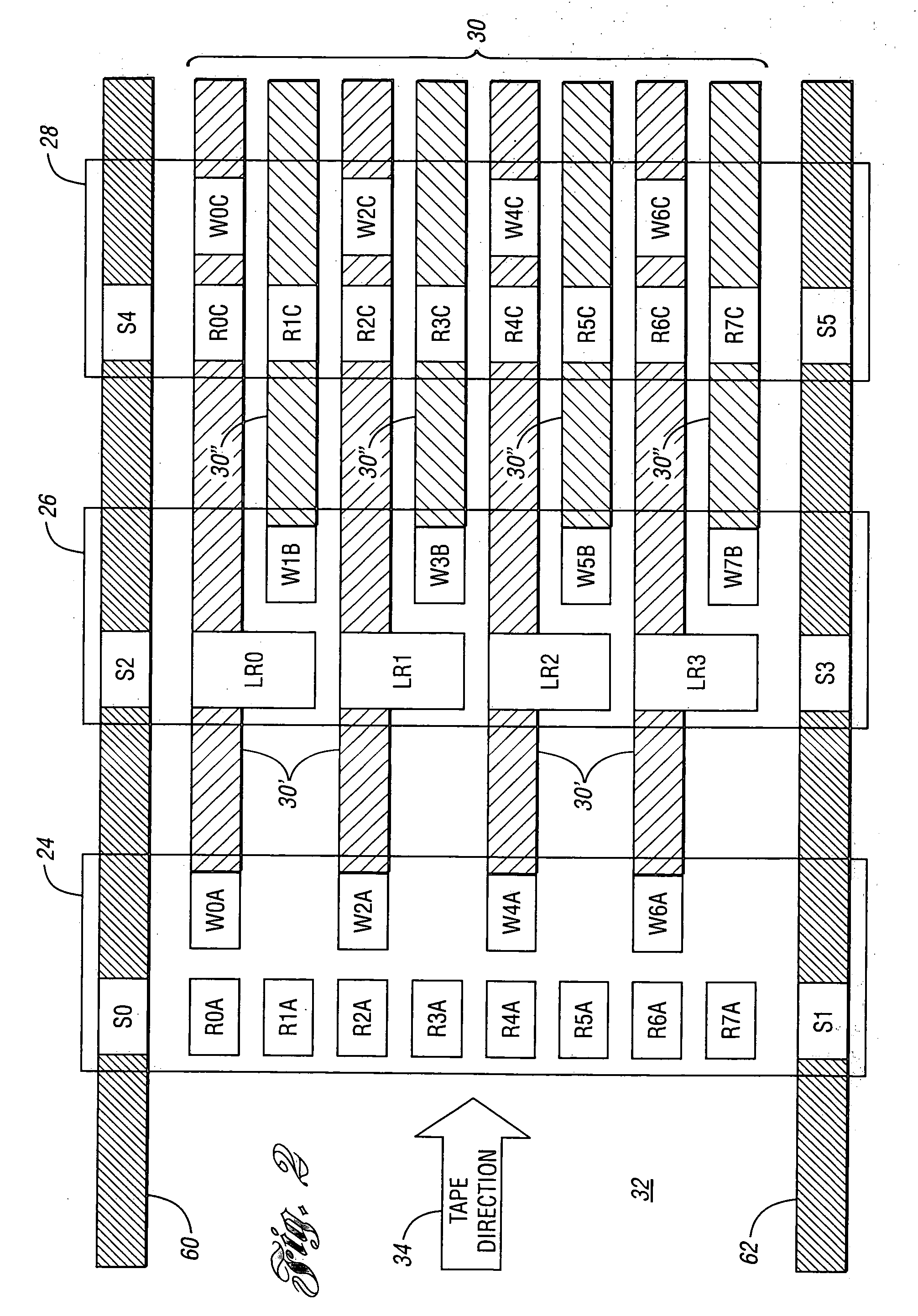
Data tracks are written across a width of a tape by positioning a first head section across the tape and writing a first subset of data tracks onto the tape with a first plurality of write elements on the first head section. A second head section is positioned across the tape separately from the first head. A second subset of data tracks is written onto the tape with a second plurality of write elements on the second head section so that the second subset is interleaved with the first subset. A third head section is positioned across the tape separately from the first head and the second head. The first subset and second subsets are read with a plurality of read elements on the third head section to verify that data was correctly written onto the tape.
Need to check novelty before this filing date? Find Prior Art

Description

BACKGROUND OF THE INVENTION

[0001] 1. Field of the Invention

[0002] The present invention relates to writing data onto and reading data from tape.

[0003] 2. Background Art

[0004] Data is written onto tape for long term storage. In order to increase efficiency and stay competitive, makers of tape systems strive to increase data rates and tape storage capacities. The increase in storage capacity can be achieved by increasing both the linear data density and also the number of data tracks written across the width of the tape. However, as the track density is increased, systems which continue to utilize current head designs inevitably become limited by a number of fundamental dimensional constraints. One major issue is the finite dimensional stability of tape media. Due to pack compression, temperature, humidity, and the like, the tape width changes over time and with use.

[0005] Competitive data tape systems often use multiple read / write channels operating in parallel. This requires that tape st...

Examples

Embodiment Construction

)

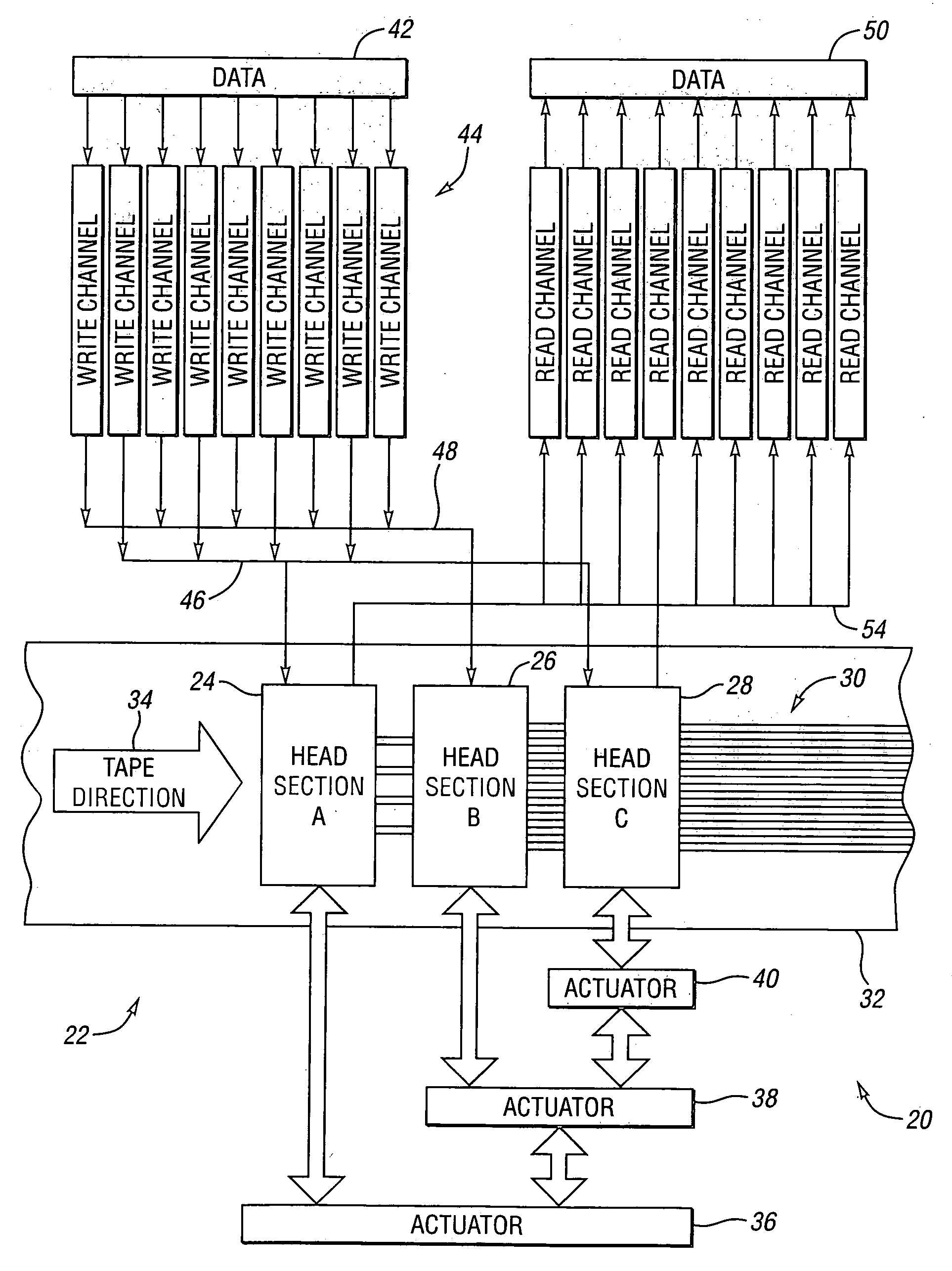
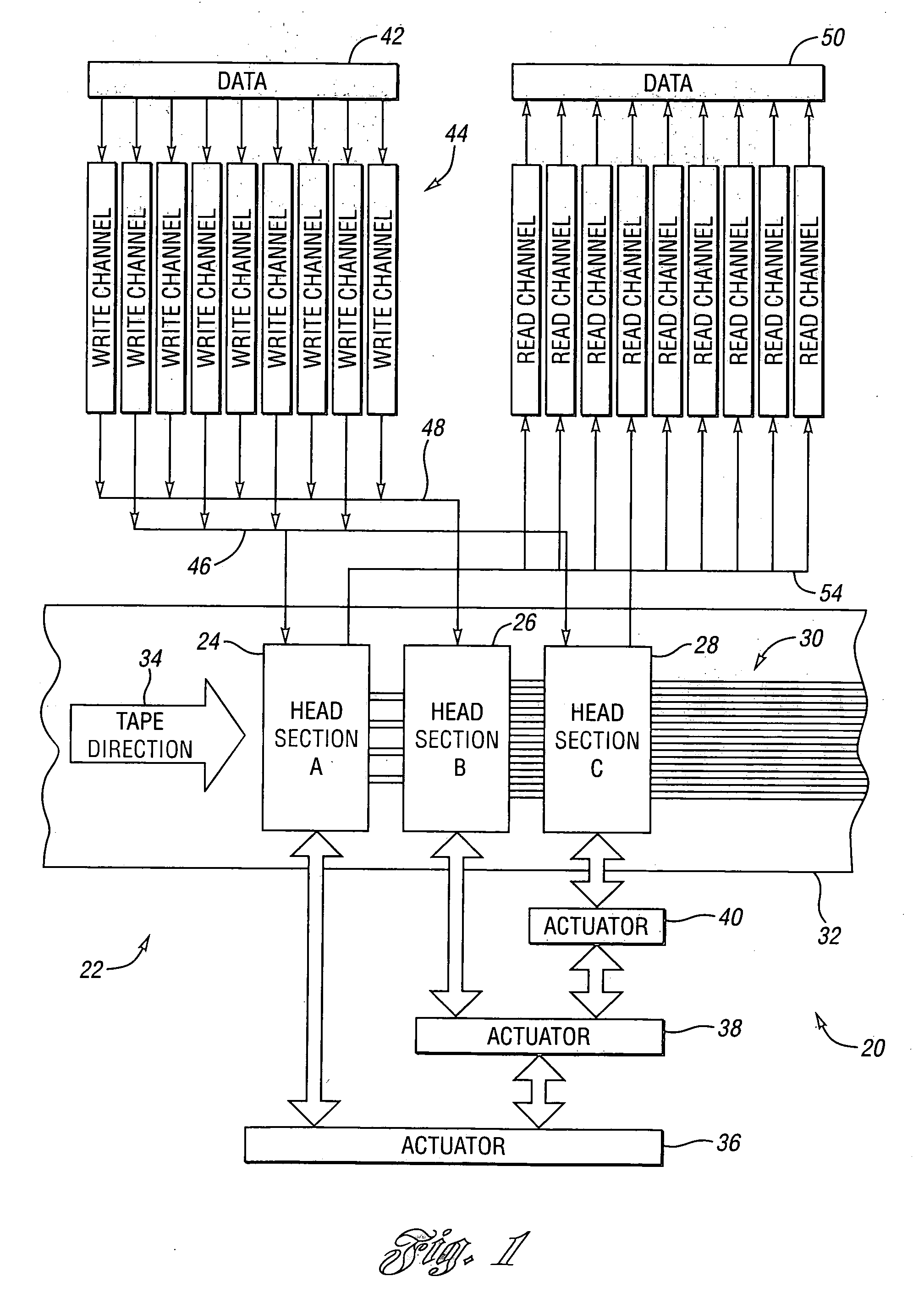
[0018]Referring to FIG. 1, a schematic drawing illustrating a data storage system according to an embodiment is shown. A data storage system, shown generally by 20, includes a tape head, shown generally by 22. Tape head 22 includes separate head section “A”24, head section “B”26, and head section “C”28. Tape head 22 writes a plurality of data tracks, shown generally by 30, onto tape 32 as tape 32 moves in tape direction 34 past tape head 22.

[0019]Head sections 24, 26, 28 can be positioned across the width of tape 32 independently of each other through the use of a plurality of actuators. In the embodiment shown, actuator 36 positions head section “A” and actuator 38. Actuator 38 positions head section “B” and actuator 40. Actuator 40 positions head section “C”. Actuators 36, 38, 40 for positioning tape head sections may be constructed by any means known in the art such as, for example, electric motors driving various linkages, voice coil motors, piezoelectric motors, and the like. ...