

Vehicle braking-force control device
a control device and vehicle technology, applied in the direction of brake systems, process and machine control, instruments, etc., can solve the problems of reducing the lateral grip force of the wheels with the braking force may lose some effect, and the control may become rather uncomfortable for the driver accelerating with the vehicle, so as to improve the stability of the vehicle
Active Publication Date: 2008-08-28
SUBARU CORP
View PDF8 Cites 13 Cited by
- Summary
- Abstract
- Description
- Claims
- Application Information
AI Technical Summary
Benefits of technology
[0008]The present invention has been made under such circumstances, and it is an object of the present invention to provide a vehicle braking-force control device that allows for improved stability of a vehicle when performing brake control for preventing an oversteer condition or an understeer condition of the vehicle, and that can perform control that sufficiently reflects the driver's intention for acceleration.
[0010]The vehicle braking-force control device according to the present invention allows for improved stability of a vehicle when performing brake control for preventing an oversteer condition or an understeer condition of the vehicle, and can perform control that sufficiently reflects the driver's intention for acceleration.
Problems solved by technology
However, with a skidding preventing device like the one disclosed in Japanese Unexamined Patent Application Publication No. 2001-233195, when an oversteer condition of a vehicle is to be prevented by performing brake control on the wheels, if a driving force from the engine is applied to the wheels receiving the braking forces, a function for adjusting the lateral grip forces of the wheels with the braking forces may somewhat lose effect.
On the other hand, if the engine output is over-reduced for preventing an understeer condition, the control may become rather uncomfortable for the driver accelerating with the vehicle while expecting and permitting the understeer condition to some extent.
Method used
the structure of the environmentally friendly knitted fabric provided by the present invention; figure 2 Flow chart of the yarn wrapping machine for environmentally friendly knitted fabrics and storage devices; image 3 Is the parameter map of the yarn covering machine
View moreImage
Smart Image Click on the blue labels to locate them in the text.
Smart ImageViewing Examples

Examples
Experimental program
Comparison scheme
Effect test
case 1
γ<0
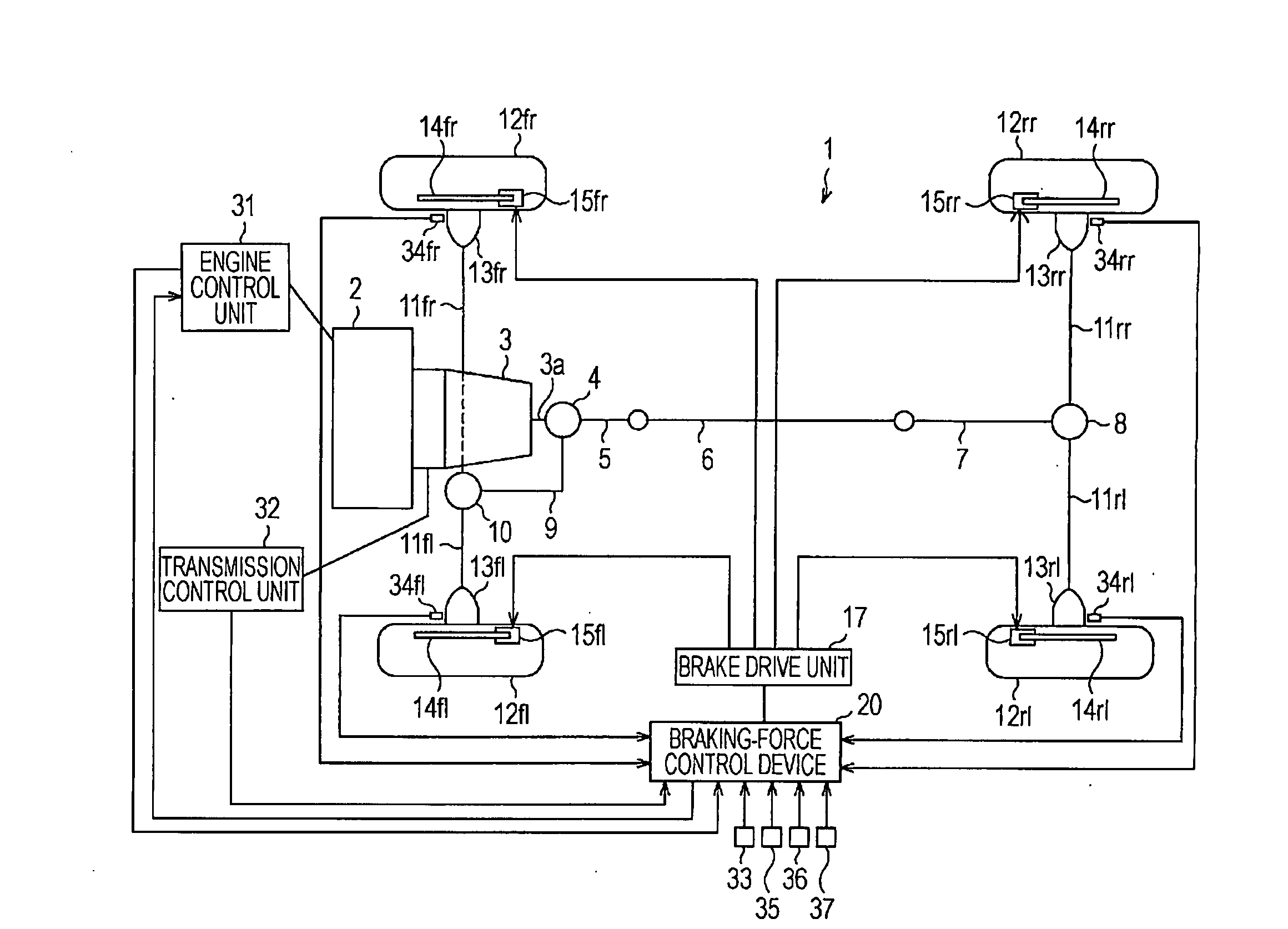
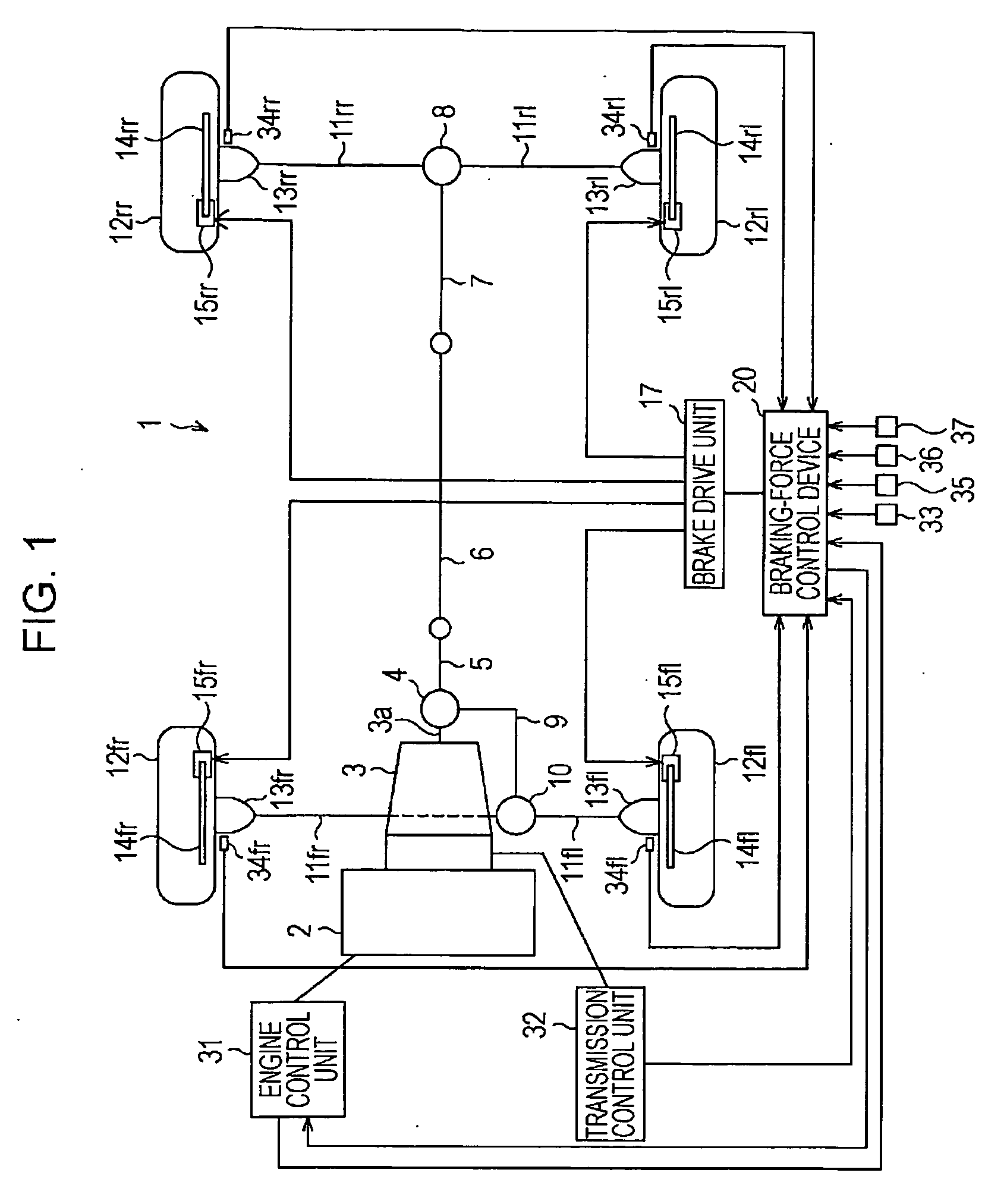
[0045]When the vehicle 1 is in an understeer condition (vehicle-behavior determination flag F=2) with respect to the target yaw rate γ′ under a left turning mode, a brake is applied to the left rear wheel.
case 2
γ>0
[0046]When the vehicle 1 is in an oversteer condition (vehicle-behavior determination flag F=1) with respect to the target yaw rate γ═ under a left turning mode, a brake is applied to the right front wheel.
case 3
Δγ<0
[0047]When the vehicle 1 is in an oversteer condition (vehicle-behavior determination flag F=1) with respect to the target yaw rate γ′ under a right turning mode, a brake is applied to the left front wheel.
the structure of the environmentally friendly knitted fabric provided by the present invention; figure 2 Flow chart of the yarn wrapping machine for environmentally friendly knitted fabrics and storage devices; image 3 Is the parameter map of the yarn covering machine
Login to View More PUM
 Login to View More
 Abstract
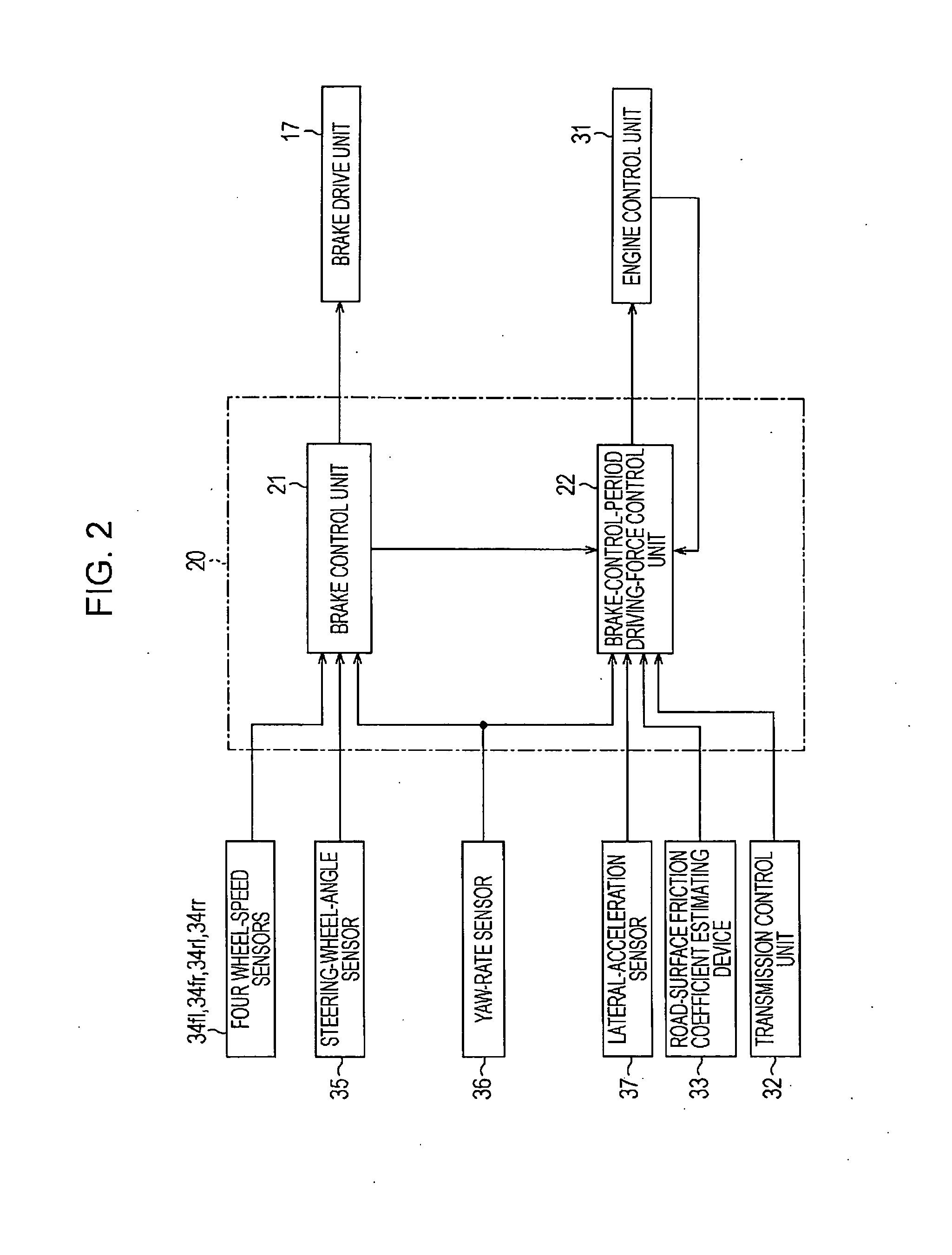
A braking-force control device has a brake control function for performing brake control on a front outside wheel when a vehicle is detected to be in an oversteer condition during a turning operation and for performing brake control on a rear inside wheel when the vehicle is detected to be in an understeer condition during a turning operation. For preventing the oversteer condition, a command for reducing the engine torque is output. On the other hand, for preventing the understeer condition, the engine torque is limited in accordance with a permissible engine torque value that is calculated on the basis of a road-surface friction coefficient, and ground loads and lateral tire forces of individual wheels. If it is detected that engine braking is in operation, the engine torque is adjusted to substantially zero.
Description
CROSS REFERENCES TO RELATED APPLICATIONS[0001]The disclosure of Japanese Patent Application No. 2007-046198 filed on Feb. 26, 2007 including the specifications, drawings, and abstracts are incorporated by references herein.BACKGROUND OF THE INVENTION[0002]1. Field of the Invention[0003]The present invention relates to a vehicle braking-force control device that apply braking forces to predetermined wheels to prevent skidding and that appropriately control driving forces.[0004]2. Description of the Related Art[0005]In recent years, a braking-force control device have been developed and put to practical use in vehicles, which detects an oversteer condition and an understeer condition of a vehicle and applies a braking force to a predetermined wheel to prevent the vehicle from skidding.[0006]For example, Japanese Unexamined Patent Application Publication No. 2001-233195 discloses a technology that increases braking forces of both front and rear outside wheels when the vehicle is in an ...
Claims
the structure of the environmentally friendly knitted fabric provided by the present invention; figure 2 Flow chart of the yarn wrapping machine for environmentally friendly knitted fabrics and storage devices; image 3 Is the parameter map of the yarn covering machine
Login to View More Application Information
Patent Timeline
 Login to View More
 IPC IPC(8): B60T8/1763B60T8/172B60T8/1755B60W10/04B60W10/06B60W10/18B60W10/188B60W30/02
CPCB60T8/1755B60W30/18109B60W10/184B60W10/06
InventorMATSUNO, KOJIYONEDA, TAKESHIIGARASHI, MASATOMOROKUMA, YOSUKE
OwnerSUBARU CORP