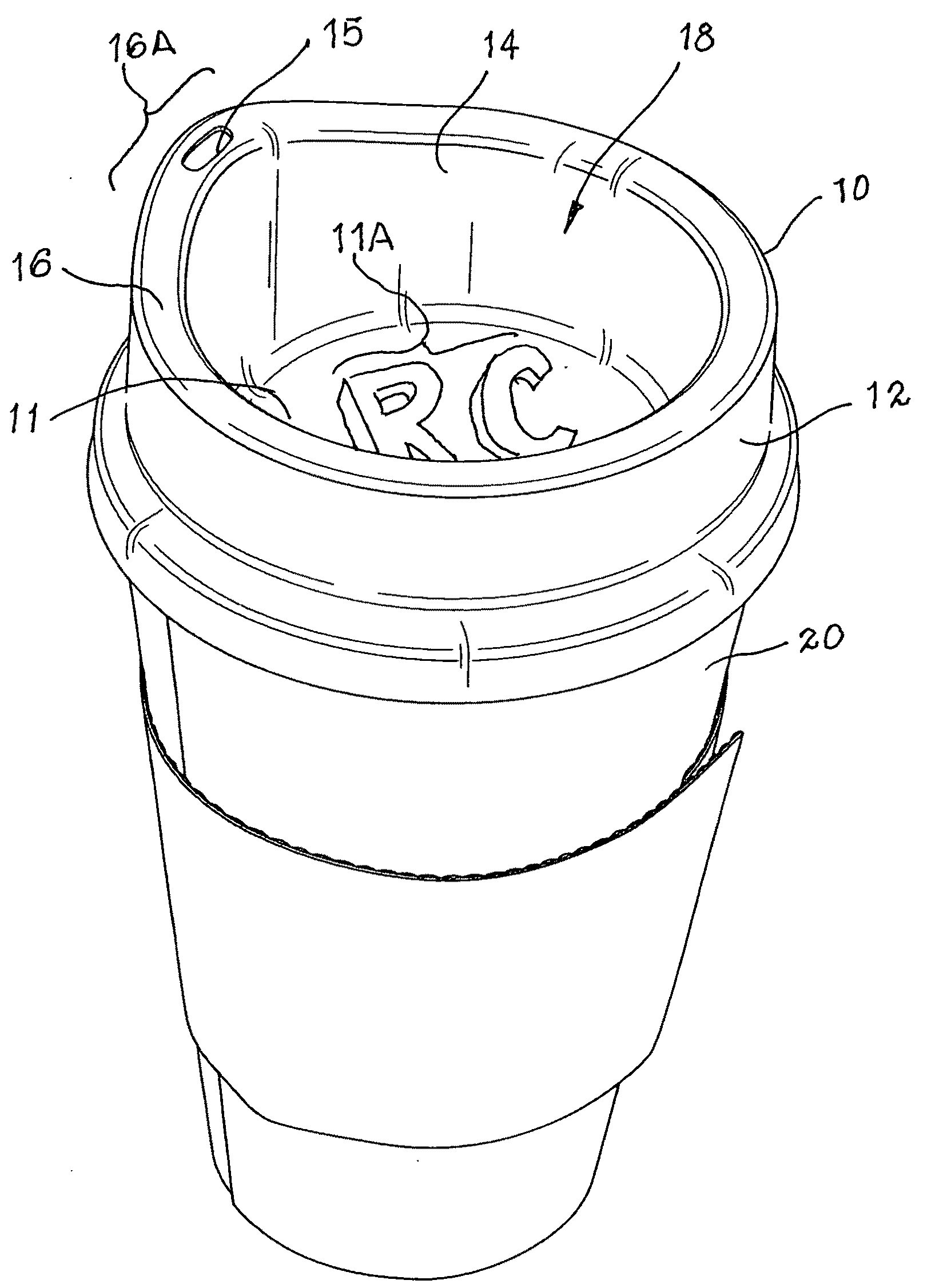
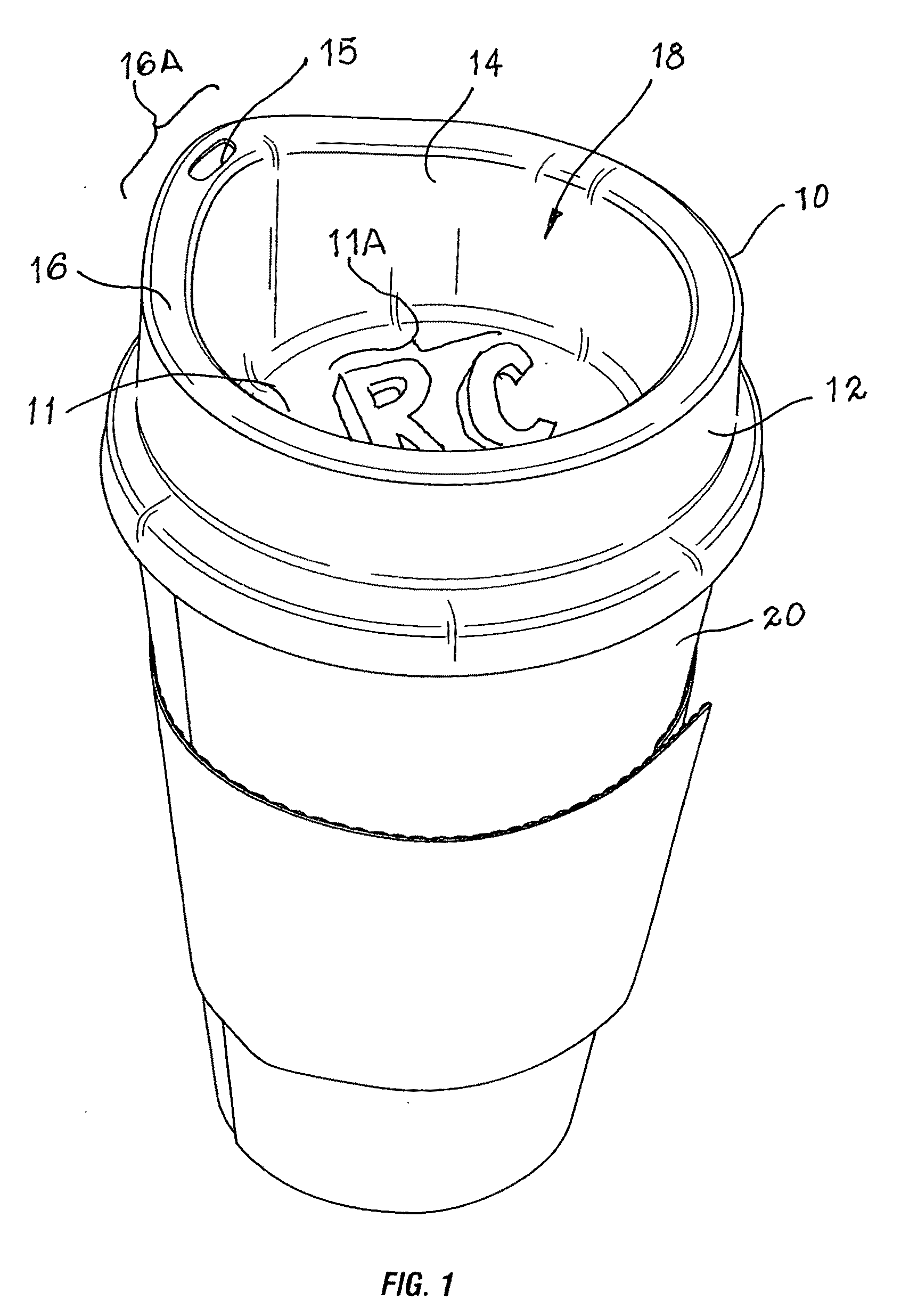
[0013]The present invention is a cup lid for covering a disposable beverage cup. Such cup lids provide important advantages such as being disposable so as to enable a beverage to be taken from a point of purchase and consumed “on the go.” Take out beverages are typically either hot or iced. With respect to such beverages, a cup lid has the general advantages of keeping the beverage sanitary, of maintaining its temperature while being consumed, and of limiting spills.
[0015]Cup lids in the prior art are typically flat across the lip of the beverage cup, see U.S. Pat. No. 5,197,624 at FIG. 2, and therefore make it impossible to drain all of the liquid from the cup without rotating one's head backward so that the
nose is directed upwardly. This is uncomfortable to the neck and it makes it likely to spill liquid on oneself while drinking since the cup is positioned over the front surface of the drinker's face and chest. The present invention, as described above, provides the
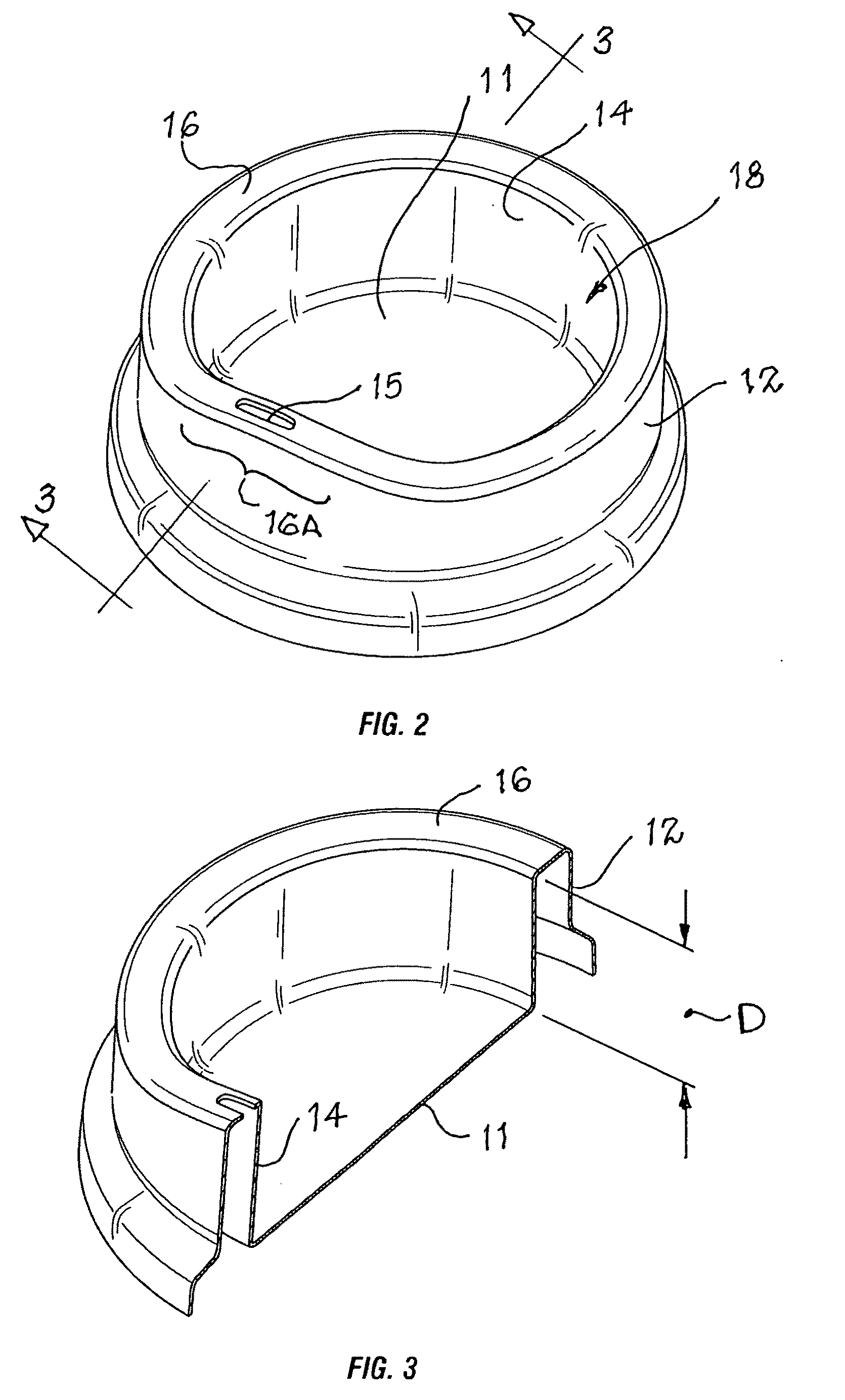
advantage of creating a space, the well, for the
nose to enter so that the cup can be drained without rotating the head backwardly and while maintaining the lip of the beverage cup forward of the chest.
[0016]Another problem with a flat lid is that it is nearly impossible to sample the temperature of the liquid in the cup because a sip from the surface of the liquid is essentially the same temperature as the bulk of the liquid. The present cup lid overcomes this problem because when the beverage cup is tilted toward the aperture a relatively small amount of the contained beverage is “sampled” by being partially isolated from the bulk of the beverage as it flows into the space between the outer and inner peripheral walls prior to reaching the aperture. This partially isolated portion of the beverage is a small volume and is spread out so that it cools relative to the bulk of the beverage. By sampling in this manner it is possible to judge the temperature of the beverage at large.
[0017]A still further problem with a flat lid is that it is too easy to splash hot liquid on oneself. This is because a typical disposable beverage cup is filled to near the lip of the cup. Some prior art lids tend to provide a drinking aperture that is positioned below the lip of the lid and may, indeed, be just above, or actually in contact with the surface of the beverage liquid. In such cases, any inadvertent tilting of the beverage cup will tend to force liquid to squirt upward out of the drinking aperture. When one attempts to tilt the cup to start drinking, the liquid may exit the cup at a faster then expected rate, a spill problem, and a
scalding problem. Finally, during handling of the cup when the surface of the beverage is below the lid's inner surface, a
surface wave is normally propagated on the beverage surface and may cause squirting of liquid from the aperture even when the cup is not intentionally tilted. Of course, the present invention overcomes all of these difficulties by placing the drinking aperture at least one-inch above the surface of the beverage. Also, the inner and outer peripheral walls prevent surface
waves from forming below the drink aperture, a further safety effect, i.e., anti-splash feature. A still further anti-splash feature of the present invention is that the entire top rim is slightly slanted inwardly toward the well and the portion of the top rim that has the drink aperture is raised above the
general level of the rest of the top rim and the drink aperture is therefore tilted toward the well. Liquid that might rush toward the drink aperture tends to emerge at an angle biased toward the well and not toward the drinker.
[0018]A yet further problem with the flat prior art drink cup lids is that they do not afford any stacking feature. In order to carry two prior art drink cups from point of purchase, it is generally necessary to carry one in each hand. This makes opening
doors, handling car keys and other simple tasks difficult. The present invention, as stated, provides a central well and this well is sized to snuggly receive the lower end of a drink cup so that nesting one cup within the lid of another makes it quite easy to carry two full drink cups with one hand.



 Login to View More
  Login to View More