System for handling frequently asked questions in a natural language dialog service
What is AI technical title?
AI technical title is built by Patsnap AI team. It summarizes the technical point description of the patent document.
a natural language and dialog service technology, applied in the field of dialect systems, can solve the problems of preventing callers from accessing information, poor user interface, confusion and frustration, etc., and achieve the effect of improving customer relationships, efficient and pleasant manner
Inactive Publication Date: 2009-03-12
NUANCE COMM INC
View PDF8 Cites 79 Cited by
Summary
Abstract
Description
Claims
Application Information
AI Technical Summary
This helps you quickly interpret patents by identifying the three key elements:
Problems solved by technology
Method used
Benefits of technology
Benefits of technology
[0013]What is needed in the art is a help desk service that provides a more natural information exchange between a user and the help desk that increases customer satisfaction. An advantage of the present invention is to enable a natural languages help desk application that provides increased ease of use for customers calling the help desk.
[0014]Another advantage of the present invention is to improve customer relationships with companies using a natural language help desk that understands and interacts with users in a more efficient and pleasant manner, especially when handling frequently asked questions. The help desk according to the present invention includes an extended spoken language understanding module that includes further features of handling frequently asked questions.
[0015]Embodiments of the present invention include systems, methods and computer-readable medium-stored instructions for providing a voice-enabled interface. In an exemplary embodiment, a voice-enabled help desk service comprises (1) an automatic speech recognition module having a general-purpose acoustic model and a domain-specific model, wherein the general-purpose model is used for bootstrapping at an initial deployment of the voice-enabled help desk service and the domain-specific model is used to adapt the automatic speech recognition module after deployment; (2) a spoken language understanding module that performs text normalization, entity extraction and semantic classification using a boosting approach that balances human-crafted rules with available data, the spoken language understanding module including a frequently asked questions module; (3) a dialog management module that comprises an interpreter, finite state machine engine and an action template; and (4) a natural voices text-to-speech synthesis module for synthesizing speech. The frequently asked questions module handles frequently asked questions from the user by changing voices and providing prompts and answers calculated to move the user from the question back to the main dialog.
Problems solved by technology
Several studies have shown that the “unnatural” and poor user interfaces of such menus tend to confuse and frustrate callers, preventing the callers from accessing information, let alone obtaining, in many cases, obtaining the desired service they expect.
For example, studies show that over 53% of surveyed consumers say that automated IVR systems are the most frustrating part of customer service.
In one survey, 46% of consumers dropped their credit card provider and 30% of them dropped their phone company provider due to poor customer care.
Previous systems fail to adequately and efficiently handle these kinds of frequently asked questions.
Current technologies fail to enable companies to afford generating automated help desks.
Such systems are time-consuming and costly to build, thus effectively preventing many companies from participating and receiving the improved customer care service that can be provided.
Method used
the structure of the environmentally friendly knitted fabric provided by the present invention; figure 2 Flow chart of the yarn wrapping machine for environmentally friendly knitted fabrics and storage devices; image 3 Is the parameter map of the yarn covering machine
View more
Image
Smart Image Click on the blue labels to locate them in the text.
Viewing Examples
Smart Image
Click on the blue label to locate the original text in one second.
Reading with bidirectional positioning of images and text.
Smart Image
Examples
Experimental program
Comparison scheme
Effect test
Embodiment Construction
[0024]The present invention may be understood according to exemplary embodiments disclosed herein. When creating a spoken dialog service, experimental results are presented in terms of recognition accuracy, understanding accuracy and call completion rate.
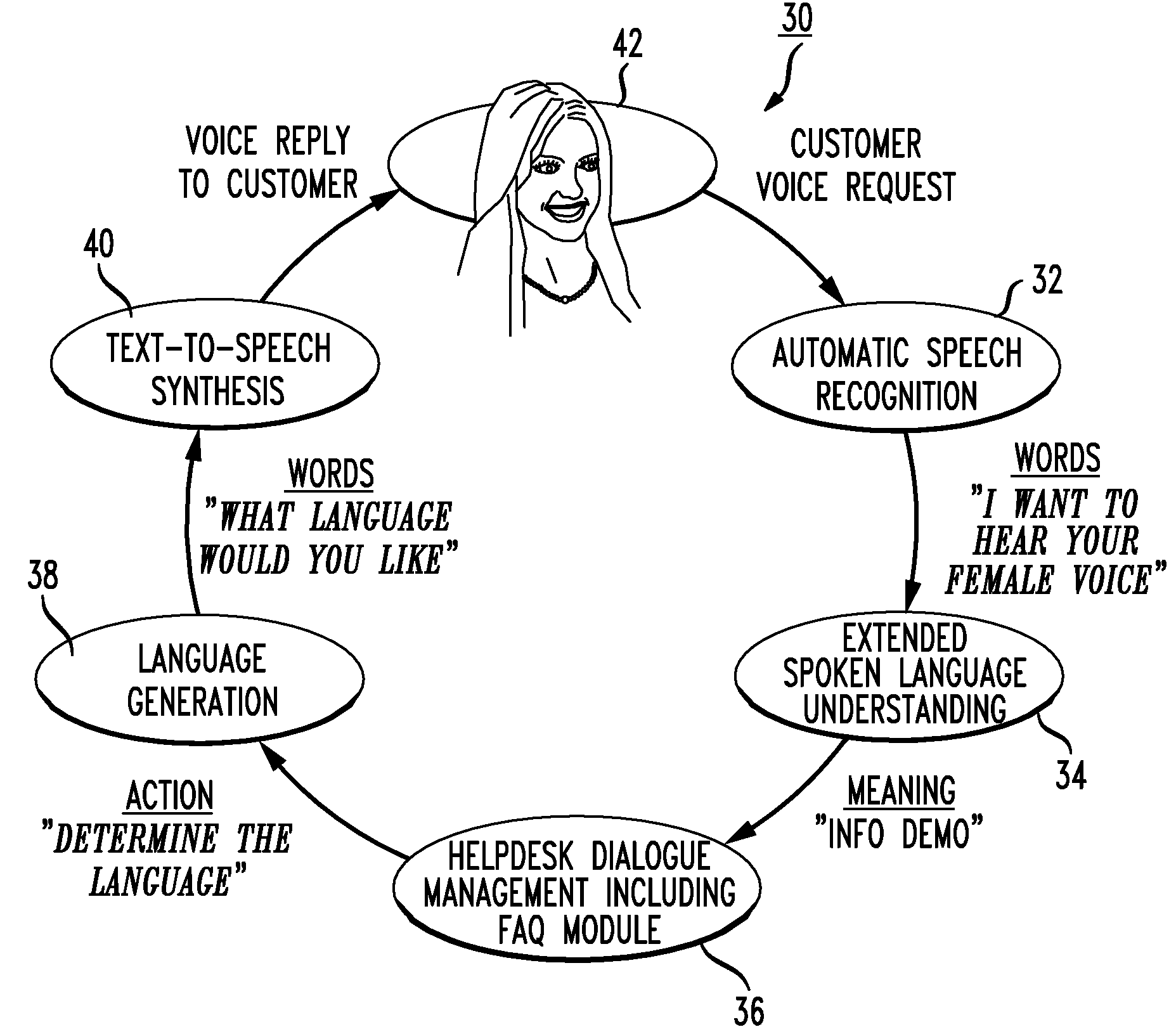
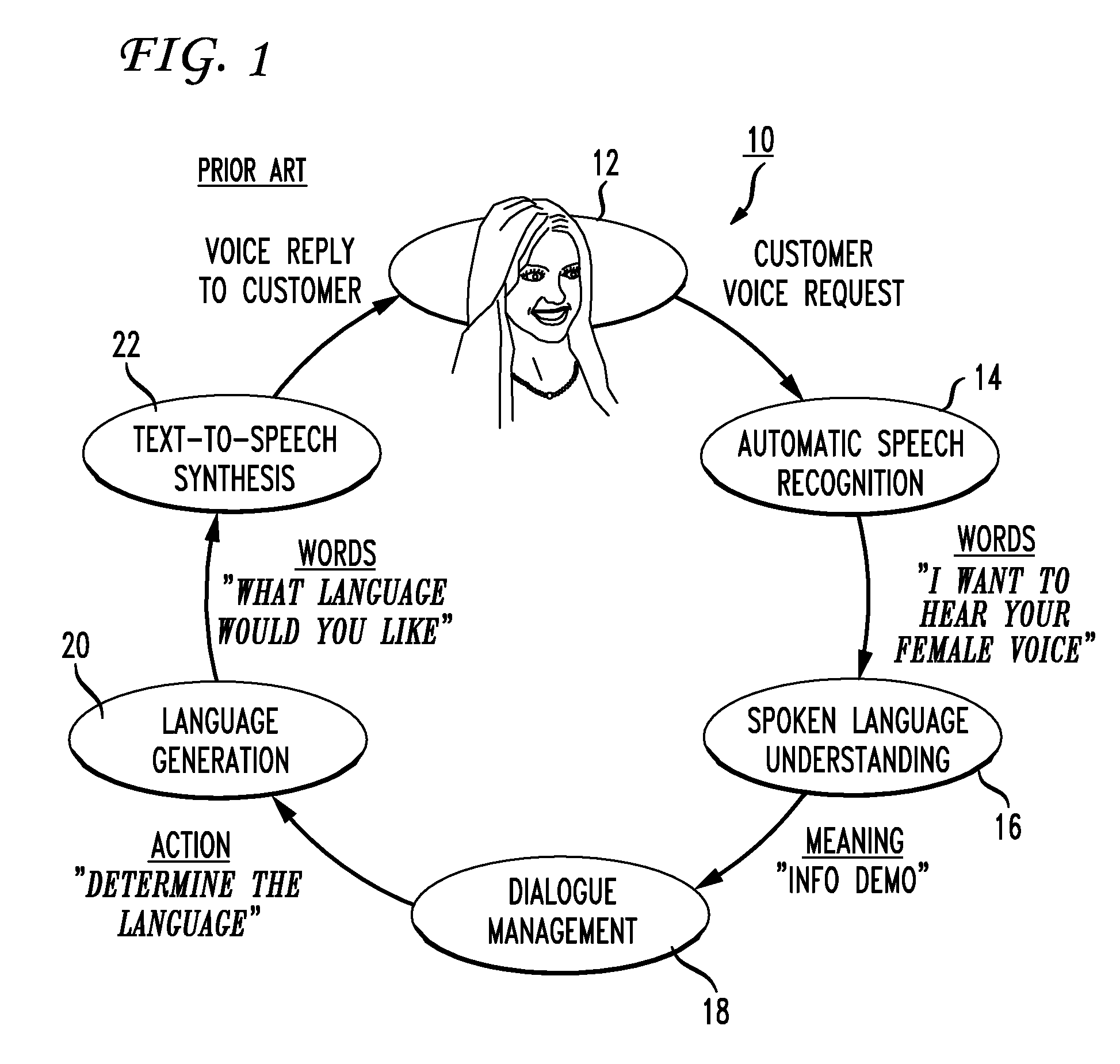
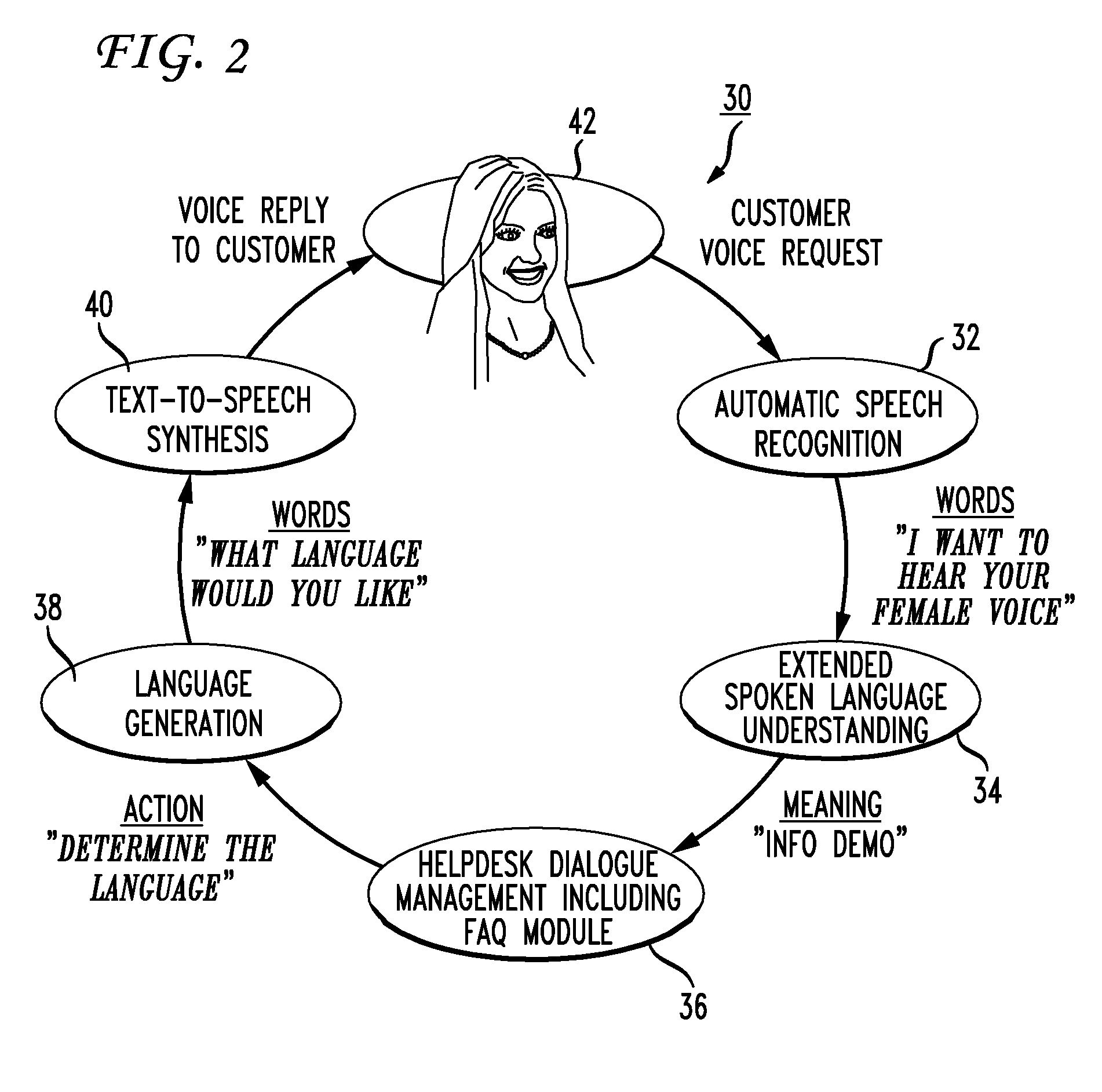
[0025]There are several technology requirements needed for a voice-enabled help desk application. FIG. 2 illustrates some of the core necessary components of such a system 30, including an automatic speech recognizer (ASR) 32 capable of recognizing large-vocabulary spontaneous speech, an extended language understanding module (SLU) 34 that parses the natural language input into relevant information, a dialog manager (DM) 36 that operates in a mixed-initiative mode, a language generation module 38 and a text-to-speech module (TTS) 40 capable of generating high-quality synthesized voices fonts. For example, AT&T Labs' Natural Voices speech technologies include customized natural voice TTS engines that may be used for a variety of appl...
the structure of the environmentally friendly knitted fabric provided by the present invention; figure 2 Flow chart of the yarn wrapping machine for environmentally friendly knitted fabrics and storage devices; image 3 Is the parameter map of the yarn covering machine
Login to View More
PUM
Login to View More
Abstract
A voice-enabled help desk service is disclosed. The service comprises an automatic speech recognition module for recognizing speech from a user, a spoken language understanding module for understanding the output from the automatic speech recognition module, a dialog management module for generating a response to speech from the user, a natural voices text-to-speech synthesis module for synthesizing speech to generate the response to the user, and a frequently asked questions module. The frequently asked questions module handles frequently asked questions from the user by changing voices and providing predetermined prompts to answer the frequently asked question.
Description
PRIORITY DOCUMENTS[0001]The present application is a continuation of U.S. patent application Ser. No. 11 / 675,166, filed Feb. 15, 2007, which is a continuation of U.S. patent application Ser. No. 10 / 326,692, filed Dec. 19, 2002, which claims priority to provisional application No. 60 / 374,961, filed Apr. 23, 2002, the contents of which are incorporated herein by reference.RELATED APPLICATIONS[0002]This case is related to commonly assigned U.S. patent application Ser. No. 10 / 235,266, filed on Dec. 19, 2002, the contents of which are incorporated herein by reference (attorney docket number 2002-0093A). This case is related to commonly assigned U.S. patent application Ser. No. 10 / 235,295, filed Dec. 19, 2002, the contents of which are incorporated herein by reference (attorney docket number 2002-0093). This case is related to commonly assigned U.S. patent application Ser. No. 10 / 326,691, filed Dec. 19, 2002, the contents of which are incorporated herein by reference (attorney docket numb...
Claims
the structure of the environmentally friendly knitted fabric provided by the present invention; figure 2 Flow chart of the yarn wrapping machine for environmentally friendly knitted fabrics and storage devices; image 3 Is the parameter map of the yarn covering machine
Login to View More
Application Information
Patent Timeline
Application Date:The date an application was filed.
Publication Date:The date a patent or application was officially published.
First Publication Date:The earliest publication date of a patent with the same application number.
Issue Date:Publication date of the patent grant document.
PCT Entry Date:The Entry date of PCT National Phase.
Estimated Expiry Date:The statutory expiry date of a patent right according to the Patent Law, and it is the longest term of protection that the patent right can achieve without the termination of the patent right due to other reasons(Term extension factor has been taken into account ).
Invalid Date:Actual expiry date is based on effective date or publication date of legal transaction data of invalid patent.
Login to View More
Patent Type & AuthorityApplications(United States)
IPC IPC(8): G10L15/18
CPCG10L15/22G06F3/167
InventorGUPTA, NARENDRA K.RAHIM, MAZIN G.RICCARDI, GIUSEPPE


 Login to View More
  Login to View More