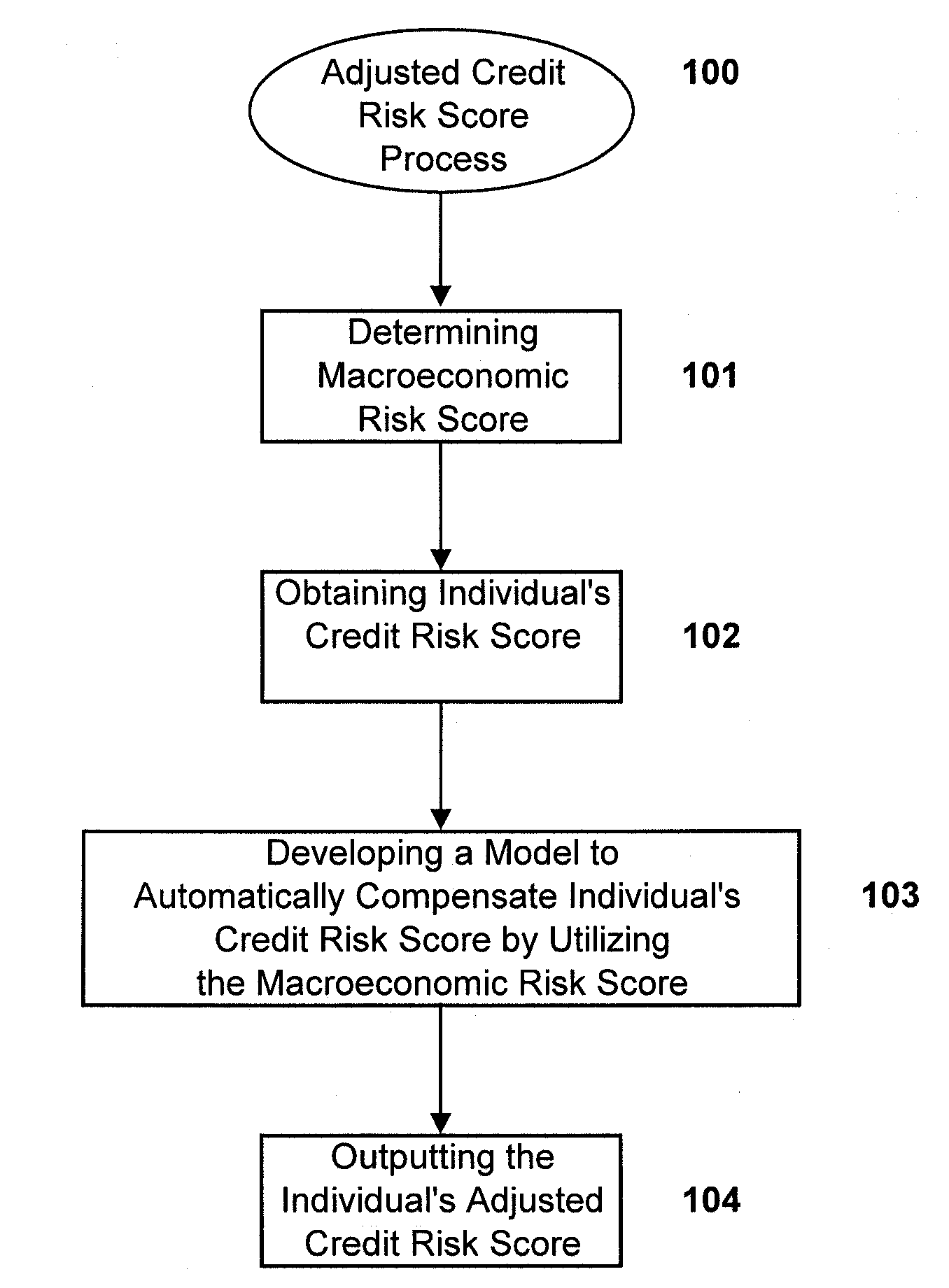
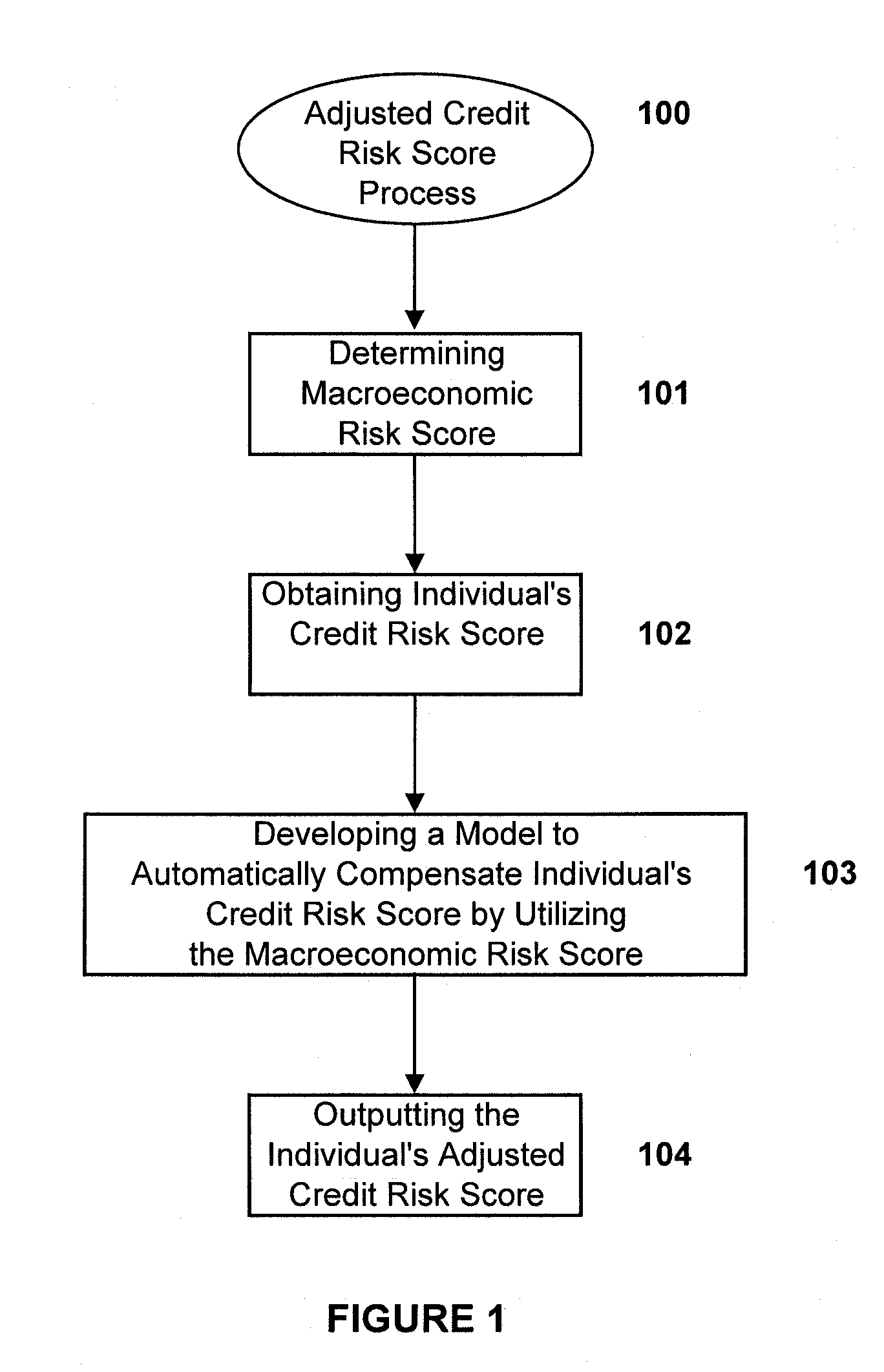
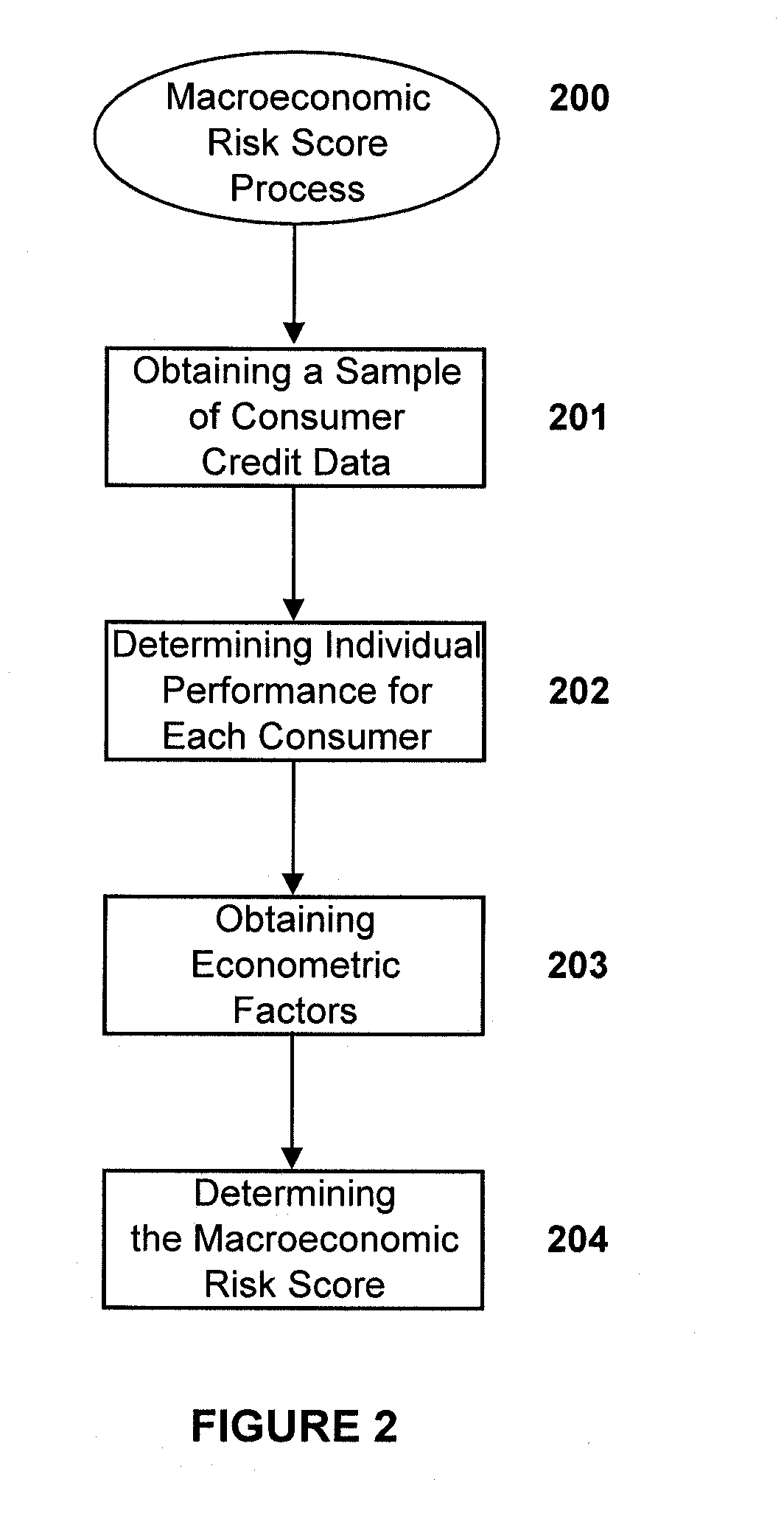
[0020]In various embodiments, the macroeconomic risk score module simply obtains the macroeconomic risk score from various sources. In other embodiments, the macroeconomic risk score module further comprises obtaining a sample of consumer credit data over a period of time covering multiple economic conditions, obtaining a performance determination for each of the consumers in the sample over a window of time to be utilized as a dependent attribute, obtaining one or more econometric factors to be utilized as one or more independent attributes, and calculating the macroeconomic risk score by utilizing the dependent attribute, the one or more independent attributes, and applying a statistical technique for modeling.
[0021]In the various embodiments of the macroeconomic risk score module that calculates the macroeconomic risk score, the module may employ numerous statistical techniques for modeling in order to determine the macroeconomic risk score. For example, the module may use techniques such as logistic regression or other nonlinear techniques that use a neural network, decision tree, or score fusion. In addition, the period of time over which embodiments of the macroeconomic risk score module obtains the consumer credit data and the window of time over which embodiments of the macroeconomic risk score module obtains a performance determination for each consumer in the sample may vary from embodiment to embodiment. For example, in one embodiment the period of time comprises a five-year period, while in other embodiments the window of time is twenty-four months or twelve months.
[0022]In addition, in the various embodiments of the macroeconomic risk score module that calculates the macroeconomic risk score, the module can use several different parameters to determine individual performance, such as whether a consumer had an account ninety-plus days past due, a charge-off, or a bankruptcy during the window of time. In various embodiments, the one or more econometric factors utilized by the macroeconomic risk score module can comprise data series, such as inflation rate, unemployment rate, or consumer confidence level. In other embodiments, the econometric factors can comprise or include aggregating data series, such as number of open trades, average credit limit, and average credit card balance, at a level of geography, demographic segment, or both. In addition, the level of geography and demographic segment can vary among embodiments. For example, the level of geography may be zip code, metropolitan statistical area (“MSA”), or census region, or the demographic segment may be based on a grouping, such as income. Other various embodiments also involve the macroeconomic risk score module obtaining or determining ratios based on the econometric factors and using these ratios as independent attributes.
[0023]Also, in the various embodiments of the macroeconomic risk score module that calculates the macroeconomic risk score, the module utilizes a weighting scheme to weight data in a development sample that includes the sample of consumer credit data and the econometric factors. In one such embodiment, the macroeconomic risk score module obtains the econometric factors at a level of geography and bases the weighting scheme on the number of consumers in each level of geography so that the development sample comprises one observation per each level of geography and observation point, and each observation is given a weight equal to the number of consumers in that level of geography. In another embodiment, the macroeconomic risk score module obtains the econometric factors at a level of geography and bases the weighting scheme on building the development sample by including an observation for each consumer in each level of geography and each consumer is given an equal weight. In another embodiment, the macroeconomic risk score module bases the weighting scheme simply on the level of geography and each level of geography is weighted equally.


 Login to View More
  Login to View More