
Planar programmable metallization memory cells
a metallization memory and programmable technology, applied in the direction of bulk negative resistance effect devices, electrical devices, semiconductor devices, etc., can solve the problem of uneven diffusion of metal ions
- Summary
- Abstract
- Description
- Claims
- Application Information
AI Technical Summary
Problems solved by technology
Method used
Image

Examples
first embodiment
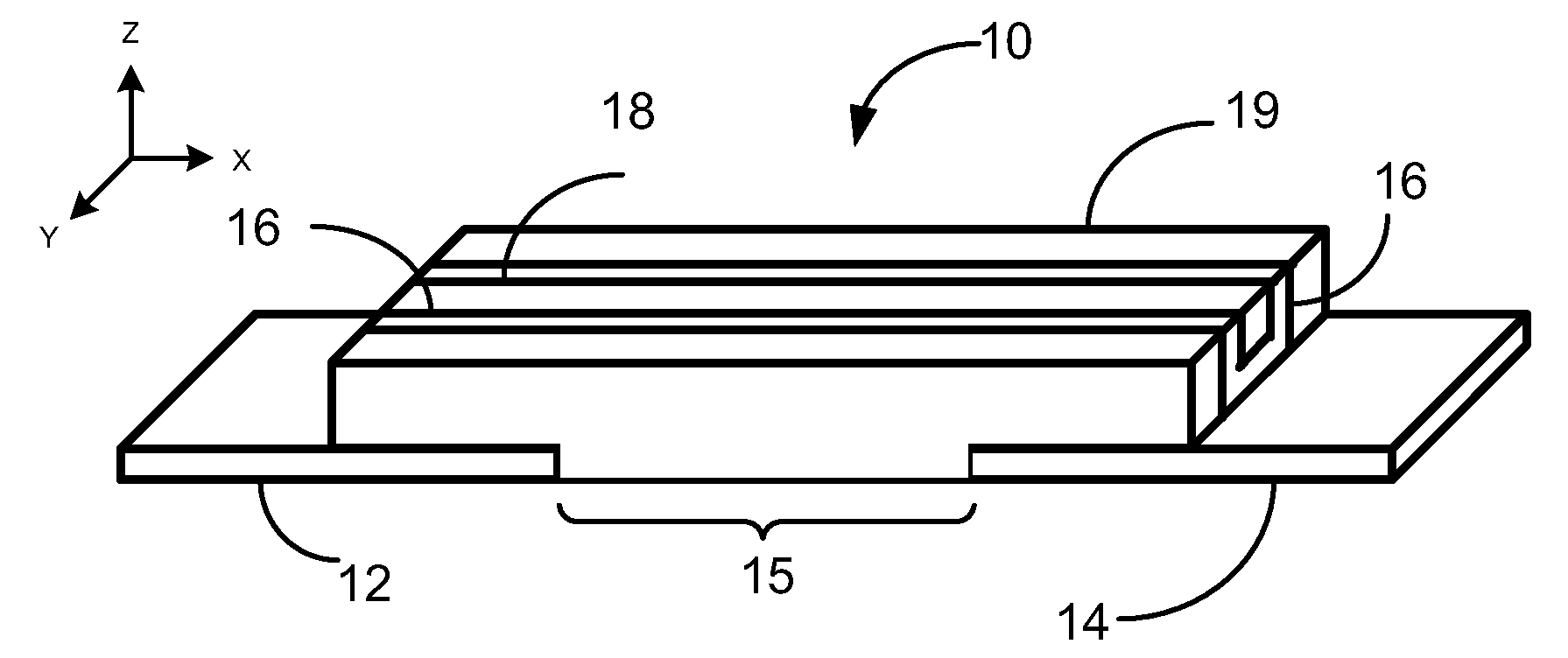
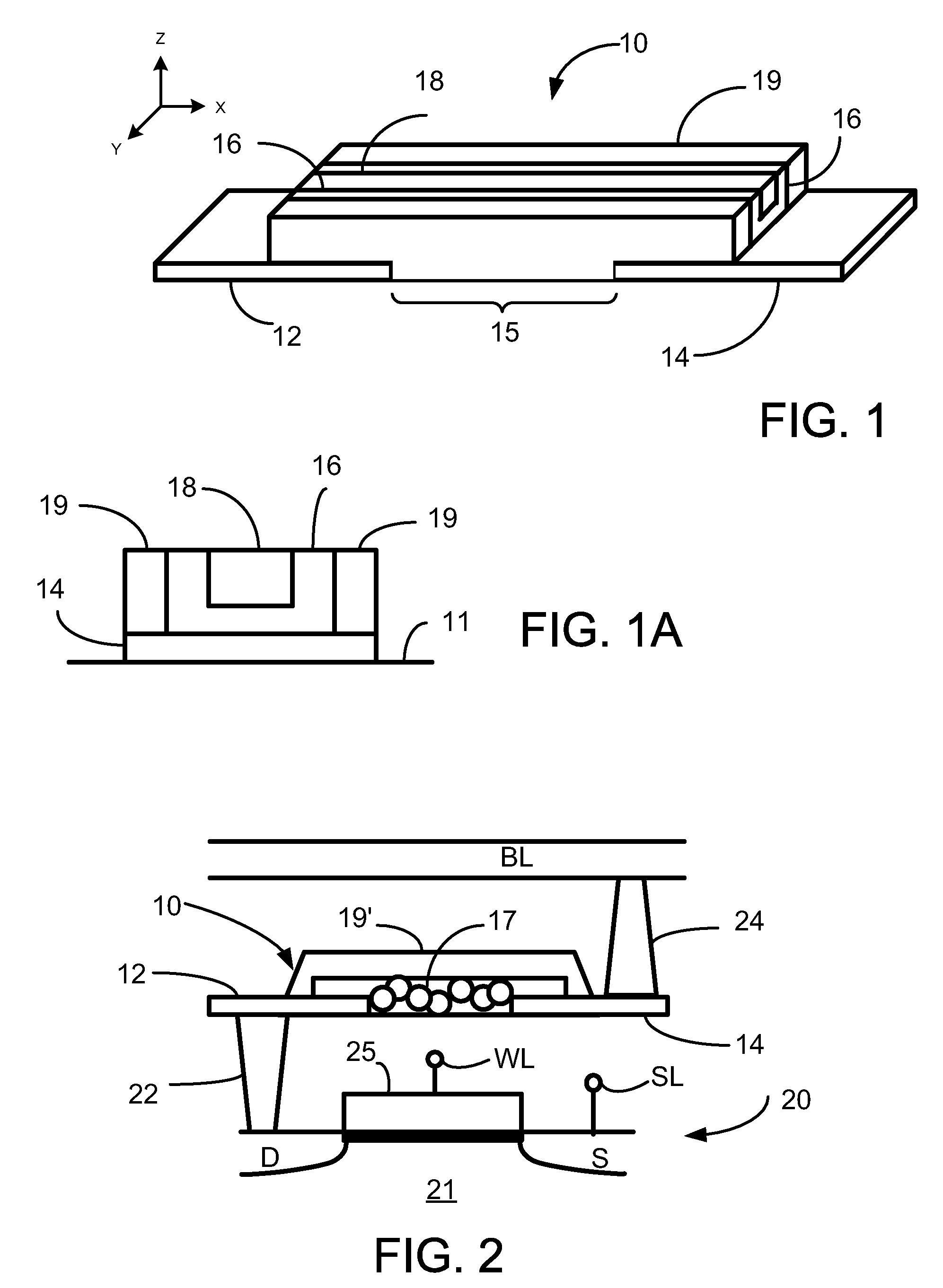
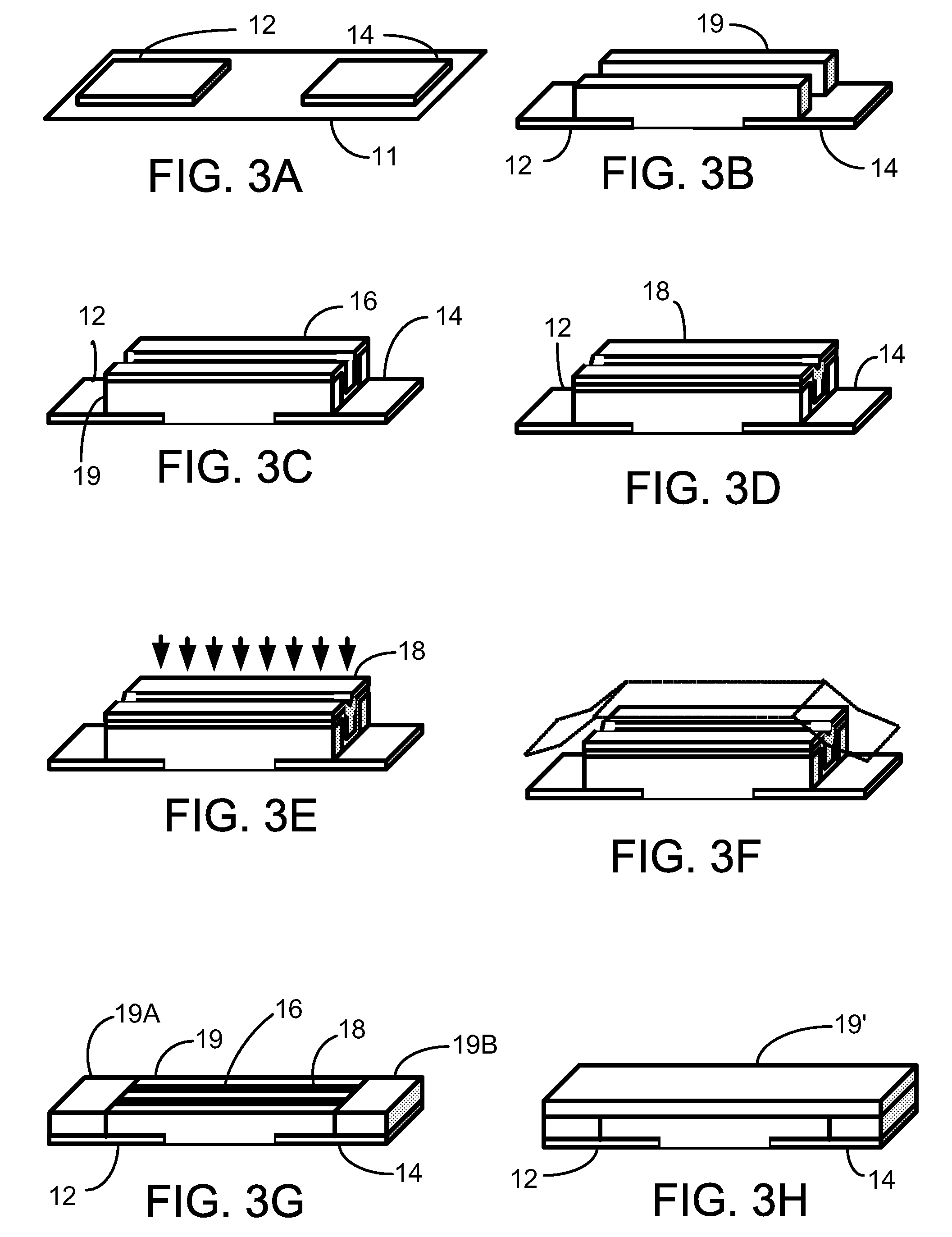
[0022]a programmable metallization memory cell according to this disclosure is illustrated in FIG. 1 and FIG. 1A as memory cell 10. Memory cell 10 has a substrate 11 with a first electrode 12 and a second electrode 14 positioned on substrate 11. Electrodes 12, 14 are co-planar, positioned on substrate 11 in a non-overlapping manner, in that no portion of one electrode (for example, electrode 12) is positioned between substrate 11 and the other electrode (for example, electrode 14). In some embodiments, electrodes 12, 14 may be non-planar, but in a non-overlapping manner.
[0023]Electrodes 12, 14 are formed of an electrically conducting material, for example, metal. First electrode 12 is an active electrode, made of for example, silver (Ag), copper (Cu), tantalum (Ta) or titanium (Ti). Second electrode 14 is an inert electrode, made of, for example, tungsten (W) or a noble metal such as gold (Au), platinum (Pt), palladium (Pd) and rhodium (Rh). Typically, the material of electrode 12 i...
second embodiment
[0036]a programmable metallization memory cell according to this disclosure is illustrated in FIGS. 4, 4A, 4B and 4C as memory cell 40. The various elements of memory cell 40 are similar to and have the same or similar properties and features as the corresponding elements of memory cell 10, unless indicated otherwise. In this embodiment, the electrodes are non-overlapping, generally co-planar, but spaced from the support substrate. Memory cell 40 has a substrate 41 with a first electrode 42 and a second electrode 44 positioned on substrate 41 with an intervening layer. Electrodes 42, 44 are positioned on substrate 41 in a non-overlapping manner, in that no portion of one electrode (for example, electrode 42) is positioned between substrate 41 and the other electrode (for example, electrode 44). Electrodes 42, 44 are parallel to substrate 41 and co-planar with each other.
[0037]Electrodes 42, 44 are formed of an electrically conducting material, for example, metal. First electrode 42 ...
PUM
 Login to View More
 Abstract
Description
Claims
Application Information
 Login to View More