
Electrostatic Aerosol Concentrator
- Summary
- Abstract
- Description
- Claims
- Application Information
AI Technical Summary
Benefits of technology
Problems solved by technology
Method used
Image

Examples
Embodiment Construction
[0020]The term “aerosol” as used herein is an airborne liquid, solid, or suspension and includes bacteria, molds, viruses, and spores. The term “aerosol particle” is used to describe a single solid particle, a liquid droplet, or a droplet of suspension. “Viability” of biological sample is used herein to describe the ability of a living organism or a virus to reproduce when placed in appropriate culture media.
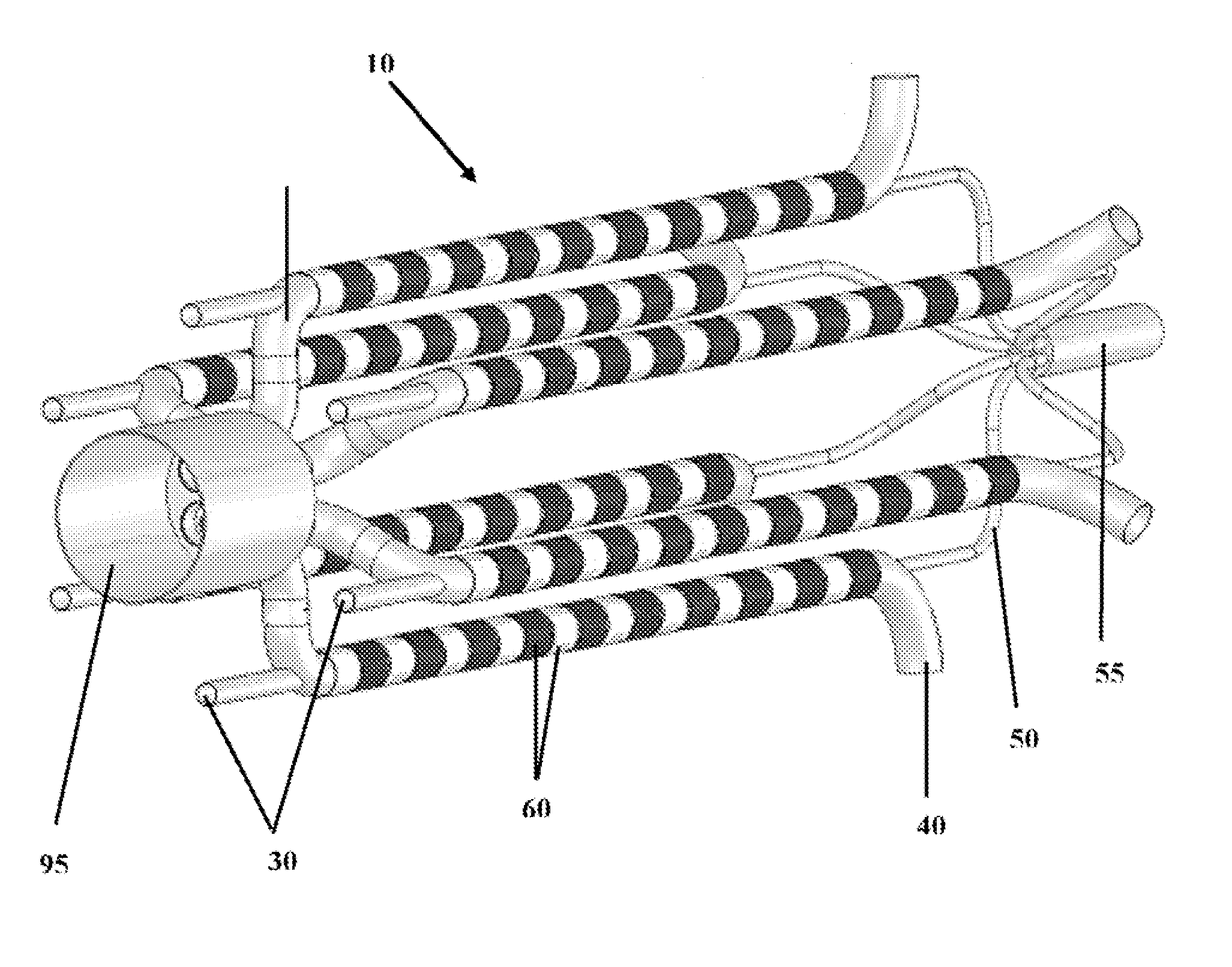
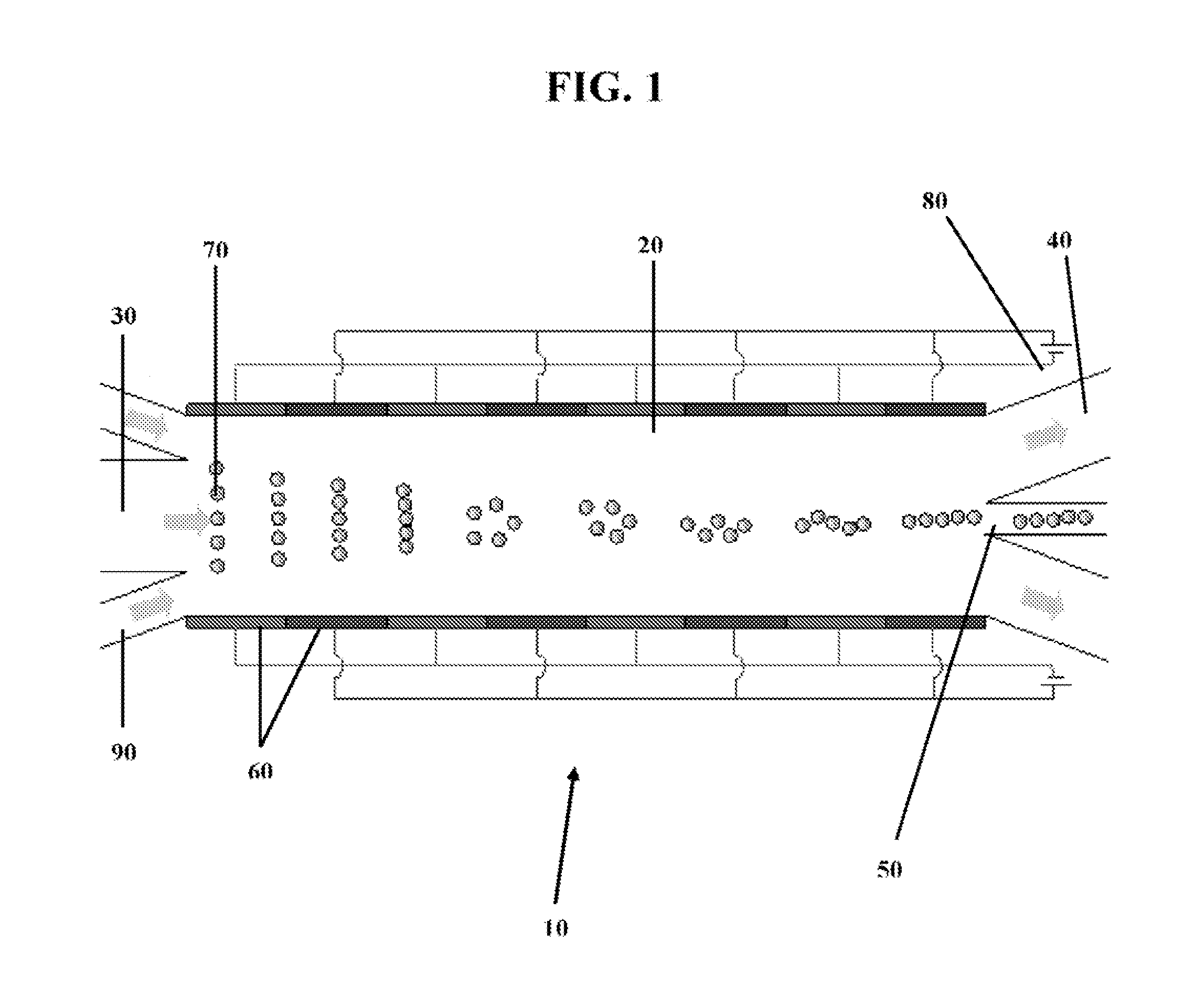
[0021]A transverse cross-section of a basic design for an apparatus for electrostatically enhanced air-to-air concentration is shown in FIG. 1. The concentrator 10 comprises an airflow chamber 20 comprising an aerosol inlet 30, an aerosol lean outlet 40, and an aerosol rich outlet 50. The wall of airflow chamber 20 comprises alternately energized and grounded electrode elements 60 that are arranged to work in concert to impart radial inward motion to charged particles 70, thereby focusing the particles toward aerosol rich outlet 50. The embodiment in FIG. 1 comprises rings of el...
PUM
 Login to View More
 Abstract
Description
Claims
Application Information
 Login to View More