

Muscle conditioning apparatus
a technology for conditioning apparatus and muscles, applied in the field of muscle conditioning apparatus, can solve the problems of poor thoracic spinal alignment, defending player is forced to adopt a poor body position, and defending player is severely disadvantaged for exerting any force on his opponent, so as to facilitate functional training, prevent hypermobility of spinal segments, and stabilize the entire spine
- Summary
- Abstract
- Description
- Claims
- Application Information
AI Technical Summary
Benefits of technology
Problems solved by technology
Method used
Image

Examples
second embodiment
[0101]In this regard, FIGS. 12A to 12C illustrate schematically the operation of muscle conditioning apparatus according to the invention suitable for general physical training. As shown in the Figures, the apparatus comprises a head member 26, arranged to rotate about an axis 38, and a chest member 32. The axis 38 is movable as indicated by the progression of positions from FIG. 12A to FIG. 12C and the head member 26 and the chest member 32 are rotatable about the axis 38. Resistance, indicated by the large arrow in FIGS. 12A to 12C is provided by a weight stack attached to a cable (not shown) as in the previous embodiment. The cable acts to urge the axis in the direction of the large arrow and by means of a cam arrangement, as described previously, provides the resistive torque for the head member 26.
[0102]The second embodiment provides a two degrees of freedom strength conditioning machine using only the degrees of freedom needed to strengthen the spine, and does not therefore in...
third embodiment
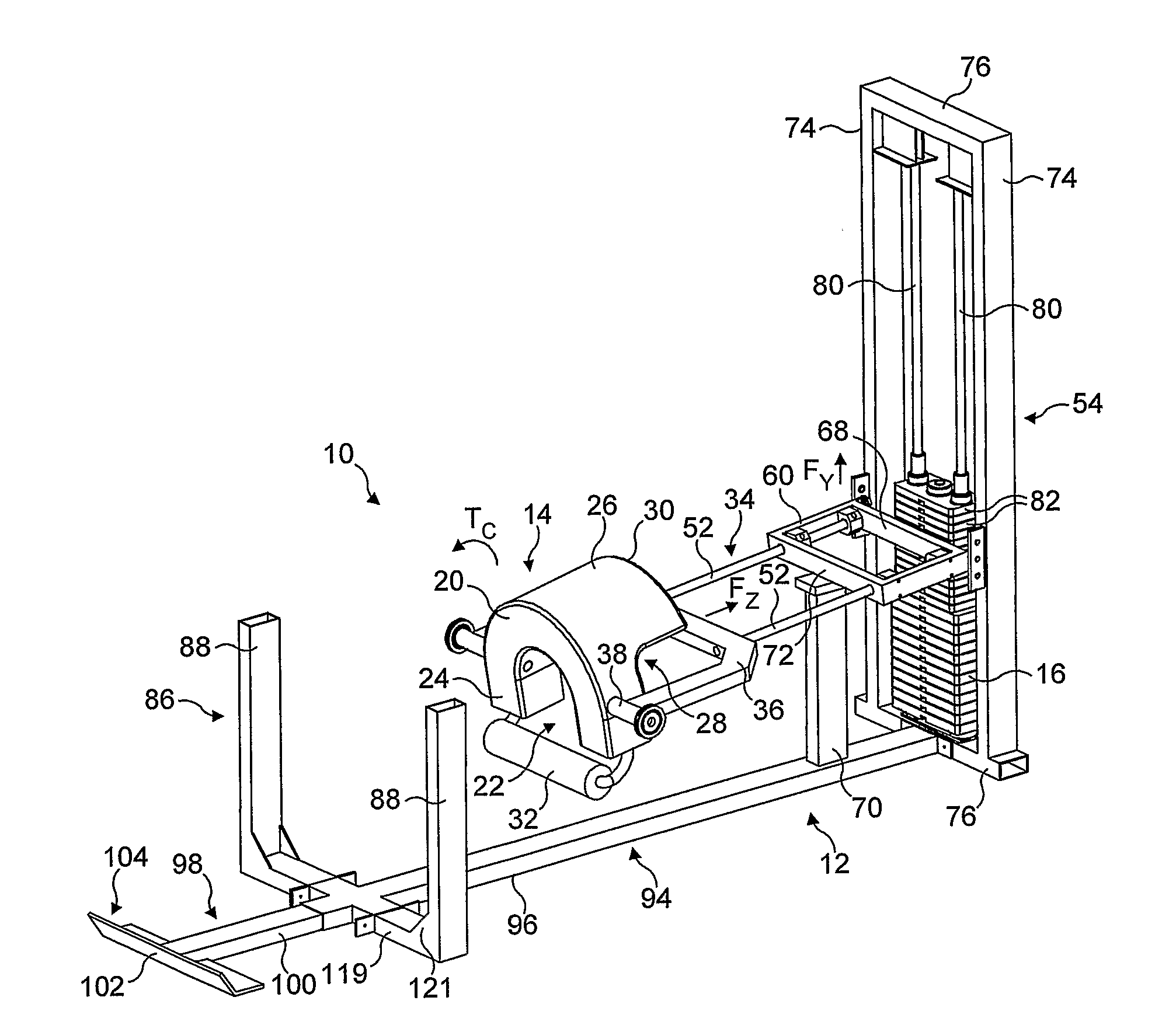
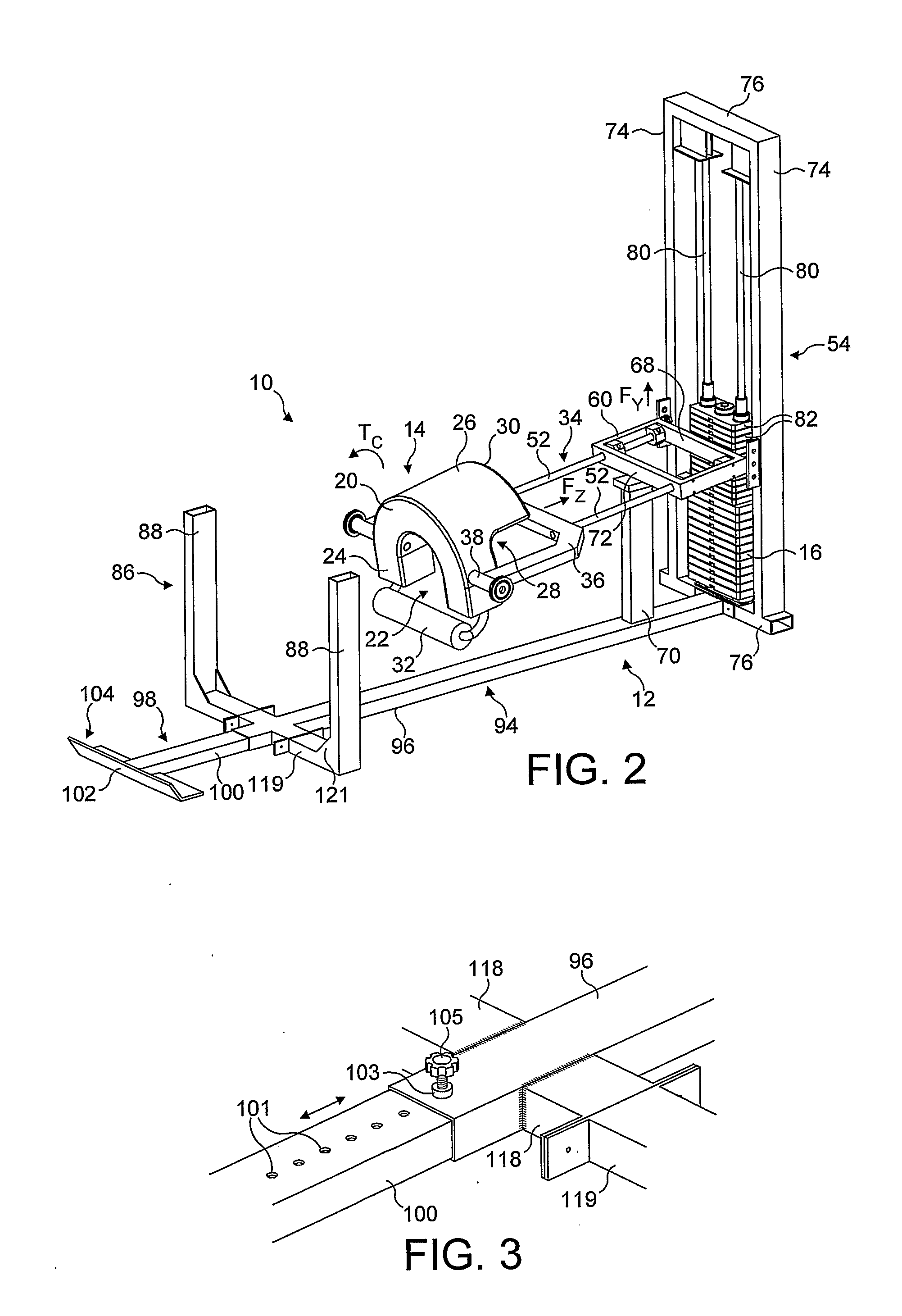
[0103]FIG. 13 shows the invention intended for scrummage training. This embodiment is substantially similar to the embodiment of FIG. 2 and corresponding reference numerals have been used for corresponding parts. The points of similarity will not be described in detail and the weight stack and cables are not shown for reasons of clarity. In this arrangement, the shoulder members are provided by discrete pads 24 and the head member is also provided by a discrete pad 26, so that there is no hood-shaped pad. The chest pad 32 in this embodiment depends from the shoulder pads 24 and does not rotate about the axis 38.
PUM
 Login to View More
 Abstract
Description
Claims
Application Information
 Login to View More