Check patentability & draft patents in minutes with Patsnap Eureka AI!

Production of renewable biofuels

a biofuel and renewable technology, applied in biofuels, fuels, waste based fuels, etc., can solve the problems of low-quality bio-oils containing high amounts of oxygen, low oxygen content of renewable fuels and/or fuel additives with limited use, and low efficiency of prior upgrading processes. achieve the effect of reducing the oxygen content of the light fraction

Active Publication Date: 2012-07-05
MARD INC
View PDF2 Cites 18 Cited by
  • Summary
  • Abstract
  • Description
  • Claims
  • Application Information

AI Technical Summary

Benefits of technology

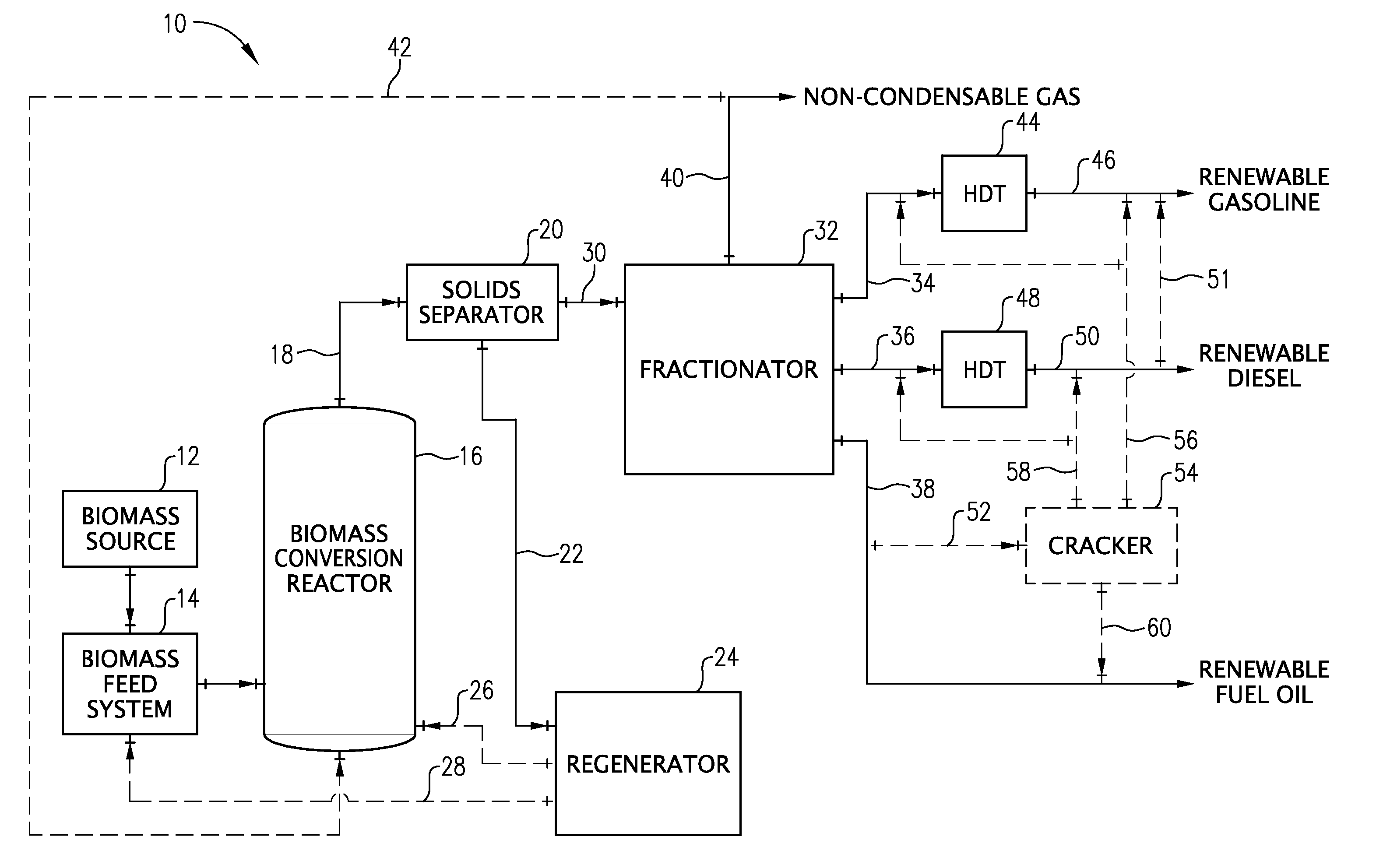
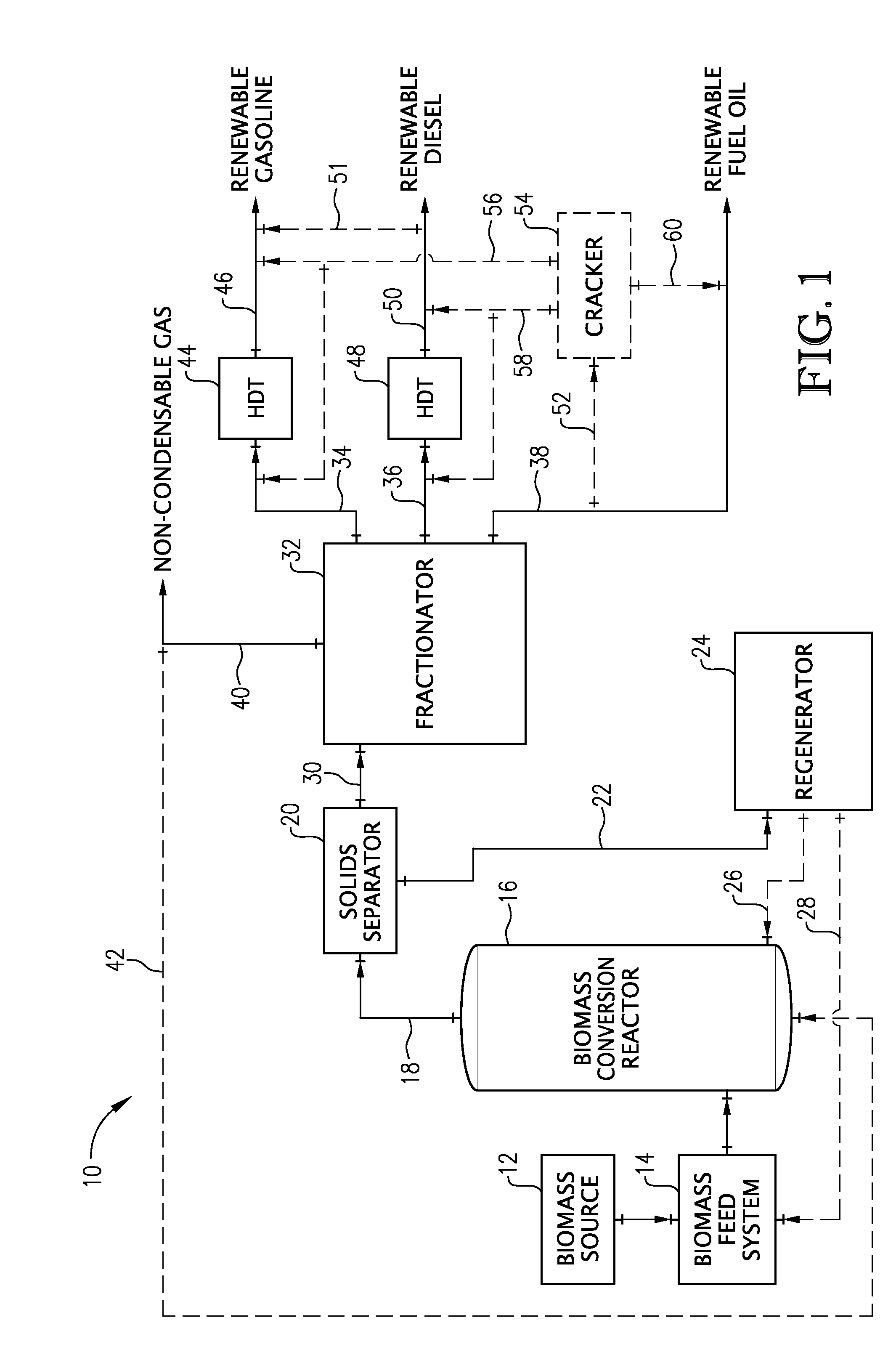
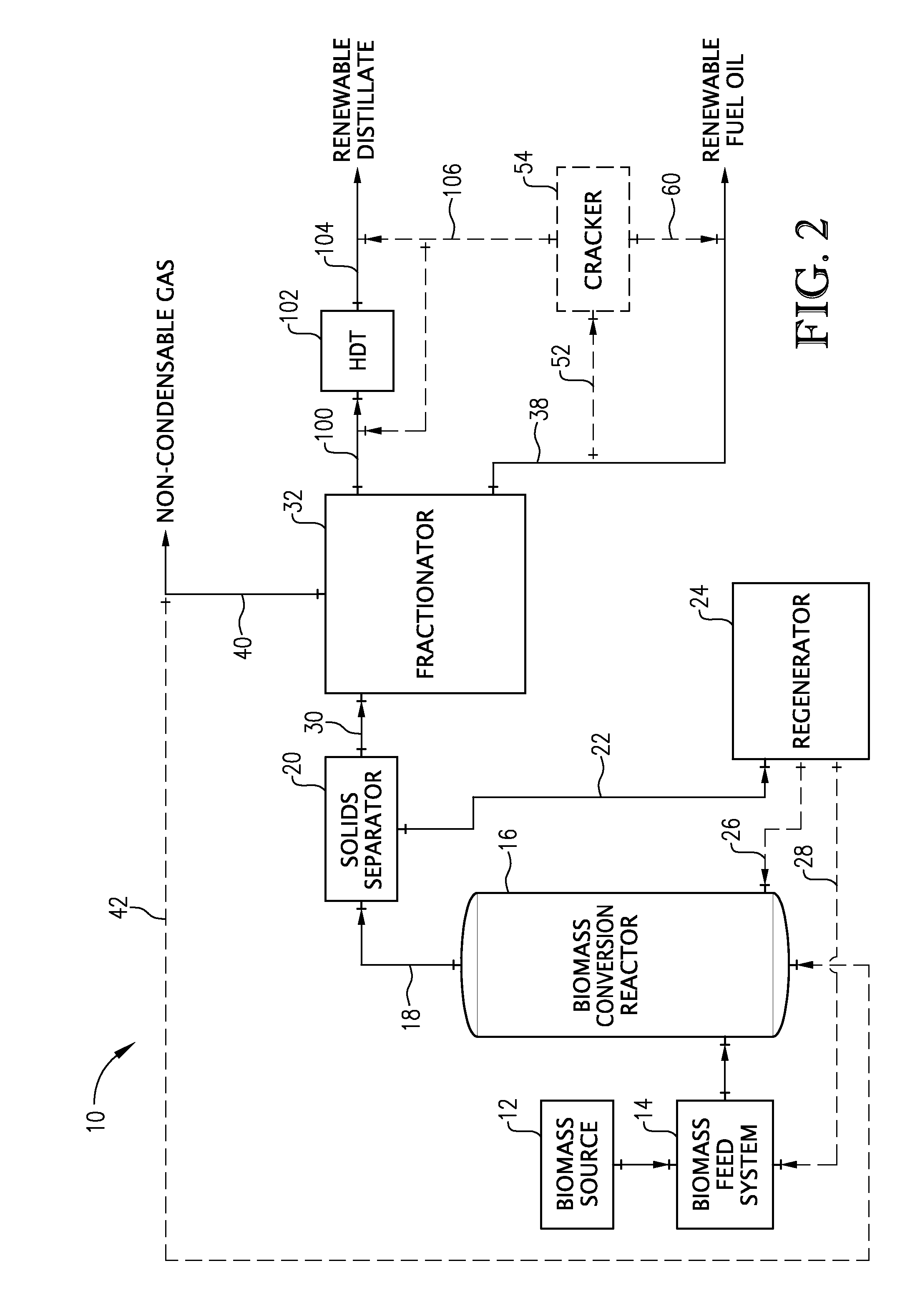
[0011]In a further embodiment, the present invention is directed to a system for producing renewable fuels comprising a biomass feedstock source for providing solid particulate biomass; a biomass feed system for feeding the solid particulate biomass into a conversion reactor; a conversion reactor for thermally converting at least a portion of the biomass feedstock into a bio-oil; a nonheated fractionator for separating the bio-oil into at least a light fraction and a heavy fraction; and a first hydrotreater for reducing the oxygen content of the light fraction.

Problems solved by technology

Despite recent advancements in biomass conversion processes, many of the existing biomass conversion processes produce low-quality bio-oils containing high amounts of oxygen.
However, prior upgrading processes have been relatively inefficient and produce renewable fuels and / or fuel additives that have limited use in today's market.
Furthermore, only limited amounts of these bio-oil derived transportation fuels and / or fuel additives may be combinable with petroleum-derived gasoline or diesel.

Method used

the structure of the environmentally friendly knitted fabric provided by the present invention; figure 2 Flow chart of the yarn wrapping machine for environmentally friendly knitted fabrics and storage devices; image 3 Is the parameter map of the yarn covering machine
View more

Image

Smart Image Click on the blue labels to locate them in the text.
Viewing Examples
Smart Image
  • Production of renewable biofuels
  • Production of renewable biofuels
  • Production of renewable biofuels

Examples

Experimental program
Comparison scheme
Effect test

example 1

[0043]A bio-oil, derived from the thermo-catalytic conversion of biomass and containing about 16.2 wt % oxygen, was separated into a light fraction and a heavy fraction by molecular distillation. The maximum temperature for the separation was 75° C. The mid-boiling point of the heavy fraction was 241.6° C., which is over 100° C. higher than the mid-boiling point of the light fraction, which was 135.6° C. The boiling profiles for each of the streams were determined by simulated distillation. The quantities of light and heavy fractions obtained were 12 wt %, and 83 wt %, respectively, based on the total weight of the bio-oil (bio-oil water, ˜4 wt % was also recovered and decanted from the light fraction). A portion of the light fraction was then hydrotreated under the following conditions, 300-375° C., 800-2000 psi and LHSV=0.5-3 h−1, over a typical Nickel and Molybdenum containing commercial hydrotreating catalyst. Results of the separation and hydrotreatment are shown in Table 1 bel...

example 2

[0045]A bio-oil, derived from the thermo-catalytic conversion of biomass and containing about 16.2 wt % oxygen, was separated into a light fraction, an intermediate fraction and a heavy fraction by molecular distillation. The maximum temperature for the separation was 120° C. The mid-boiling point of the intermediate fraction was 255.3° C., which is over 100 C higher than the mid-boiling point of the light fraction, which was 153.7° C. The boiling profiles for each of the streams were determined by simulated distillation. The quantities of light and intermediate fractions obtained were 14 wt %, and 38 wt %, respectively, based on the total weight of the bio-oil. A portion of each of these fractions was then hydrotreated under the following conditions, 300-375° C., 800-2000 psi and LHSV=0.5-3 h−1, over a typical Nickel and Molybdenum containing commercial hydrotreating catalyst. Results of the separation and hydrotreatment are shown in Table 2 below.

TABLE 2HydrotreatedHydrotreatedHea...

the structure of the environmentally friendly knitted fabric provided by the present invention; figure 2 Flow chart of the yarn wrapping machine for environmentally friendly knitted fabrics and storage devices; image 3 Is the parameter map of the yarn covering machine
Login to View More

PUM

No PUM Login to View More

Abstract

A process and system for separating and upgrading bio-oil into renewable fuels is provided. The process comprises separating bio-oil into a light fraction, an optional intermediate fraction, and heavy fraction based on their boiling points. The light fraction and optional intermediate fraction can be upgraded via hydrotreatment to produce a renewable gasoline and a renewable diesel, which may be combined with their petroleum-derived counterparts. The heavy fraction may be subjected to cracking and further separated into light, intermediate, and heavy fractions in order to increase the yield of renewable gasoline and renewable diesel.

Description

BACKGROUND[0001]1. Field of the Invention[0002]The present invention relates generally to the treatment of bio-oil. More specifically, the invention concerns processes and systems for producing renewable fuels or fuel additives from bio-oil.[0003]2. Description of the Related Art[0004]With the rising costs and environmental concerns associated with fossil fuels, renewable energy sources have become increasingly important. The development of renewable fuel sources provides a means for reducing the dependence on fossil fuels. Accordingly, many different areas of renewable fuel research are currently being explored and developed.[0005]With its low cost and wide availability, biomass has increasingly been emphasized as an ideal feedstock in renewable fuel research. Consequently, many different conversion processes have been developed that use biomass as a feedstock to produce useful biofuels and / or specialty chemicals. Existing biomass conversion processes include, for example, combusti...

Claims

the structure of the environmentally friendly knitted fabric provided by the present invention; figure 2 Flow chart of the yarn wrapping machine for environmentally friendly knitted fabrics and storage devices; image 3 Is the parameter map of the yarn covering machine
Login to View More

Application Information

Patent Timeline
no application Login to View More
IPC IPC(8): C10L1/04B01J19/00
CPCC10B49/02C10G2300/202C10C5/00C10G3/50C10G69/02C10G2300/203C10L1/023C10L1/026C10G3/46C10G2300/1014C10G2300/301Y02E50/13Y02E50/14Y02E50/32C10B53/02Y02P20/145Y02P30/20Y02E50/10Y02E50/30
Inventor RAMIREZ CORREDORES, MARIA MAGDALENAIGLESIAS, VICENTE SANCHEZ
Owner MARD INC
Features
  • R&D
  • Intellectual Property
  • Life Sciences
  • Materials
  • Tech Scout
Why Patsnap Eureka
  • Unparalleled Data Quality
  • Higher Quality Content
  • 60% Fewer Hallucinations
Social media
Patsnap Eureka Blog
Learn More