
External skin preparation and production method of same
a technology of external skin and production method, applied in the field of external skin preparation, can solve problems such as skin irritation in persons with sensitive skin, and achieve the effect of minimal skin irritation
- Summary
- Abstract
- Description
- Claims
- Application Information
AI Technical Summary
Benefits of technology
Problems solved by technology
Method used
Image

Examples
example 1
, Comparative Examples 1 to 3, and Reference Example 1
[0048]Lotions having the compositions indicated in Table 1 (units: wt %) were prepared according to the procedure described below.
[0049]4-n-butylresorcinol was warmed and dissolved in purified water and ethanol while other components were dissolved at room temperature followed by mixing to prepare lotions.
[0050]Skin irritation was evaluated using the resulting lotions. The results are shown in Table 2. The numerical values indicated in Table 2 indicate the number of guinea pig damaged skin models that corresponded to the respective scores.
TABLE 1Comp.Comp.Comp.Ref.ComponentsEx. 1Ex. 1Ex. 2Ex. 3Ex. 1Ethyl alcohol (95%)2525252525POE(25) hydrogenated22222castor oil etherMethyl0.10.10.10.10.1p-hydroxybenzoate4-n-butylresorcinol0.50.50.50.52-O-methyl ascorbic acid0.5Sodium ascorbyl0.52-phosphateSodium ascorbyl0.52-phosphate-6-palmitateGlycerin22222Propylene glycol11111Purified water68.968.968.969.469.9Total100100100100100
TABLE 2Comp.E...
examples 2 to 4
, Comparative Example 4, and Reference Example 2
[0053]Lotions having the compositions indicated in Table 3 (units: wt %) were prepared according to the procedure described below.
[0054]First, the following compositions A, B and C were prepared.
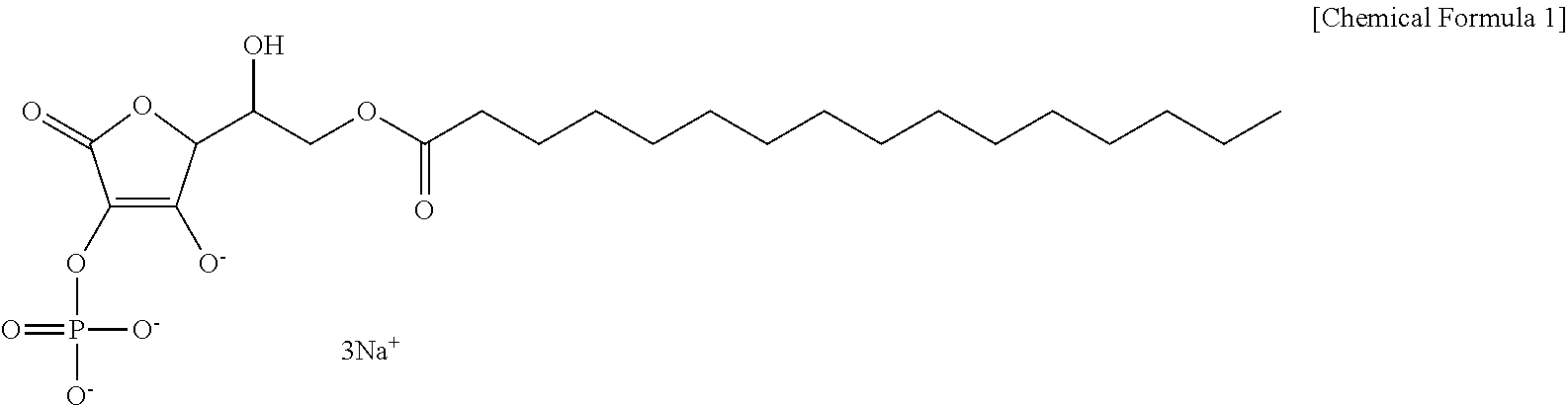
[0055]Composition A: 4-n-butyl resorcinol and / or sodium ascorbyl 2-phosphate-6-palmitate were heated and dissolved followed by mixing into a mixture of other components (oily components) and holding at 80° C.
[0056]Composition B: Each component was dissolved in heated purified water and held at 80° C. (B phase).
[0057]Composition C: Arginine was dissolved in purified water.
[0058]Next, Composition A (oily phase) was added to Composition B (aqueous phase) followed by preliminarily emulsifying and then uniformly emulsifying with a homomixer. Following emulsification, the emulsion was cooled to 30° C. followed by the addition of Composition C to obtain lotions.
[0059]Skin irritation was evaluated using the resulting lotions. The results are shown in T...
example 5
, Comparative Examples 5 and 6, and Reference Example 3
[0061]Lotions having the compositions indicated in Table 5 (units: wt %) were prepared according to the procedure described below.
[0062]First, the following compositions A and B were prepared.
[0063]Composition A: Each component was heated and dissolved, mixed and held at 70° C.
[0064]Composition B: Purified water and ethanol were mixed, heated and dissolved in 4-n-butylresorcinol followed by dissolving the other components therein and holding at 70° C.
[0065]Next, Composition A (oily phase) was added to Composition B (aqueous phase) followed by preliminarily emulsifying and then uniformly emulsifying with a homomixer. Following emulsification, the emulsion was cooled to 30° C. while stirring well to obtain lotions.
[0066]Skin irritation was evaluated using the resulting lotions. The results are shown in Table 6.
TABLE 5Comp.Comp.Ref.ComponentsEx. 5Ex. 5Ex. 6Ex. 3Com-POE(20) cetyl ether1.01.01.01.0position ASilicone oil2.02.02.02.0Li...
PUM
| Property | Measurement | Unit |
|---|---|---|
| weight ratio | aaaaa | aaaaa |
| weight ratio | aaaaa | aaaaa |
| stability | aaaaa | aaaaa |
Abstract
Description
Claims
Application Information
 Login to View More