Knowledge Reasoning Method of Boolean Satisfiability (SAT)

a boolean satisfiability and knowledge reasoning technology, applied in knowledge based models, instruments, computing, etc., can solve the problems of solving algorithms that have been proposed and implemented, and none of them can reach a polynomial-time efficiency

US20140289181A1Inactive Publication Date: 2014-09-25HAN SHERWIN +1
2 Cites 4 Cited by

Patent Information

Authority / Receiving Office
US · United States
Patent Type
Applications(United States)
Current Assignee / Owner
Publication Date
2014-09-25
Estimated Expiration
Not applicable · inactive patent

Smart Images

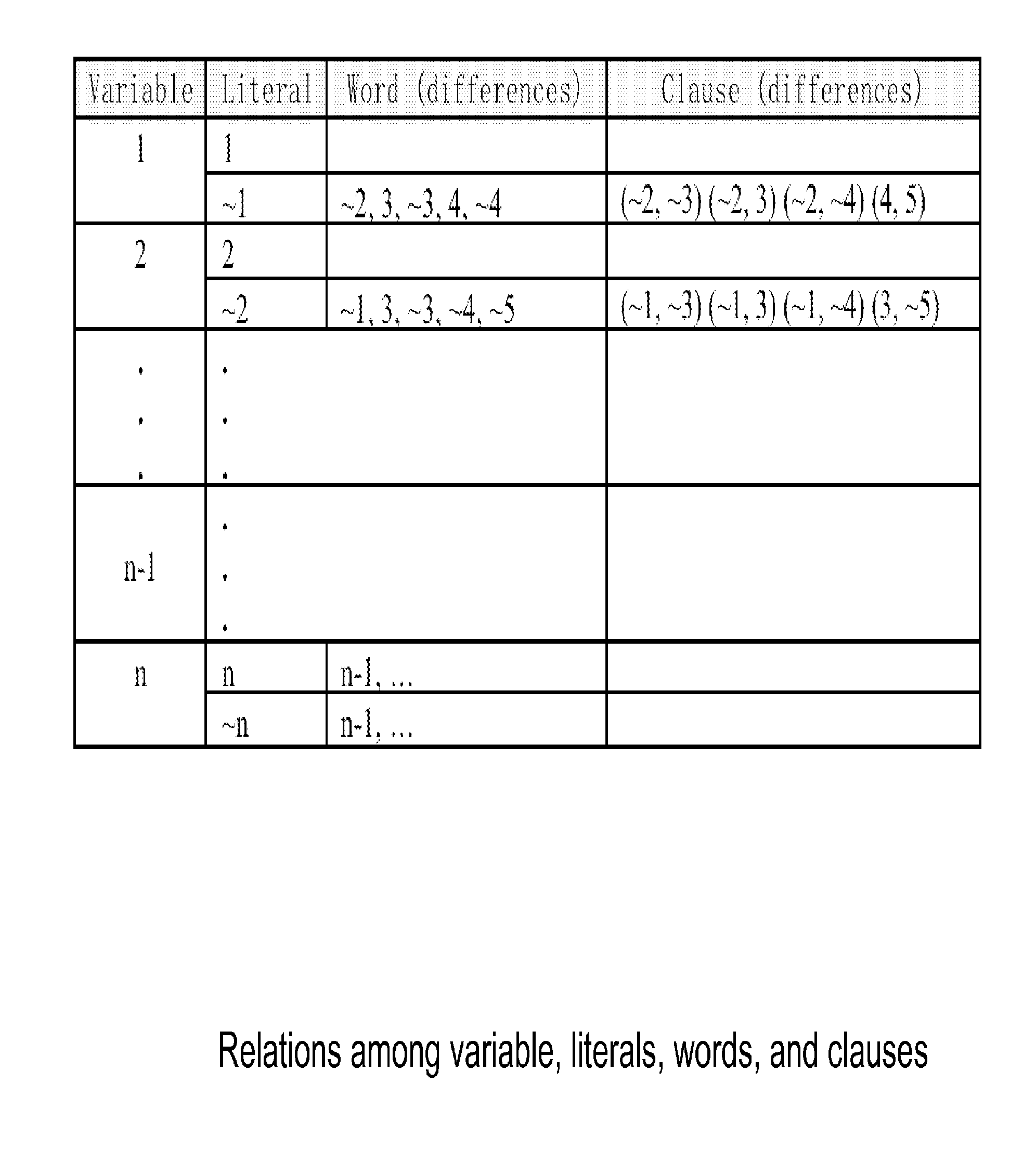
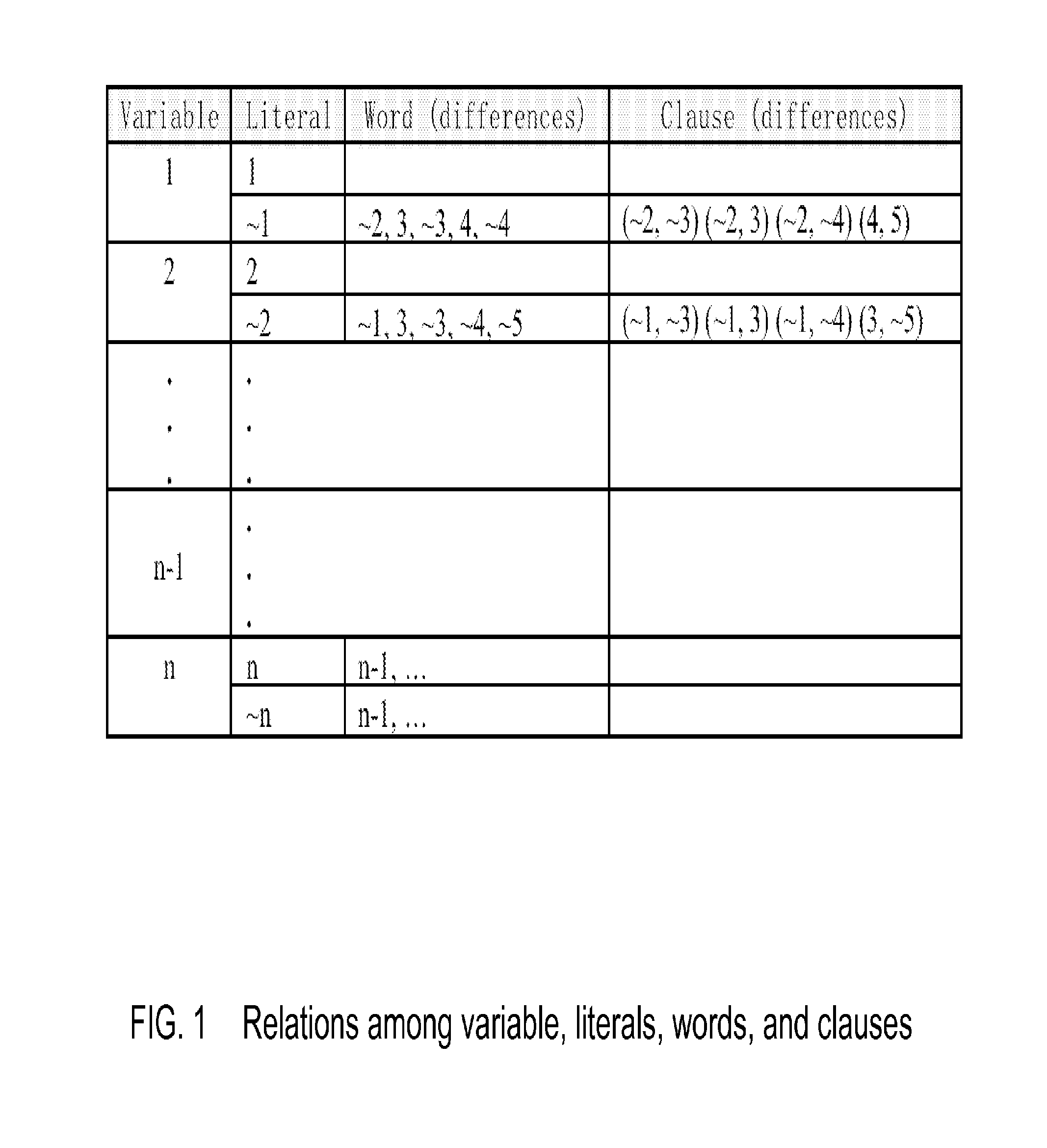
  • Figure 1
    Figure 1
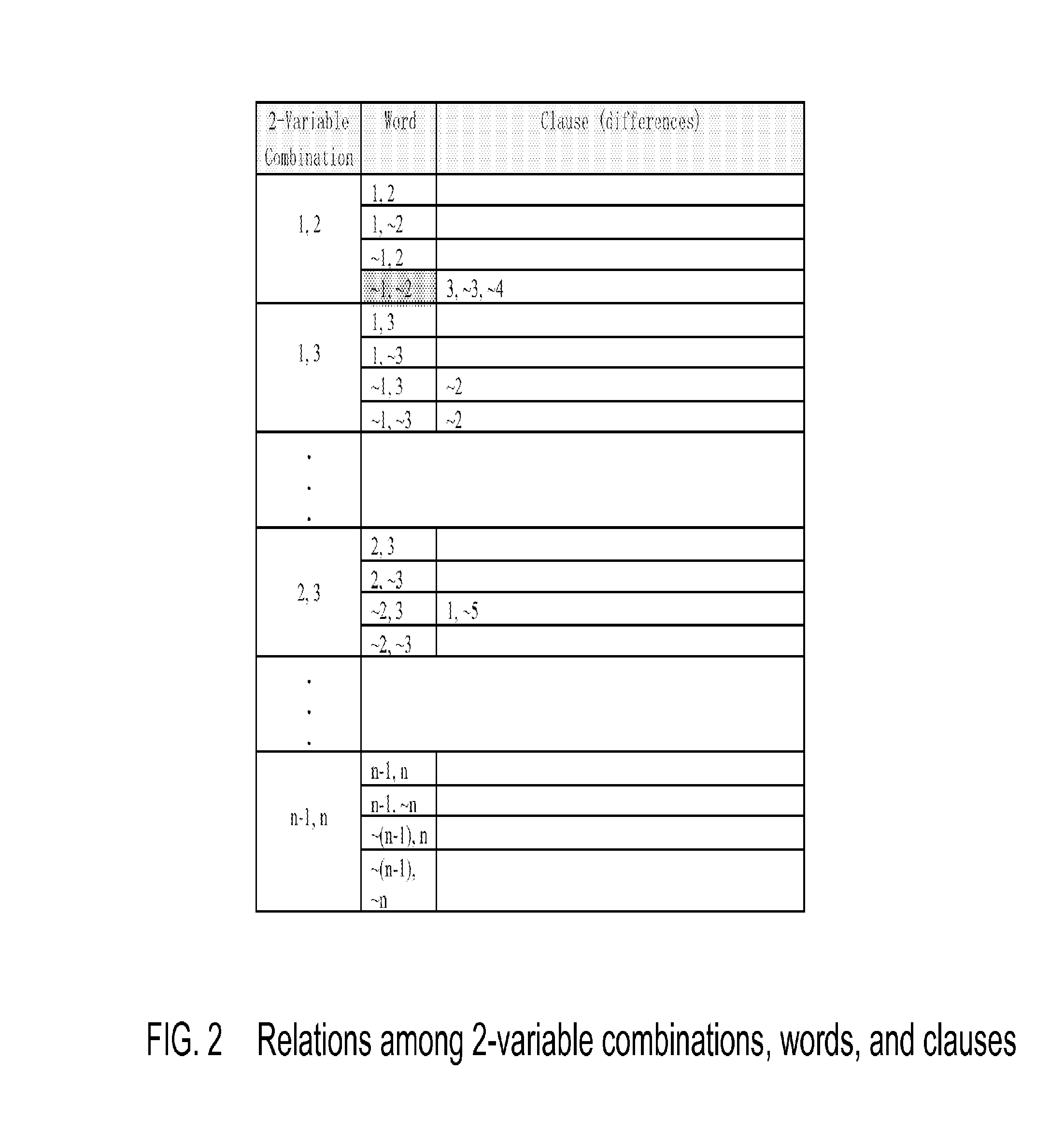
  • Figure 2
    Figure 2
  • Figure 3
    Figure 3
Patent Text Reader

Abstract

Disclosed is a knowledge reasoning method for solving Boolean Satisfiability problems. This method is one of the applications of the method disclosed in the US patent “Knowledge Acquisition and Retrieval Apparatus and Method” (U.S. Pat. No. 6,611,841). Disclosed method applies learning function to access iterative set relations among variables, literals, words and clauses as knowledge; And applies deduction and reduction functions to retrieve relations as reasoning. The process is a knowledge learning (KL) and knowledge reasoning algorithm (KRA). KRA abandons the “OR” operation of Boolean logic and processes only set relations of the data. The novelty of the disclosed method is the reversibility between the deduction and reduction. That is, KRA of Boolean Satisfiability applies a pair of perceptual-conceptual languages to learn member-class relations and retrieve information through deductive and reductive reasoning.
Need to check novelty before this filing date? Find Prior Art

Description

FIELD OF THE INVENTION

[0001] The present invention relates generally to solving the problem of Boolean Satisfiability, and more particularly to a method that applies knowledge learning and reasoning technology to solve Boolean Satisfiability problems in linear time.BACKGROUND OF THE INVENTION

[0002] Boolean Satisfiability (SAT) is a problem that has both academic and practical significance. In the industry domain the methodology of solution is used to prove the correctness of digital logic circuits and for many other purposes. Numerous solution algorithms have been proposed and implemented, however, none of them is able to reach a polynomial-time efficiency. The present invention provides such a polynomial, more accurately, linear-time efficiency methodology of solving Boolean satisfiability problems.SUMMARY OF THE INVENTION

[0003] The present invention is a method of solving Boolean Satisfiability (SAT) problem that employs a patented knowledge learning (KL) and cognitive logic reasonin...

Examples

Embodiment Construction

[0017]Elimination of OR Operator Method

[0018]The present knowledge reasoning method applies a patented knowledge acquisition and retrieval method disclosed in the US patent “Knowledge Acquisition and Retrieval Apparatus and Method” (U.S. Pat. No. 6,611,841) by the same inventor Sherwin Han. Knowledge reasoning method converts the disjunction of the literals of the formula clauses to its semantic equivalent conjunction of literals, and eliminates OR operators. Each 3SAT formula contains m disjunctive clauses, and each disjunctive clause can be represented by a set of eight conjunctive clauses including one complement. For example, disjunctive clause (xxx2˜x3) can be presented by a set of eight conjunctive clauses {(x1x2x3), (x1x2˜x3), x1˜x2x3), (x1˜x2˜x3), (˜x1x2x3), (˜x1x2˜x3), (˜x1˜x2x3), (˜x1˜x2˜x3)} in which (˜x1˜x2x3) is a complement of (x1x2˜x3). Clause (x1x2˜x3) means that (˜x1˜x2x3) is not satisfiable, and the rest of conjunctive clauses are satisfiable. Elimination of OR ope...