
Copolymer and organic solar cell comprising same
a solar cell and organic technology, applied in the field of copolymer and organic solar cells, can solve the problems of increasing manufacturing costs, and achieve the effects of increasing open-circuit voltage and short-circuit current, small band gap, and increasing efficiency
- Summary
- Abstract
- Description
- Claims
- Application Information
AI Technical Summary
Benefits of technology
Problems solved by technology
Method used
Image

Examples
example 1
Synthesis of Copolymer 1
[0171]
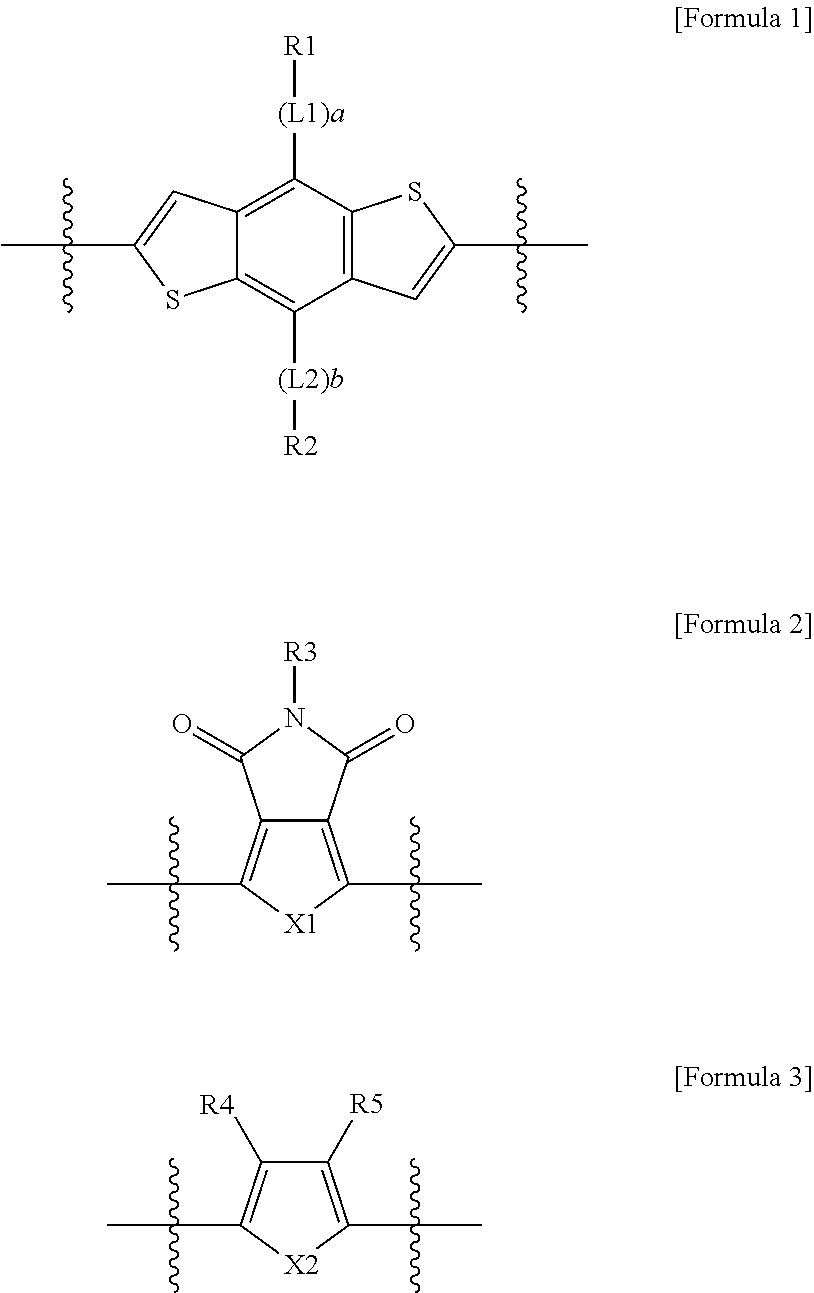
[0172]15 ml of chlorobenzene, 2,6-bis(trimethyltin)-4,8-bis(2-ethylhexyl-2-thienyl)-benzo[1,2-b:4,5-b′]dithiophene (0.7 g, 0.7738 mmol), 2,5-bis(trimethylstannyl)thiophene (0.3171 g, 0.7738 mmol), 1,3-dibromo-5-dodecylthieno[3,4-c]pyrrole-4,6-dione (0.7418 g, 1.548 mmol), 28 mg of tris(dibenzylideneacetone)dipalladium(0) (Pd2(dba)3), and 37 mg of tri-(o-tolyl)phosphine were put into a microwave reactor vial, and reacted under the condition of 170° C. for 1 hour. After the mixture was cooled to room temperature and poured into methanol, the solid was filtered and Soxhlet extracted with methanol, acetone, hexane, and chloroform, and then the chloroform part was precipitated again in methanol and the solid was filtered out.
example 2
Synthesis of Copolymer 2
[0173]
[0174]15 ml of chlorobenzene, 2,6-bis(trimethyltin)-4,8-bis(3-((2-ethylhexyl)oxy)phenyl)-benzo[1,2-b:4,5-b′]dithiophene (0.7154 g, 0.7738 mmol), 2,5-bis(trimethylstannyl)thiophene (0.3171 g, 0.7738 mmol), 1,3-dibromo-5-dodecylthieno[3,4-c]pyrrole-4,6-dione (0.7418 g, 1.548 mmol), 28 mg of tris(dibenzylideneacetone)dipalladium(0) (Pd2(dba)3), and 37 mg of tri-(o-tolyl)phosphine were put into a microwave reactor vial, and reacted under the condition of 170° C. for 1 hour. After the mixture was cooled to room temperature and poured into methanol, the solid was filtered and Soxhlet extracted with methanol, acetone, hexane, and chloroform, and then the chloroform part was precipitated again in methanol and the solid was filtered out.
example 3
Synthesis of Copolymer 3
[0175]
[0176]15 ml of chlorobenzene, 2,6-bis(trimethyltin)-4,8-bis(5-((E)-2-(5-(2-ethylhexyl)thiophen-2-yl)vinyl)thiophen-2-yl)-benzo[1,2-b:4,5-b′]dithiophene (0.8673 g, 0.7738 mmol), 2,5-bis(trimethylstannyl)thiophene (0.3171 g, 0.7738 mmol), 1,3-dibromo-5-dodecylthieno[3,4-c]pyrrole-4,6-dione (0.7418 g, 1.548 mmol), 28 mg of tris(dibenzylideneacetone)dipalladium(0) (Pd2(dba)3), and 37 mg of tri-(o-tolyl)phosphine were put into a microwave reactor vial, and reacted under the condition of 170° C. for 1 hour. After the mixture was cooled to room temperature and poured into methanol, the solid was filtered and Soxhlet extracted with methanol, acetone, hexane, and chloroform, and then the chloroform part was precipitated again in methanol and the solid was filtered out.
PUM
| Property | Measurement | Unit |
|---|---|---|
| molar ratio | aaaaa | aaaaa |
| molecular weight distribution | aaaaa | aaaaa |
| molar ratio | aaaaa | aaaaa |
Abstract
Description
Claims
Application Information
 Login to View More