Compositions and methods relating to nucleic acid-protein complexes

a technology of nucleic acid and complex, applied in the direction of peptides, peptide/protein ingredients, enzyme stabilisation, etc., can solve the problems of chemistries failing, unable to use techniques, and all three problems at on

a technology of nucleic acid and complex, applied in the direction of peptides, peptide/protein ingredients, enzyme stabilisation, etc., can solve the problems of chemistries failing, unable to use techniques, and all three problems at on

US20160279257A1Active Publication Date: 2016-09-29PRESIDENT & FELLOWS OF HARVARD COLLEGE +1

Image

Smart Image Click on the blue labels to locate them in the text.
Viewing Examples
Smart Image
  • Compositions and methods relating to nucleic acid-protein complexes
  • Compositions and methods relating to nucleic acid-protein complexes
  • Compositions and methods relating to nucleic acid-protein complexes

Examples

Experimental program
Comparison scheme
Effect test

examples

Methods

[0113]Four protocols are presented describing:

[0114]2.1) the formation of a DNA-oligonucleotide bearing a sortase-compatible GGG-peptide,

[0115]2.2) the sortase-catalyzed coupling of a protein to the DNA-peptide chimera, and

[0116]2.3 / 2.4) the integration of DNA-protein hybrids into self-assembling nanostructures for thermostable / non-thermostable proteins.

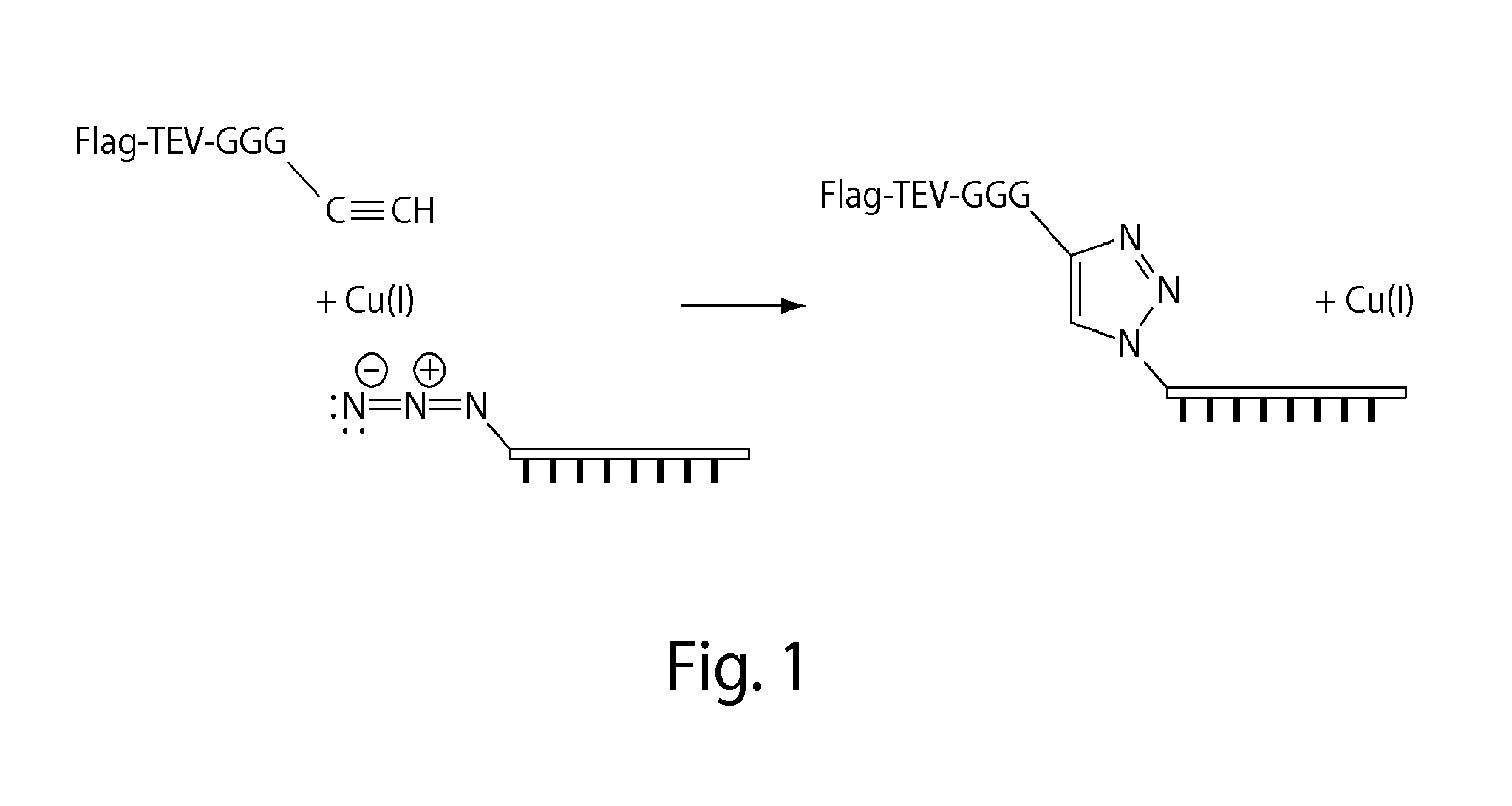
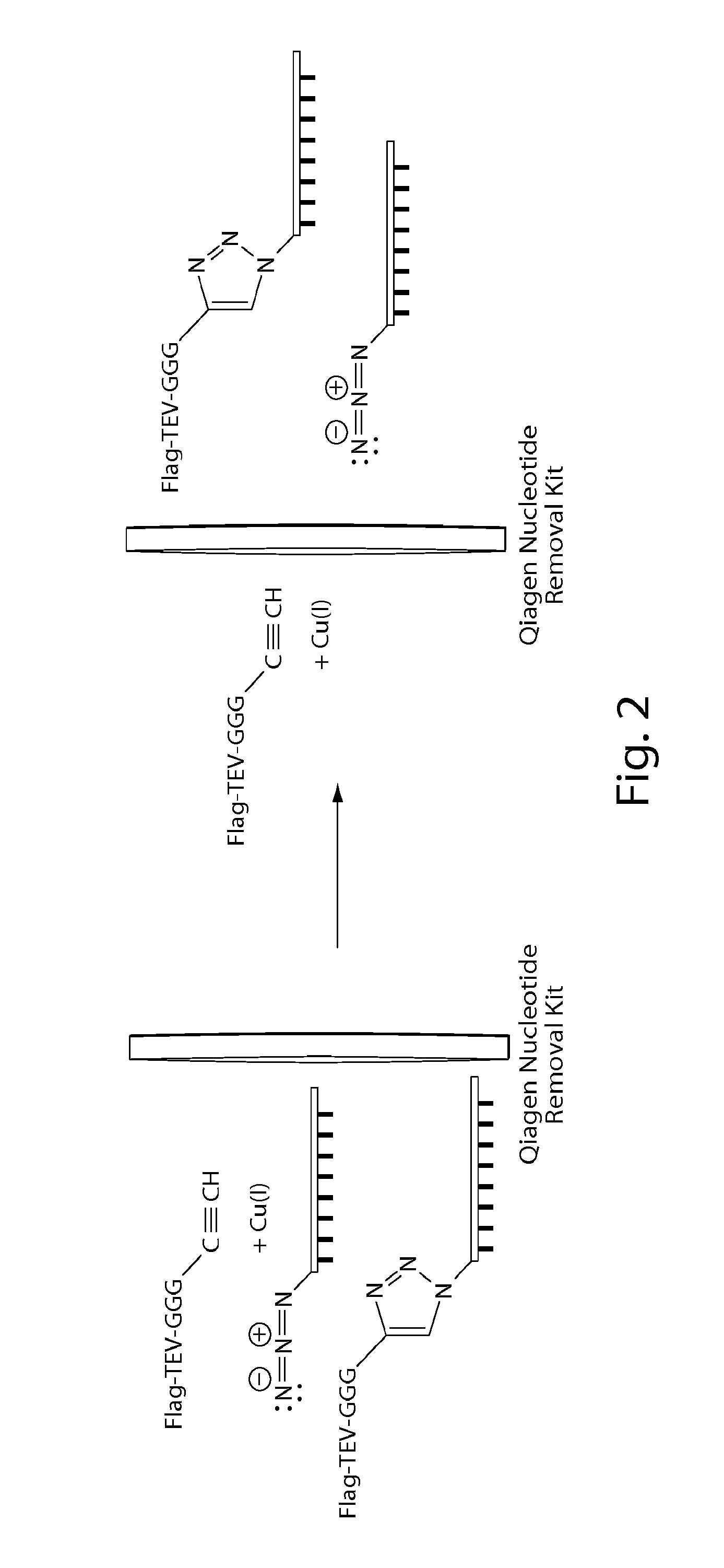
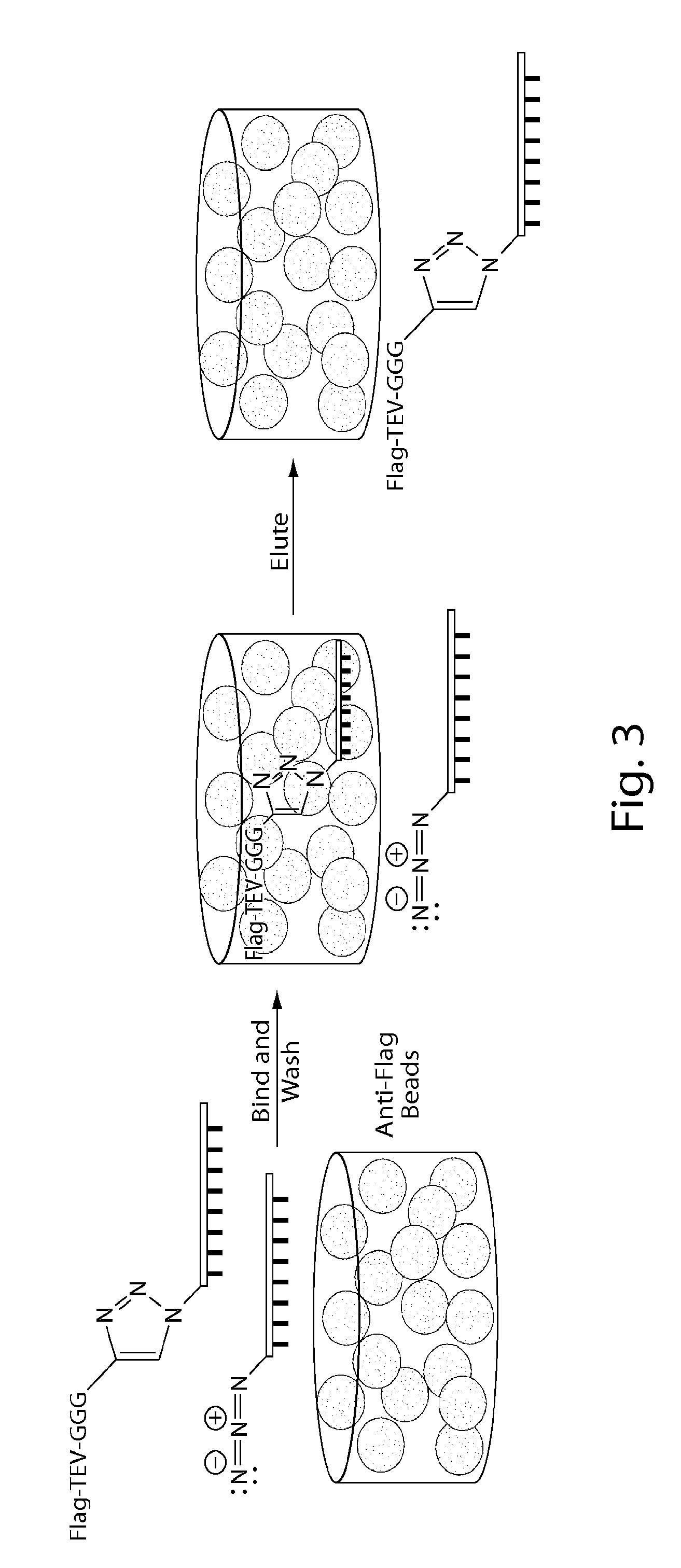
[0117]The oligonucleotides functionalized for these experiments were both 60 base pairs (bp) oligonucleotides referred to as “oligo 1” and “oligo 2”. Oligo 1 was synthesized with a 3′-azide and oligo 2 was synthesized with a 5′-azide, and both were commercially available from IDT, a custom oligonucleotide manufacturer. The peptide used in these experiments has the sequence of (amino to carboxy or N to C) Flag-TEV-GGG-Pra (i.e., DYKDDDDK-ENLYFQ-GGG-Pra), where “Pra” is the unnatural amino acid propargylglycine (SEQ ID NO: 12). Such synthetic peptides may be ordered from commercial sources such as NeoBioLab. The Pra residue prov...

the structure of the environmentally friendly knitted fabric provided by the present invention; figure 2 Flow chart of the yarn wrapping machine for environmentally friendly knitted fabrics and storage devices; image 3 Is the parameter map of the yarn covering machine
Login to View More

PUM

PropertyMeasurementUnit
Compositionaaaaaaaaaa
Lengthaaaaaaaaaa
Login to View More

Abstract

Provided are methods and compositions relating to conjugation of nucleic acids and proteins of interest under conditions that maintain protein activity. The nucleic acid-protein conjugates may be used in nucleic acid nanostructures such as those generated using DNA origami methods.

Description

RELATED APPLICATIONS[0001]This application claims the benefit of U.S. Provisional Application No. 61 / 844,818 filed Jul. 10, 2013, and entitled “COMPOSITIONS AND METHODS RELATING TO NUCLEIC ACID-PROTEIN COMPLEXES”, the entire contents of which are incorporated by reference herein.FEDERALLY SPONSORED RESEARCH[0002]This invention was made with U.S. Government support under DC002281 awarded by the National Institutes of Health. The U.S. Government has certain rights in the invention.BACKGROUND OF INVENTION[0003]DNA has become the scaffold of choice for the construction of self-assembling nanostructures. As techniques for the programmed patterning of these structures have advanced, it is now possible to create complex assemblies (Linko and Dietz, Curr. Opin. Biotechnol. 24:555-561, 2013). To take these structural elements and make them into a functional nanomachine one often needs to incorporate proteins at very specific sites (Niemeyer, Trends in Biotech 20:395-401, 2002). The barrier i...

Claims

the structure of the environmentally friendly knitted fabric provided by the present invention; figure 2 Flow chart of the yarn wrapping machine for environmentally friendly knitted fabrics and storage devices; image 3 Is the parameter map of the yarn covering machine
Login to View More

Application Information

Patent Timeline
29 Sep 2016
Publication
US20160279257A1
IPC
A61K47/48; C12N9/96; A61K38/48
CPC
A61K47/48338; C12N9/96; C12Y304/22044; A61K38/4873; C07K1/1077; C07K7/06; A61K47/65
Inventors
KOUSSA, MOUNIR AHMAD; WONG, WESLEY PHILIP