Unlock instant, AI-driven research and patent intelligence for your innovation.

Triptycene derivatives for nucleic acid junction stabilization

Inactive Publication Date: 2018-09-20
THE TRUSTEES OF THE UNIV OF PENNSYLVANIA
View PDF0 Cites 0 Cited by
  • Summary
  • Abstract
  • Description
  • Claims
  • Application Information

AI Technical Summary

Benefits of technology

The present patent provides methods for screening triptycene derivative (TCD) compounds that stabilize nucleic acid three way junction (TWJ) structures. These methods involve contacting a nucleic acid substrate with a TCD and a nucleic acid inhibitor that prevents the formation of a TWJ, followed by contacting the inhibited substrate with a TCD under conditions where FRET occurs. The presence or absence of FRET indicates the binding of the TCD to the TWJ. The methods can be used to screen for cytotoxic TCDs and TCDs that inhibit viral replication. The TCDs can be attached to a solid support and can have different structures.

Problems solved by technology

Despite significant advances in modern medicine and drug discovery, there are still tremendous unmet medical needs for combating human diseases.
However, targeting DNA and RNA structure for therapeutic use has been hampered by an incomplete understanding of the requirements needed for small molecule recognition in a structure and sequence specific manner.
Neurodegenerative disease will become a significant burden with our aging population.
The ability to target RNA-dependent processes in bacterial and viral pathogens in addition to pathogenic RNAs implicated in neurological diseases and cancer represent important challenges.
Currently, we lack the ability to design molecules to target important DNA and RNA structural motifs beyond B-form DNA with high affinity and specificity.
Advances towards targeting nucleic acids in a structure-specific manner remain a challenge.
The development of nucleic acid binding small molecules is a major challenge with great potential.
The Py-Im polyamides are perhaps one of the most successful platforms for nucleic acid recognition although they are primarily limited to targeting dsDNA structure and have not been shown to be effective at targeting RNA structure.
Minor groove binding ligands have also been reported to bind nucleic acid junctions; however, there is a lack of specificity over binding double helical nucleic acid structures.
Intercalators have been broadly utilized to target both DNA and RNA structure however this approach also suffers from a lack of specificity.
There is a minimal amount of precedent for targeting nucleic acid three-way junctions; however, to date all prior studies utilize molecular scaffolds that are already known to bind non-junction nucleic acid structures leading to little selectivity for their intended target.
Nucleic acid junctions have been targeted with poly-intercalators with the major limitation again being non-specific intercalation events leading to promiscuity.

Method used

the structure of the environmentally friendly knitted fabric provided by the present invention; figure 2 Flow chart of the yarn wrapping machine for environmentally friendly knitted fabrics and storage devices; image 3 Is the parameter map of the yarn covering machine
View more

Image

Smart Image Click on the blue labels to locate them in the text.
Viewing Examples
Smart Image
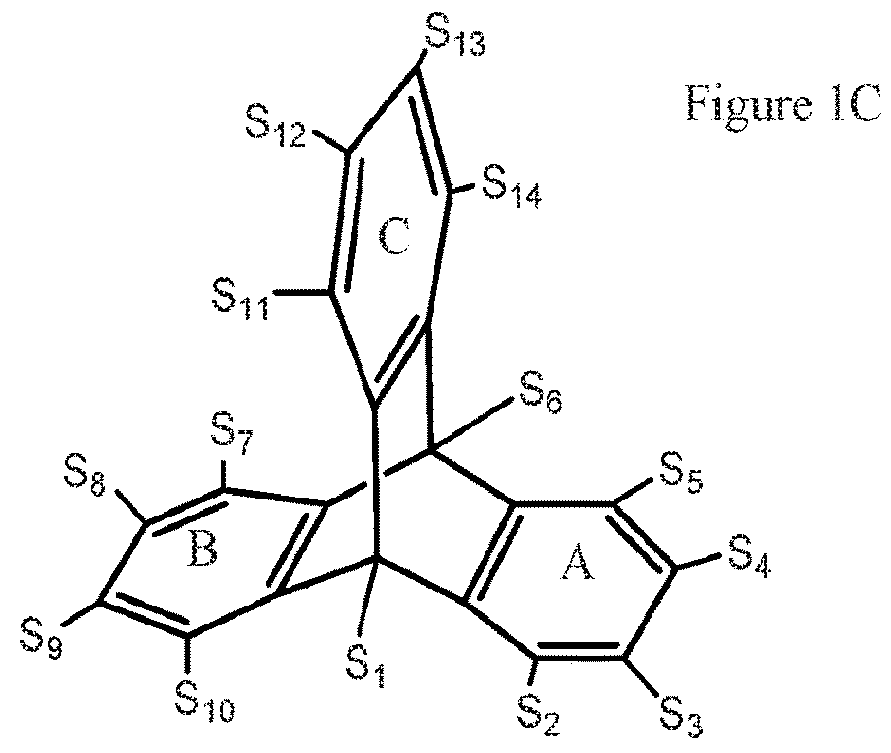
  • Triptycene derivatives for nucleic acid junction stabilization
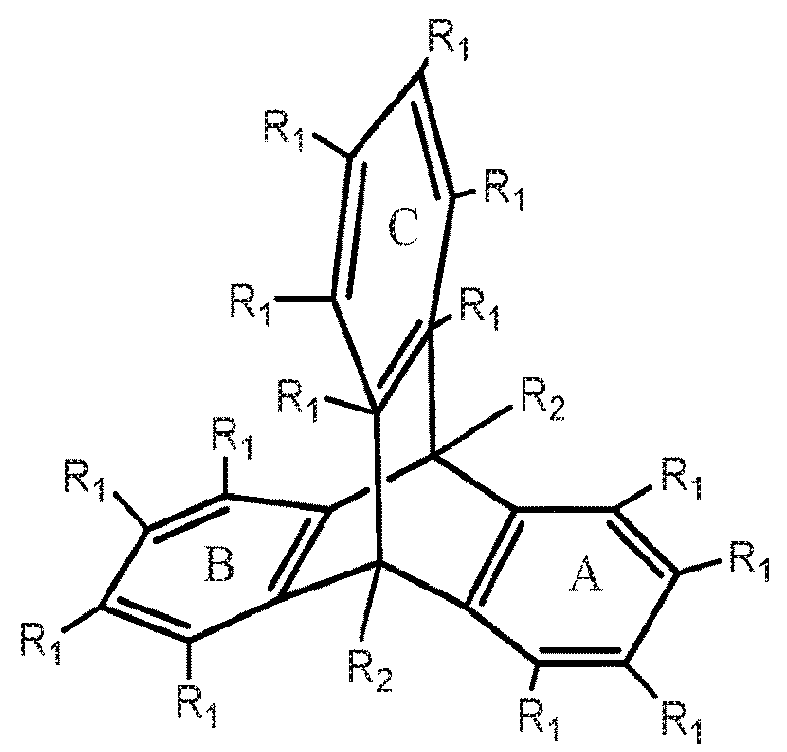
  • Triptycene derivatives for nucleic acid junction stabilization
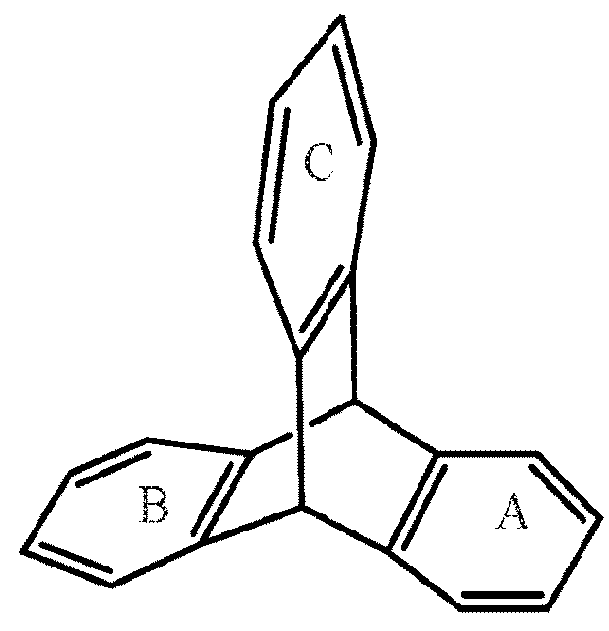
  • Triptycene derivatives for nucleic acid junction stabilization

Examples

Experimental program
Comparison scheme
Effect test

example 1

Recognition of Nucleic Acid Junctions Using Triptycene Based Molecules

[0210]Figures and references are as published in Barros et al., Angew Chem Int Ed Engl., 2014(53):13746, published on Sep. 24, 2014.

[0211]Nucleic acid modulation by small molecules is an essential process across the kingdoms of life. Targeting nucleic acids with small molecules represents a significant challenge at the forefront of chemical biology. Nucleic acid junctions are ubiquitous structural motifs in nature and in designed materials. Herein, we describe a new class of structure specific nucleic acid junction stabilizers based on a triptycene scaffold. Triptycenes provide significant stabilization of DNA and RNA three-way junctions, providing a new scaffold for building nucleic acid junction binders with enhanced recognition properties. Additionally, cytotoxicity and cell uptake data in two human ovarian carcinoma cell lines are reported.

[0212]Nucleic acid junctions are ubiquitous structural motifs, occurrin...

example 2

[0248]Modulation of the rpoH Temperature Sensor in E. coli

[0249]Figures and references are as published in Barros et al., Angew. Chem. Int. Ed., 2016(55):8258, published on May 30, 2016.

[0250]Regulation of the heat shock response (HSR) is essential in all living systems. In E. coli, the HSR is regulated by an alternative σ factor, σ32, which is encoded by the rpoH gene. The mRNA of rpoH adopts a complex secondary structure that is critical for the proper translation of the σ32 protein. At low temperatures, the rpoH gene transcript forms a highly structured mRNA containing several three-way junctions, including a rare perfectly paired three-way junction (3WJ). This complex secondary structure serves as a primitive but highly effective strategy for the thermal control of gene expression. In this work, the first small-molecule modulators of the E. coli σ32 mRNA temperature sensor are reported.

[0251]Temperature is a universal stress factor for all living organisms, and a rapid response...

example 3

Triptycene-Based Small Molecules Modulate (CAG)⋅(CTG) Repeat Junctions

[0278]The figures and references are as published in Barros et al., Chemical Science, 2015 (6):4752, published on Jun. 10, 2015.

[0279]Nucleic acid three-way junctions (3WJs) play key roles in biological processes such as nucleic acid replication in addition to being implicated as dynamic transient intermediates in trinucleotide repeat sequences. Structural modulation of specific nucleic acid junctions could allow for control of biological processes and disease states at the nucleic acid level. Trinucleotide repeat expansions are associated with several neurodegenerative diseases where dynamic slippage is thought to occur during replication, forming transient 3WJ intermediates with the complementary strand. Here, we report triptycene-based molecules that bind to a d(CAG)⋅(CTG) repeat using a gel shift assay, fluorescence-quenching and circular dichroism

[0280]Nucleic acid junctions play important roles in biological...

the structure of the environmentally friendly knitted fabric provided by the present invention; figure 2 Flow chart of the yarn wrapping machine for environmentally friendly knitted fabrics and storage devices; image 3 Is the parameter map of the yarn covering machine
Login to View More

PUM

PropertyMeasurementUnit
Electrical conductanceaaaaaaaaaa
Chemical shiftaaaaaaaaaa
Login to View More

Abstract

The present invention is directed to compositions and methods using triptycene derivatives (TCDs) for three way junctions (TWJs).

Description

CROSS REFERENCE TO RELATED APPLICATIONS[0001]The present application claims benefit of priority to US Provisional Patent Application No. 62 / 232,324, filed Sep. 24, 2015, which is incorporated by reference.BACKGROUND OF THE INVENTION[0002]Despite significant advances in modern medicine and drug discovery, there are still tremendous unmet medical needs for combating human diseases.[0003]Nucleic acid junctions are ubiquitous in biological systems. Small molecule control of these structures would allow for regulation of a myriad of nucleic acid dependent biological processes. In addition, these probes will provide fundamental insight into biological systems. Small molecule nucleic acid junction binders could open new avenues for the discovery and development of therapeutics to address unmet medical needs.[0004]However, targeting DNA and RNA structure for therapeutic use has been hampered by an incomplete understanding of the requirements needed for small molecule recognition in a struct...

Claims

the structure of the environmentally friendly knitted fabric provided by the present invention; figure 2 Flow chart of the yarn wrapping machine for environmentally friendly knitted fabrics and storage devices; image 3 Is the parameter map of the yarn covering machine
Login to View More

Application Information

Patent Timeline
no application Login to View More
IPC IPC(8): C12Q1/68G01N33/50C12Q1/02C07C271/30
CPCC12Q1/68G01N33/5008C12Q1/025C07C271/30C07C2603/90C07H21/00C12Q1/6818C12Q2525/30C12Q2563/173
Inventor CHENOWETH, DAVID M.BARROS, STEPHANIE A.
Owner THE TRUSTEES OF THE UNIV OF PENNSYLVANIA