Dispersant composition

US20190153245A1Active Publication Date: 2019-05-23BASF SE
0 Cites 0 Cited by

Patent Information

Authority / Receiving Office
US · United States
Current Assignee / Owner
Publication Date
2019-05-23

Smart Images

  • Figure 1
    Figure 1
Patent Text Reader

Abstract

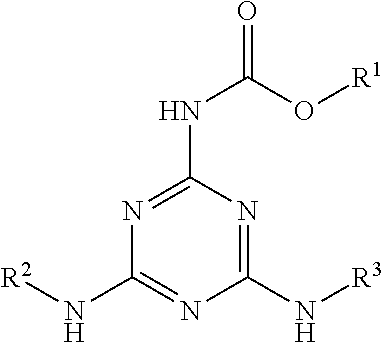
The present invention relates to a dispersant composition comprising: a) at least one oligomeric acid A, which has i) at least one acidic group selected from COOH and PO3H2, and ii) at least one polyoxyalkylene-ether radical of the formula (I): R—(O-A)xO-G-, where A is an C2-C4-alkan-1,2-diyl radical; X is an integer having a number average value in the range from 2 to 20; and R is hydrocarbon radical having from 1 to 30 carbon atoms; G is a chemical bond or a carbonyl group; and b) at least one polyamine B, which is selected from the group consisting of polyvinylamines, poly-C2-C3-alkyleneimines, modified poly-C2-C3-alkyleneimines, melamine compounds, modified melamine compounds, poly-(C2-C4-alkyleneether) amines, polyetheramine polyols, and modified polyetheramine polyols. The invention also relates to aqueous pigment compositions containing a dispersant composition as defined herein, a pigment component, selected from the group consisting of pigments and mixtures of at least one pigment and at least one filler, and an aqueous diluent.
Need to check novelty before this filing date? Find Prior Art

Description

[0001] The present invention relates to novel dispersant compositions, which are useful for preparing aqueous pigment compositions, in particular low VOC pigment compositions, which can be used as colorants for coloring both solvent borne and water borne paints, stains or other coating compositions, in particular as colorants for use in point-of-sale tinting systems and in in-plant tinting systems.BACKGROUND OF THE INVENTION

[0002] Pigments are ordinarily organic or inorganic dry powders that incorporate a mixture of primary particles, aggregates and agglomerates. For both industrial and consumer coating compositions, whether solvent borne or water borne, the pigment should be dispersed homogeneously throughout the coating composition in order to ensure a uniform appearance of the final coating. To properly be dispersed, pigments are usually wetted, deaggregated and deagglomerated in a vehicle to obtain a dispersion of the pigment particles. Wetting involves incorporation of the pigmen...

Examples

examples

Abbreviations

[0199]1,2-CDA: 1,2-cyclohexane-dicarboxylicanhydride[0200]AN: Acid number[0201]AV: Amine number[0202]CAc: citric acid monohydrate[0203]DL-TAc: DL-tartaric acid[0204]EO: ethyleneoxide[0205]Eq.: equivalents[0206]GA: glutaric anhydride[0207]IA: itaconic anhydride[0208]IAc: itaconic acid[0209]MA: maleic anhydride[0210]Mac: malic acid[0211]Mn: molecular weight, number average[0212]PA: phthalic anhydride[0213]PBTAc: 2-phosphono-butan-1,2,4-tricarboxylic acid[0214]PO: propyleneoxide[0215]PPAc: polyphosphoric acid[0216]PU polyurethane[0217]PyA: pyromelliticdianhydride[0218]SA: succinic anhydride[0219]SC: solid content[0220]sb: solvent borne[0221]t-AAc: trans aconitic acid[0222]TCAc: tricarballylic acid[0223]VA: visual appearance[0224]wb: water borne

Preparation of Acid A:

[0225]In procedures A to X, the following compounds were used as component 1:[0226]1a: C10-oxoalcohol with 7 EO[0227]1b: C10-guerbet alcohol with 1 PO and 6 EO[0228]1c: C13-oxoalcohol with 7 EO[0229]1d: C10-guer...