
Block copolymer
a technology of copolymer and block, applied in the field of block copolymer, can solve the problems of poor impact resistance and heat resistance limited application, and brittleness of polylactic acid resin, and achieve excellent mechanical properties, maintain environmental friendliness and biodegradability.
Active Publication Date: 2020-06-04
LG CHEM LTD
View PDF0 Cites 2 Cited by
- Summary
- Abstract
- Description
- Claims
- Application Information
AI Technical Summary
Benefits of technology
The present invention provides a lactic acid-based block copolymer with good strength and flexibility while being environmentally friendly and biodegradable.
Problems solved by technology
However, the polylactic acid resin has poor impact resistance and heat resistance as compared with existing petroleum-based resins, and thus is used in limited applications.
Further, the polylactic acid resin exhibits brittleness due to poor elongation at break, which is a limitation in a general-use resin.
However, since PBS and PBAT have low tensile strength, there is a problem in that the compound or the block copolymer also has low tensile strength.
Method used
the structure of the environmentally friendly knitted fabric provided by the present invention; figure 2 Flow chart of the yarn wrapping machine for environmentally friendly knitted fabrics and storage devices; image 3 Is the parameter map of the yarn covering machine
View moreImage
Smart Image Click on the blue labels to locate them in the text.
Smart ImageViewing Examples

Examples
Experimental program
Comparison scheme
Effect test
example 1
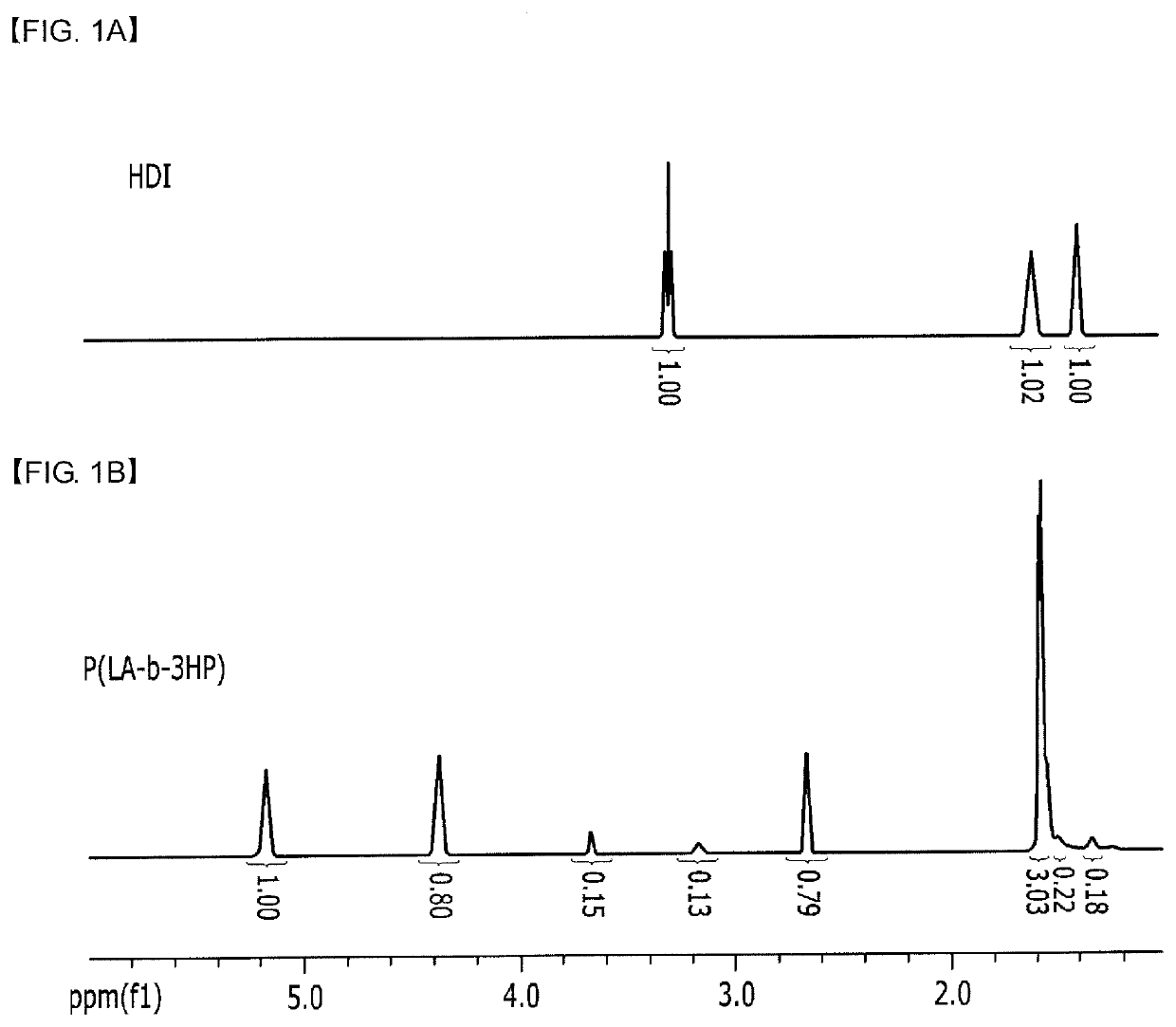
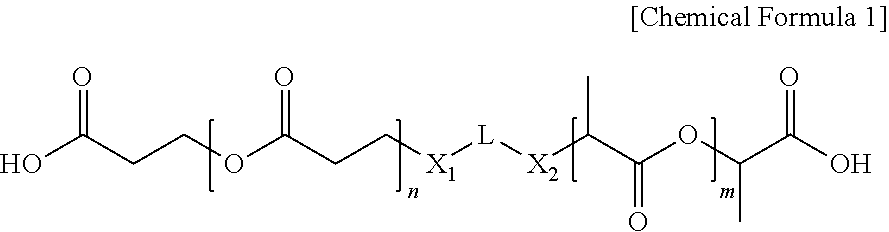
[0039]To a 500 mL round-bottom flask, 11 g (number of moles: 0.055 mmol, MW: 200,000 g / mol) of polylactic acid, 2.75 g (number of moles: 0.028 mmol, MW: 100,000 g / mol) of poly(3-hydroxypropionic acid), and 50 ml of toluene were introduced, and stirred at 180° C. for 1 hour. Thereafter, 1,6-hexamethylene diisocyanate (HDI, number of moles: 0.110 mmol, MW: 168.2 g / mol) was added thereto, and allowed to react at 180° C. for 30 minutes. Thereafter, the reaction product was dissolved in chloroform, and then extracted with methanol to recover a block copolymer of the following Chemical Formula 5.
the structure of the environmentally friendly knitted fabric provided by the present invention; figure 2 Flow chart of the yarn wrapping machine for environmentally friendly knitted fabrics and storage devices; image 3 Is the parameter map of the yarn covering machine
Login to View More PUM
| Property | Measurement | Unit |
|---|---|---|
| Temperature | aaaaa | aaaaa |
| Temperature | aaaaa | aaaaa |
| Temperature | aaaaa | aaaaa |
Login to View More
Abstract
Provided is a lactic acid-based block copolymer which is biodegradable while having excellent mechanical properties.
Description
CROSS-REFERENCE TO RELATED APPLICATION(S)[0001]The present application is based on, and claims priority from, Korean Patent Application No. 10-2018-0001716, filed on Jan. 5, 2018, the disclosure of which is hereby incorporated by reference herein in its entirety.FIELD OF THE INVENTION[0002]The present invention relates to a block copolymer which is biodegradable, while having excellent mechanical properties.BACKGROUND OF THE INVENTION[0003]A polylactic acid (PLA) resin is a plant-derived resin obtained from plants such as corn, etc., and has a biodegradable property. It suppresses depletion of petroleum-based resources and emits less carbon dioxide gas, unlike existing petroleum-based resins, such as a polystyrene resin, a polyvinyl chloride (PVC) resin, a polyethylene resin, etc., and thus reduces environmental pollution which is a disadvantage of petroleum-based plastic products. As environmental pollution caused by waste plastics and the like has caused social problems, efforts h...
Claims
the structure of the environmentally friendly knitted fabric provided by the present invention; figure 2 Flow chart of the yarn wrapping machine for environmentally friendly knitted fabrics and storage devices; image 3 Is the parameter map of the yarn covering machine
Login to View More Application Information
Patent Timeline
 Login to View More
 IPC IPC(8): C08G81/02C08G18/28C08G18/73C08G18/60
CPCC08G18/606C08G18/73C08G81/027C08G18/281C08G63/912C08G63/08C08G2230/00C08G69/44C08G81/00C08G63/6852
InventorCHOI, JUNG YUNKANG, HYE OKKANG, DONGGYUNCHO, YOUNGHYUNKIM, JAE HYUNGKIM, CHUL WOONGHUH, IN YOUNG
OwnerLG CHEM LTD