Unlock instant, AI-driven research and patent intelligence for your innovation.

Geolocation system

a geolocation and system technology, applied in the field of geolocation and wireless communication systems, can solve the problems of insufficient precision in the vertical direction of the geolocation system, especially indoor geolocation, and insufficient accuracy for reliable operation

Active Publication Date: 2021-01-21
PRICEWATERHOUSECOOPERS LLP
View PDF0 Cites 1 Cited by
  • Summary
  • Abstract
  • Description
  • Claims
  • Application Information

AI Technical Summary

Benefits of technology

The patent text describes an improved system for geolocation in indoor environments. The system uses low-power wireless devices and detects electromagnetic signals from native devices in the environment. It does not require dedicated beacons or one-to-one pairing with a mobile device. The system has better accuracy and reliability compared to existing systems. It also allows for communication over decreased bandwidth requirements and is cost-effective. The technical effects of the patent text are improved accuracy and reliability of geolocation in indoor environments, improved connectivity, and reduced reliance on dedicated beacons or one-to-one pairing with a mobile device.

Problems solved by technology

Known systems for geolocation, and particularly indoor geolocation, have several problems.
First, they are often not sufficiently accurate in the vertical direction, offering insufficient precision for reliably determining, for example, what floor of a building someone or something is located on.
Second, known systems that have attempted to address issues of vertical-axis accuracy for indoor geolocation have introduced additional problems.
Some systems rely on deploying arrays of dedicated beacon devices by which to triangulate a person or device, but these systems suffer from high costs due to the cost of deploying the dedicated beacon devices, and high costs in time and resources associated with maintaining beacon deployments.
Some systems rely on arrays of beacons included in specific devices such as Wi-Fi access points, but these systems suffer from inadequate coverage due to the specific devices only being in range of certain areas of an environment being monitored.
Failures in beacon-based systems may be caused, for example, by beacon devices being unplugged / losing power, damaged, or stolen; or by incomplete coverage of an environment due to the requirement that all regions of the environment be covered by a functioning dedicated device at all times. Furthermore, many indoor geolocation systems suffer from poor reliability due to the requirement that location devices used to locate their carriers (e.g., wearable devices) are required to repeatedly pair and re-pair to different Wi-Fi access points, which is a process that is and failure-prone, or the requirement that location devices pair to a smart phone or tablet, which requires every person to carry an expensive device that is constantly connected to the internet.

Method used

the structure of the environmentally friendly knitted fabric provided by the present invention; figure 2 Flow chart of the yarn wrapping machine for environmentally friendly knitted fabrics and storage devices; image 3 Is the parameter map of the yarn covering machine
View more

Image

Smart Image Click on the blue labels to locate them in the text.
Viewing Examples
Smart Image
  • Geolocation system
  • Geolocation system
  • Geolocation system

Examples

Experimental program
Comparison scheme
Effect test

Embodiment Construction

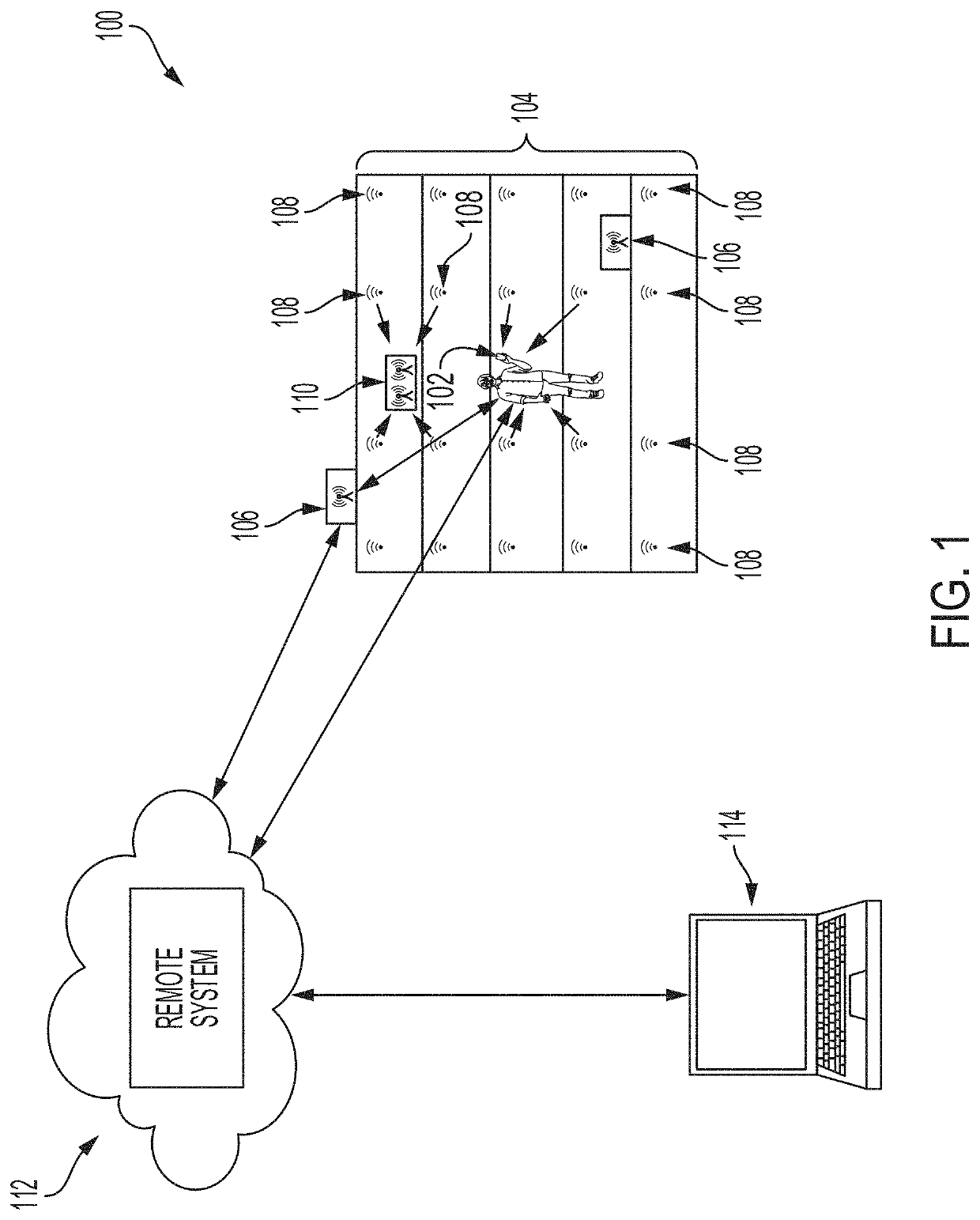
[0057]As described above, in some embodiments, a system for indoor geolocation determines a location of a mobile electronic device, such as a wearable device, within a three-dimensional indoor environment. In some embodiments, the system comprises the mobile electronic device to be located, a plurality of low-power wide-area network (LPWAN) devices deployed in and / or around the indoor environment, and a plurality of resident electronic devices native to the indoor environment that emit electromagnetic signals. In some embodiments, the geolocation system operates in accordance with at least two stages: a calibration or mapping stage, followed by a device geolocation stage.

[0058]Below, FIG. 1 depicts an exemplary system for indoor geolocation; FIGS. 2A-B and 3A-B depict exemplary mobile electronic devices (e.g., geolocation devices) to be located in a system for indoor geolocation; FIGS. 4 and 5 show flowcharts depicting methods for indoor geolocation; FIGS. 6A-6K depict graphical use...

the structure of the environmentally friendly knitted fabric provided by the present invention; figure 2 Flow chart of the yarn wrapping machine for environmentally friendly knitted fabrics and storage devices; image 3 Is the parameter map of the yarn covering machine
Login to View More

PUM

No PUM Login to View More

Abstract

An indoor geolocation system for determining a location in three-dimensional space includes a plurality of base stations and a mobile device movable about an indoor environment in three dimensions. The mobile device detects electromagnetic signals in the indoor environment emitted by devices other than the base stations, and generates a signal profile based on the signals. The mobile device transmits the signal profile to one or more of the base stations, which forward the signal profile to a remote server. The system determines a location of the in three-dimensional space of the mobile device by comparing the signal profile to data regarding signal profiles at a plurality of locations in the indoor environment. The data regarding signal profiles in the indoor environment may have been captured by a detection device other than the mobile device at a time prior to the detection of the electromagnetic signals by the mobile device.

Description

CROSS-REFERENCE TO RELATED APPLICATIONS[0001]This application is a continuation of U.S. patent application Ser. No. 16 / 657,623, filed Oct. 18, 2019, which claims the benefit of U.S. Provisional Application No. 62 / 855,320, filed May 31, 2019, U.S. Provisional Application No. 62 / 811,805, filed Feb. 28, 2019, and U.S. Provisional Application No. 62 / 748,079, filed Oct. 19, 2018, the entire contents of each of which are incorporated herein by reference.FIELD OF THE DISCLOSURE[0002]This disclosure relates generally to geolocation and to wireless communication systems, and more specifically to improved systems and methods for geolocation, including indoor geolocation with improved accuracy in the vertical (e.g., z-axis direction), and to wireless alarm devices, systems, and related techniques.BACKGROUND OF THE DISCLOSURE[0003]Geolocation systems are used to determine locations of persons and objects, and have many applications in transportation, logistics, asset tracking, systems monitorin...

Claims

the structure of the environmentally friendly knitted fabric provided by the present invention; figure 2 Flow chart of the yarn wrapping machine for environmentally friendly knitted fabrics and storage devices; image 3 Is the parameter map of the yarn covering machine
Login to View More

Application Information

Patent Timeline
no application Login to View More
Patent Type & Authority Applications(United States)
IPC IPC(8): H04W4/33H04W4/80H04W80/02H04W64/00G01S5/16H04B17/318H04W52/02G01S5/00
CPCH04W4/33H04W4/80H04W80/02G01S5/0054G01S5/16H04B17/318H04W52/0261H04W64/003H04W64/006H04W4/02H04W4/70H04L67/30G01S5/0252G01S5/02528G01S5/02525
Inventor MESIROW, ROBERTMASSEY, ALECYAUNG, DEVIN
Owner PRICEWATERHOUSECOOPERS LLP