Unlock instant, AI-driven research and patent intelligence for your innovation.

Recursive artificial intelligence neuromodulation system

a neuromodulation system and artificial intelligence technology, applied in mental therapies, diagnostic recording/measuring, therapy, etc., can solve the problems of limiting the duration of how long a patient can participate in a bci protocol, patients with chronic pain are known to have reduced attention, and become attention fatigued

Pending Publication Date: 2021-09-23
WASHINGTON UNIV IN SAINT LOUIS
View PDF0 Cites 0 Cited by
  • Summary
  • Abstract
  • Description
  • Claims
  • Application Information

AI Technical Summary

Benefits of technology

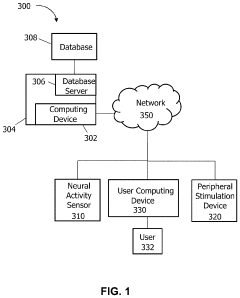
The patent describes a brain-computer interface (BCI) system that can detect and modify the neural activity in a person's brain to control their behavior. The system includes a neural activity sensor, a peripheral stimulation device, and a computing device that uses an artificial intelligence model to generate the stimulation based on the detected neural activity signals. The system can also receive a target neural state and iteratively modify the stimulation pattern to match the modified neural state to the target state. The technical effect of this technology is to provide a means for controlling the behavior of a person with higher precision and accuracy using a non-invasive and safe method.

Problems solved by technology

One challenge associated with BCI-implemented treatments as described above is that patients can become attentionally fatigued over the course of a treatment session, thus limiting the duration for how long a patient can participate in a BCI protocol.
Further, patients with chronic pain are known to have reduced attention.

Method used

the structure of the environmentally friendly knitted fabric provided by the present invention; figure 2 Flow chart of the yarn wrapping machine for environmentally friendly knitted fabrics and storage devices; image 3 Is the parameter map of the yarn covering machine
View more

Image

Smart Image Click on the blue labels to locate them in the text.
Viewing Examples
Smart Image
  • Recursive artificial intelligence neuromodulation system
  • Recursive artificial intelligence neuromodulation system
  • Recursive artificial intelligence neuromodulation system

Examples

Experimental program
Comparison scheme
Effect test

example 1

Frequency of Tactile Stimulation on Electrophysiological Responses

[0144]To assess the effect of tactile stimulations on electrophysiological responses, the following experiments were conducted.

[0145]A BRI system similar to the system illustrated in FIG. 26 and as described herein was used to conduct these experiments. A wearable EEG dry electrode array containing 24 electrodes distributed over the scalp of the subject and configured to record EEG signals at a variety of regions, including a frontal pole (Fp) region, a central (C) region, a parietal (P) region, an occipital (O) region, and a temporal (T) region. The peripheral stimulation device used in these experiments was a tactile stimulation device that included two arrays of motor discs similar to the arrays shown illustrated in FIG. 11. The arrays were configured to administer a tactile stimulus pattern delivered at a characteristic stimulus frequency.

[0146]The wearable EEG electrode array and peripheral stimulation device wer...

the structure of the environmentally friendly knitted fabric provided by the present invention; figure 2 Flow chart of the yarn wrapping machine for environmentally friendly knitted fabrics and storage devices; image 3 Is the parameter map of the yarn covering machine
Login to View More

PUM

No PUM Login to View More

Abstract

A brain-computer interface (BCI) system for modifying a subject's neural state are described that includes a neural activity sensor and a peripheral stimulation device operatively coupled to a computing device. A method of modifying a neural state of a subject is provided that includes receiving a target neural state from a system operator; detecting baseline neural activity signals; transforming the baseline neural activity signals into a peripheral stimulation pattern using an artificial intelligence model; administering a peripheral stimulation to the subject; detecting modified neural activity signals; and iteratively modifying the peripheral stimulation pattern to achieve a target neural state.

Description

CROSS-REFERENCE TO RELATED APPLICATIONS[0001]This application claims priority from U.S. Provisional Application Ser. 62 / 971,714 filed on Feb. 7, 2020, which is incorporated herein by reference in its entirety.STATEMENT REGARDING FEDERALLY SPONSORED RESEARCH OR DEVELOPMENT[0002]Not applicable.FIELD OF THE DISCLOSURE[0003]The present disclosure generally relates to devices, systems, and methods that make use of brain-computer interfaces (BCIs) to modify a neural state of a subject.BACKGROUND OF THE DISCLOSURE[0004]Brain computer interface (BCI) systems have emerged as a method to restore function and enhance communication in motor-impaired patients. To date, BCIs have been primarily applied to patients suffering compromised motor neuron outflow due to spinal cord dysfunction, despite an intact and functioning cerebral cortex. BCIs have also been used to treat stroke survivors with damaged hemispheres. In BCI-implemented stroke treatments, stroke survivors are trained to intentionally ...

Claims

the structure of the environmentally friendly knitted fabric provided by the present invention; figure 2 Flow chart of the yarn wrapping machine for environmentally friendly knitted fabrics and storage devices; image 3 Is the parameter map of the yarn covering machine
Login to View More

Application Information

Patent Timeline
no application Login to View More
Patent Type & Authority Applications(United States)
IPC IPC(8): A61M21/00
CPCA61M21/00A61M2230/10A61M2021/0022A61M2021/0066A61M2021/0027A61M2021/0044A61M2021/0072A61M2205/3592A61M2205/3553A61M2209/088A61M2210/0693A61M2205/3584A61M2205/505A61M2205/332A61N1/0452A61N1/0456A61N1/3603G16H20/70G16H50/20G16H50/30G16H40/63A61B5/165A61B5/4836A61M2230/005
Inventor LEUTHARDT, ERIC
Owner WASHINGTON UNIV IN SAINT LOUIS