
Phosphate polymers
a phosphate polymer and polymer technology, applied in the field of phosphate polymers, can solve the problems of not having an ionizable phosphate group, negative impact on the aquatic environment, and build-up and yellowing of the substrate on which they are applied, and achieve the effect of less penetration of the skin
- Summary
- Abstract
- Description
- Claims
- Application Information
AI Technical Summary
Benefits of technology
Problems solved by technology
Method used
Image

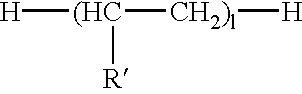
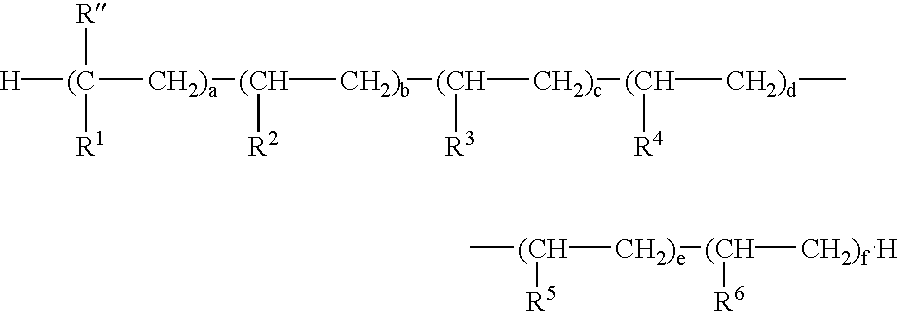
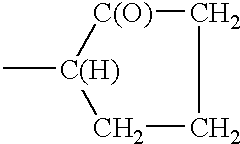
Examples
example 33
To the 5,000 grams of deionized water, which has just been sparged with nitrogen for 30 minutes, is added the specified amount 5,000 grams of the specified allyl phosphate monomer Ex #13 under good agitation and nitrogen sparge. The temperature is raised to about 50 C. Once the temperature has reached 50 and the nitrogen has been bubbled through the reaction mass for thirty minutes, 0.05% by weight of batch of azobisisobutylnitrile. The catalyst may be optimally added in smaller increments of one quarter of the total needed waiting 30 minutes between additions. The viscosity will raise as the polymerization occurs. The temperature raises to about 90 C. and is cooled with cooling water as needed to prevent the temperature from reaching 90 C. The molecular weight is controlled by viscosity. When the desired viscosity is achieved, air is bubbled through the vessel to quench the polymer. The desired polymer is used as prepared.
examples 33-52
Example 33 is repeated only substituting the allyl phosphate monomer for example 13 used in example 49.
Preparation of Phosphate Hetero-polymers
The vinyl containing compounds that were homo-polymerized in example 33-52 can be polymerized with other vinyl containing, free radical reactive monomers. These so-called heteropolymers have added functionality and provide unique properties.
Preparation of Hetero-polymers
examples 65-93
General Polymerization Procedure
The polymerization of the vinyl containing meadowfoam esters is achieved by utilizing free radical catalyst in a low oxygen containing solvent, most commonly water. The water is deionized and sparged with nitrogen to remove dissolved oxygen contained therein immediately prior to use. Then, the specified amount of the treated de-ionized water is added to a suitable glass vessel. Most commonly, 50 to 80% of the total weight of the batch is water. The specified amount of the specified monomers are then added under agitation. Nitrogen is continuously sparged and the temperature is raised to about 50 C. Once the temperature has reached 50 and the nitrogen has been bubbled through the reaction mass for thirty minutes, a free radical initiator is added. Many peracids, like t-butyl-perbenzoate, t-butyl-hydroperoxide and inorganic free radical initiators like stannic chloride can be used. The preferred initiator is azobisisobutyl-nitrile. The reaction is exoth...
PUM
| Property | Measurement | Unit |
|---|---|---|
| generic structure | aaaaa | aaaaa |
| composition | aaaaa | aaaaa |
| temperatures | aaaaa | aaaaa |
Abstract
Description
Claims
Application Information
 Login to View More