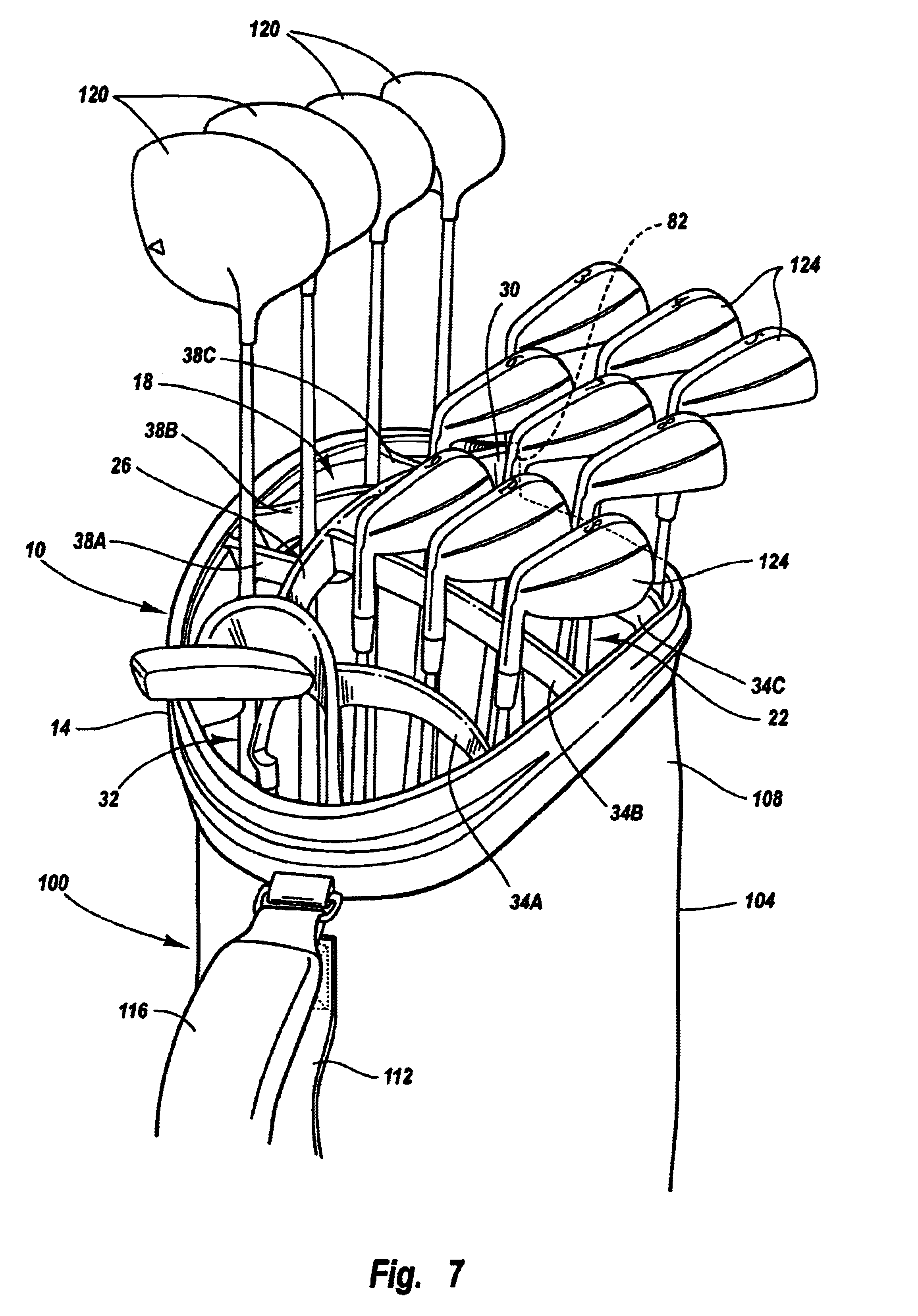
In light of the prior art deficiencies discussed above, the present invention seeks to provide a more efficient means for housing and positioning golf clubs within a golf bag, as well as providing a more efficient way to access and retrieve these golf clubs from an ergonomic standpoint, especially during a round of golf. Therefore, in accordance with the invention as embodied and broadly described herein, the present invention features an ergonomically designed golf bag top and club separator.
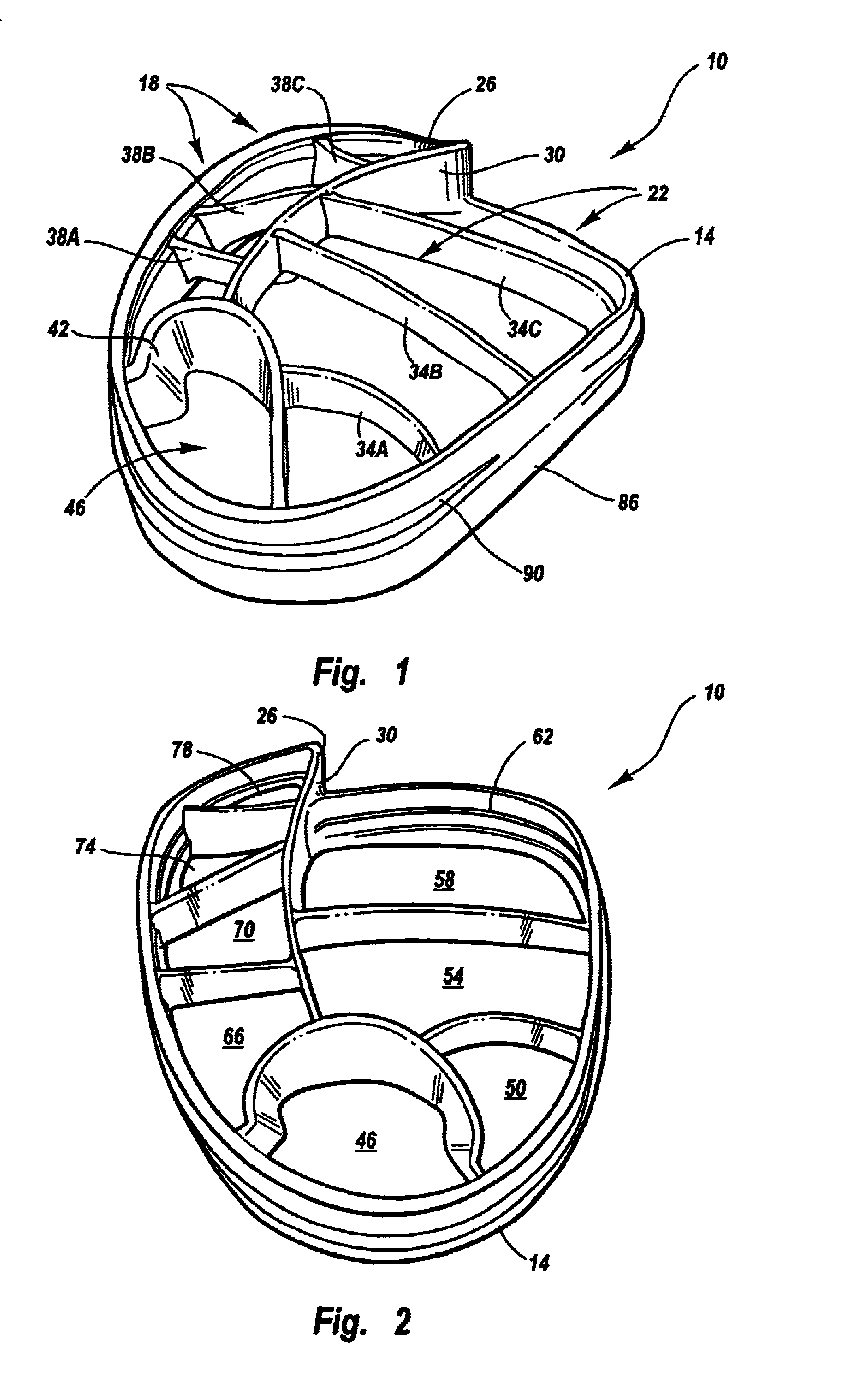
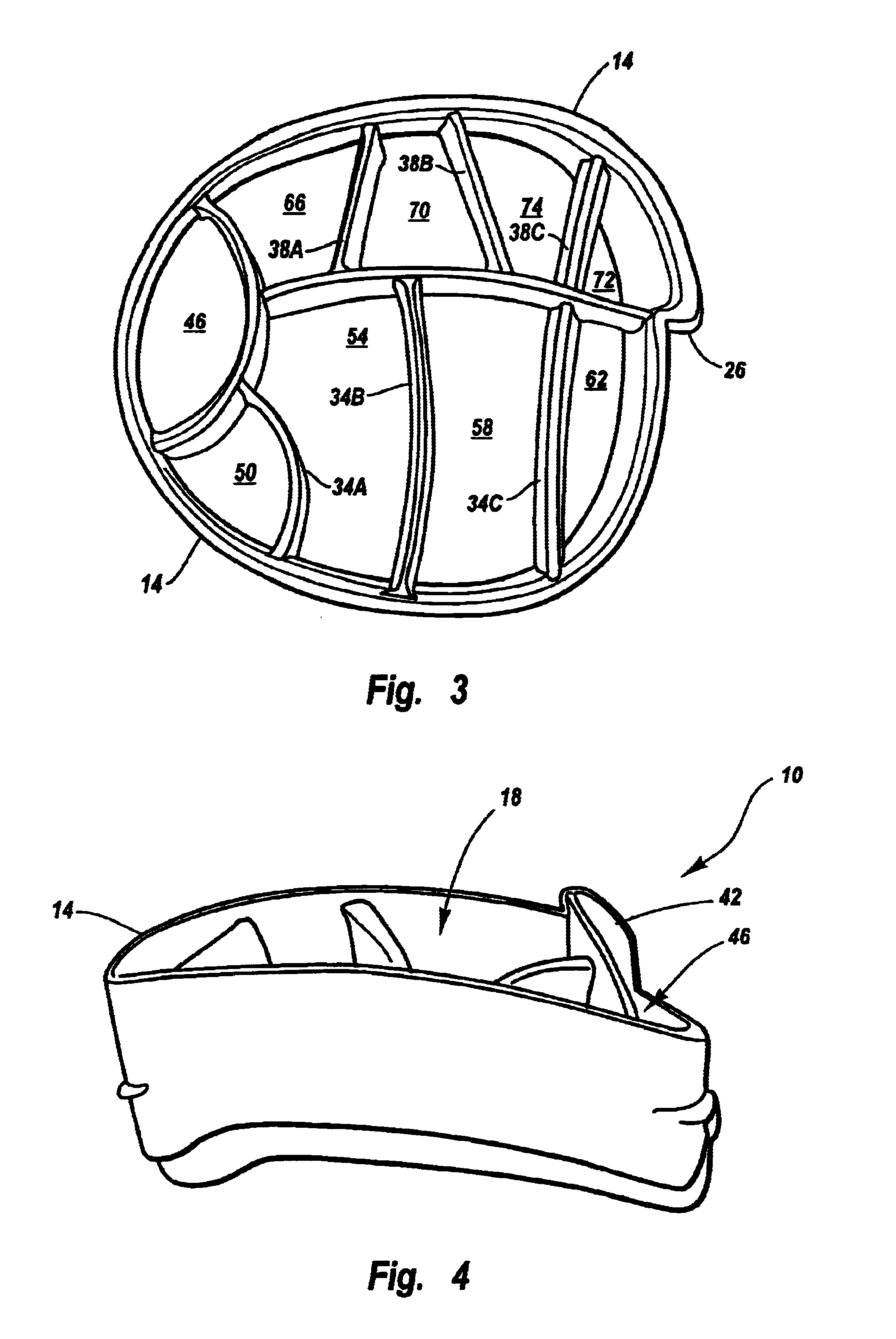
In a preferred embodiment, the golf bag top and club separator comprises: (a) a perimeter support member having a contoured profile and periphery so as to provide optimal wood and iron separation as well as optimal ergonomic club access; (b) a wood complex for housing wood-type golf clubs, wherein the wood complex is oriented to one side of a vertical bisector, oriented parallel to the user when in use so as to allow wood-type
golf club placement and positioning therein along a continuum, the wood complex parallel to the user comprising a plurality of wood dividers therein to define a plurality of wood compartments. An
iron complex for housing iron-type golf clubs is located on the other side of the vertical bisector, wherein the
iron complex is positioned opposite of the wood complex, the iron complex comprising a plurality of iron dividers therein to define a plurality of iron compartments. A wood / iron partition separating the wood complex from the iron complex is aligned along a generally parallel axis to the user, the partition reducing the opportunity for contact between any iron-type golf clubs housed within the iron complex and any wood-type golf clubs housed within the wood complex. The present invention further features a putter complex wherein the putter complex comprises a putter divider separating the putter complex from either the wood complex, the iron complex, or both.
In each of the embodiments discussed herein, it is emphasized that the wood and iron complexes are always separated so that all of the woods are either close to the user (proximal) or all away from the user (distal). Situating the wood complex in a distal position has several advantages including, easier access and retrieval of both iron and wood-type golf clubs placed within the golf bag and more ergonomically correct positioning for carrying.
As a result of the strategic design of the perimeter support member, the wood complex can situate the wood-type golf clubs away from the body of the user at all times. Stated another way, the wood complex of one embodiment of the present invention is positioned within the golf bag top and club separator so that the wood-type golf clubs are always inserted and stored within the golf bag at a location distal the body of the user. In addition, the wood complex provides for vertical segregation, or are vertically segregated, rather than horizontal segregation as found in most prior art designs. In addition, the relative placement of the wood complex with respect to the iron complex reduces interference between the woods and irons. Moreover, because there is less contact between these two types of clubs, there is less chance for the clubs to become scratched, dented, or otherwise damaged.
Finally, in another embodiment, the perimeter support member may comprise multiple-levels in both its longitudinal and lateral directions. In addition to these multiple levels, the perimeter support member comprises a perimeter rise allowing the perimeter support member to comprise a lower profile, and to accommodate the positioning of the wood complex and iron complex. This perimeter rise also exposes a greater portion of the golf clubs housed within the golf bag, thus making it easier for the golfer to access and retrieve the golf clubs.



 Login to View More
  Login to View More