Methods for separating and/or identifying DNA molecules
a dna and methyl cellulose technology, applied in the field of separating and/or identifying dna molecules, can solve the problems of increased difficulty in graft failure, difficult to separate alleles from a mixture of alleles, and difficult to separate alleles, so as to improve the effect of mismatches
- Summary
- Abstract
- Description
- Claims
- Application Information
AI Technical Summary
Benefits of technology
Problems solved by technology
Method used
Image



Examples
example 1
Seperation of HLA Allelic Strands by CSA
1. Methods
1.1 Summary
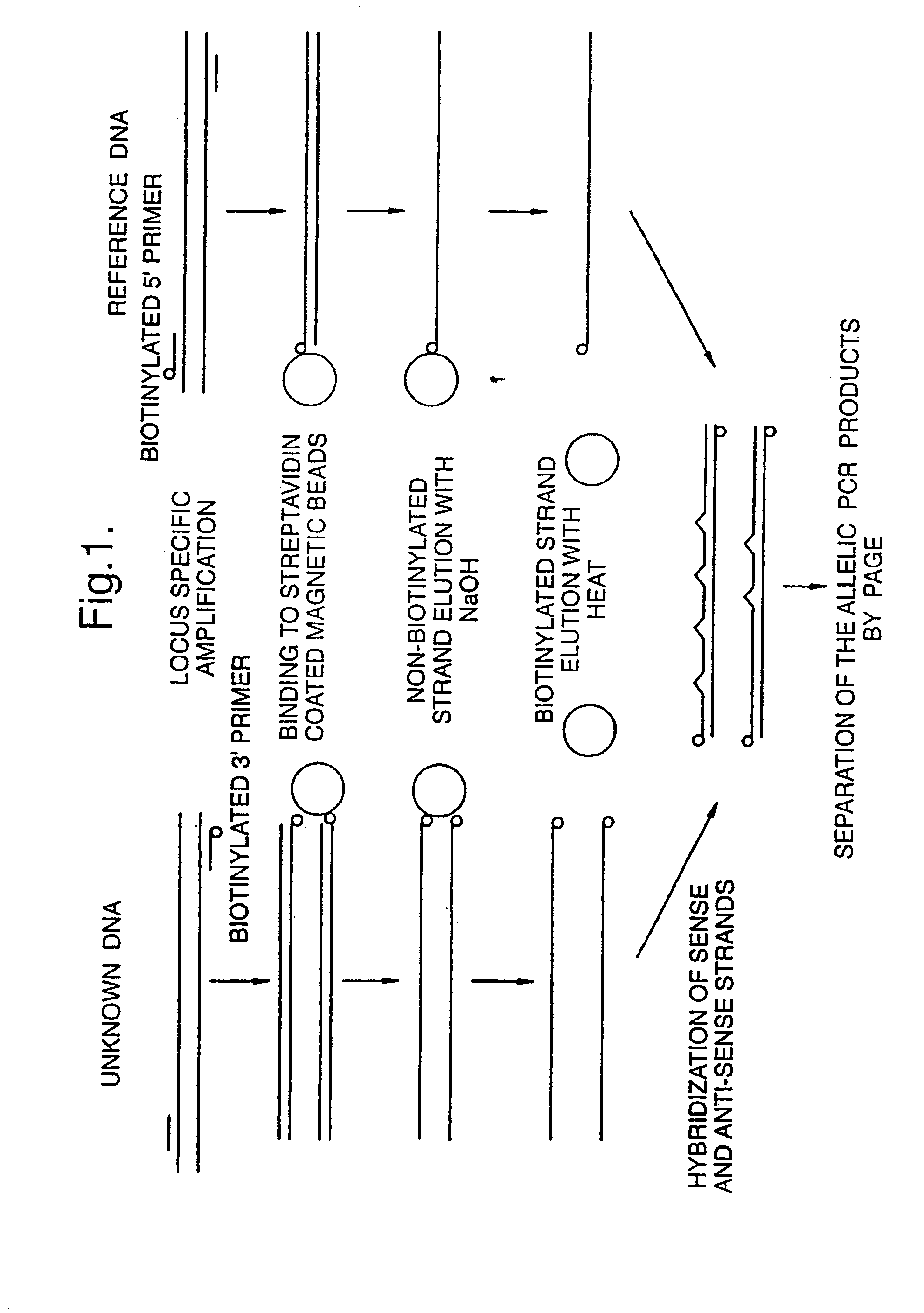
[0157]Amplification and isolation of the biotinylated anti-sense strand(s) were performed. They were then hybridised with allele specific reference sense single strands.
[0158]In order to test the resolving power of this method, 7 allele specific reference sense single strands were prepared. These were hybridised with several isolated anti-sense strand HLA-A alleles which were selected to include alleles with one or several nucleotide differences compared to the reference strand.
[0159]Following this step, PAGE analysis was performed under non-denaturing conditions (urea at a range of 2-6 M and formamide between 10%-30% concentrations were included in other experiments) and the gels were run at either room temperature or 50-58° C. (200 Volts for 6 hours).
[0160]The identification of a single band in PAGE gels indicated identity between the allele and the reference strand and homozygosity of the sample.
[0161]As a positive cont...
example 2
Seperation of EXON 13 Mutations of Cystic Fibrosis Gene
[0192]CSA can be used for the isolation of any polyallelic gene. This example shows the analysis of the cystic fibrosis gene. The largest encoded exon of this gene is exon 13. Samples from an unaffected individual which is homozygous for the wild type exon 13 and samples from two mutations were prepared and analysed by CSA. The mutation samples were from individuals with a single base deletion 2603delT(36) and a single nucleotide substitution at position 709-R709X(37). These samples had previously been typed by other methods.
[0193]PCR amplification of the exon 13 of the cystic fibrosis gene was performed as described in Zielenski et al(38) except that the 5′ primer was biotinylated at the 5′ end. The reference strand was prepared from the wild type sample and after the preparation of the single strands from three samples as described in example 1, these were hybridised with the reference strand and analysed in non-denaturing PAG...
example 3
Allelic Identification by Double Strand Conformation Analysis (DSCA)
[0194]This Example shows how DNA fragments from a particular segment of a genome can be analysed and identified using a labelled reference strand without isolation of the duplex from the analysis phase. The Example uses specific reference strands for HLA-A, B and Cw alleles.
[0195]The reference strands were prepared using sense primers for the three loci, which had fluorescent dye (Pharmacia Ltd) at the 5′-end. These were not biotinylated. Separate PCR reactions were performed for each locus to produce the reference reagents. The primer sequences and PCR conditions were as described above in Example 1 and the amplified reference strands included exons 2 and 3, intron 2 and short segments from introns 1 and 3 of each locus. Lymphoblastoid, homozygous cell lines were used for each locus amplification and a number of reference strands were tested in order to obtain optimum separation and least ambiguity in the identific...
PUM
| Property | Measurement | Unit |
|---|---|---|
| molecular weight | aaaaa | aaaaa |
| molecular weight | aaaaa | aaaaa |
| temperature | aaaaa | aaaaa |
Abstract
Description
Claims
Application Information
 Login to View More