Supercharge Your Innovation With Domain-Expert AI Agents!

Element for wavelength conversion and/or optical computing

a technology of optical computing and elements, applied in the field of elements for wavelength conversion and/or optical computing, can solve the problems of inability to obtain accurate computing results, difficult retention of pulse shapes, and inability to improve conversion efficiency and computing efficiency

Inactive Publication Date: 2006-09-12
INTER UNIV RES INST NAT INST OF NATURAL SCI
View PDF2 Cites 9 Cited by
  • Summary
  • Abstract
  • Description
  • Claims
  • Application Information

AI Technical Summary

Problems solved by technology

However, when the present inventors studied wavelength conversion behavior of the above-mentioned conventional poled structure element, it was found that, when a pulsed light is handled, the incident light and the outgoing light are separated in space and in time, along with the propagation of the light, due to a difference in the group velocity between the incident light and the outgoing light, and as a result, the following various problems such as those described below occur.
In contrast, when a short pulsed light is to be handled, such as pulse-number 1 Tbit / sec or above (=pulse width 1 ps or below), the incident light and the outgoing light are separated due to a difference in the group velocity between them, posing a problem in that the conversion efficiency and computing efficiency are not improved even if the element length is prolonged.
A problem also occurs in that, as a result of wavelength conversion, the pulse width of the outgoing light is extended depending on the difference in the group velocity, making retention of the pulse shape difficult, and accurate computing results cannot be obtained.
In some cases, a problem also occurs in that pulses before and behind in the pulse train interfere with each other and produce serious errors in computing.

Method used

the structure of the environmentally friendly knitted fabric provided by the present invention; figure 2 Flow chart of the yarn wrapping machine for environmentally friendly knitted fabrics and storage devices; image 3 Is the parameter map of the yarn covering machine
View more

Image

Smart Image Click on the blue labels to locate them in the text.
Viewing Examples
Smart Image
  • Element for wavelength conversion and/or optical computing
  • Element for wavelength conversion and/or optical computing
  • Element for wavelength conversion and/or optical computing

Examples

Experimental program
Comparison scheme
Effect test

examples

[0032]In the Examples, an SHG element having an incident light wavelength of 1.5 μm (central wavelength 1.55 μm) was actually formed using MgO doped LiNbO3 as a nonlinear optical crystal, a pulse train was projected and the conversion efficiency was examined.

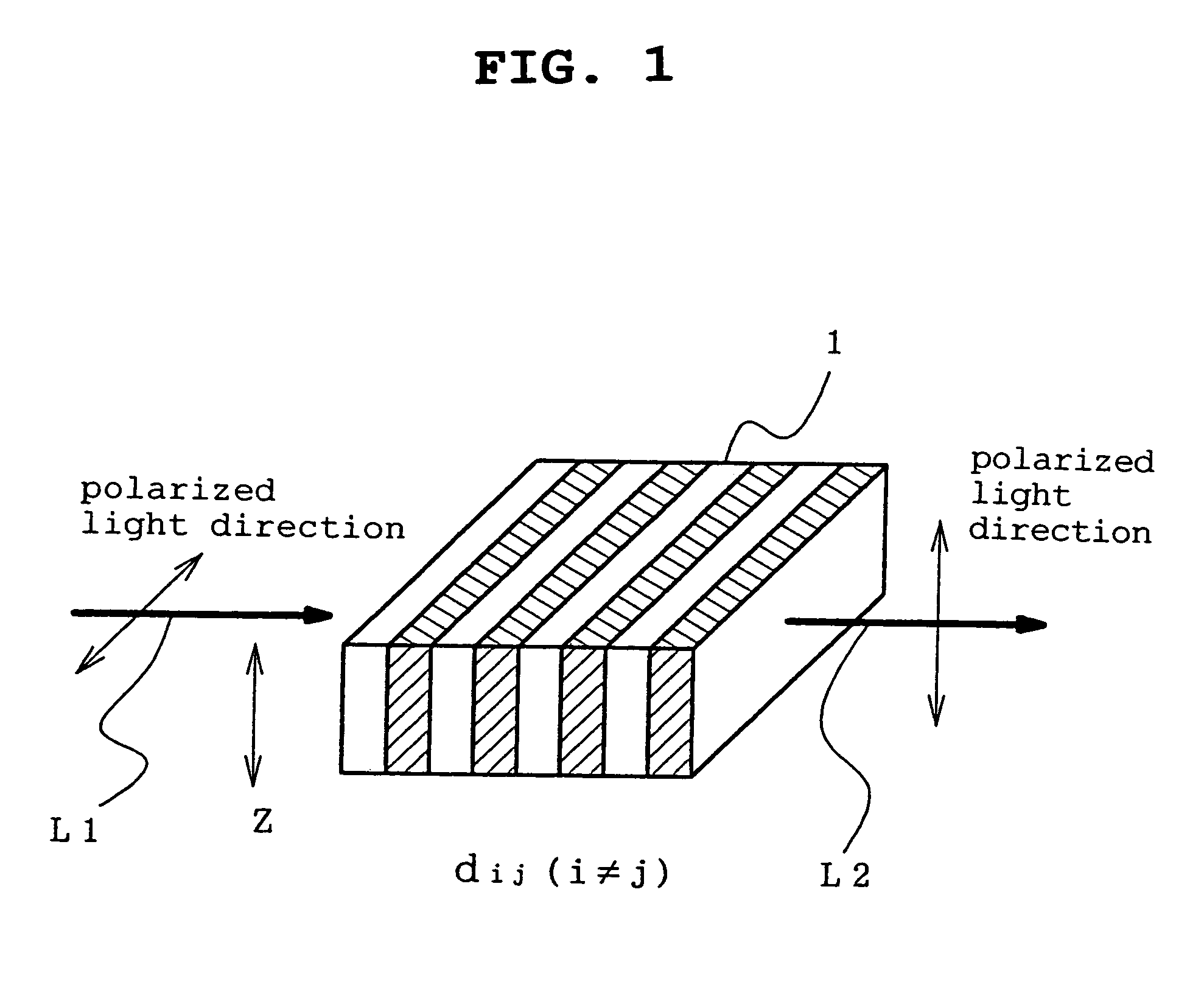
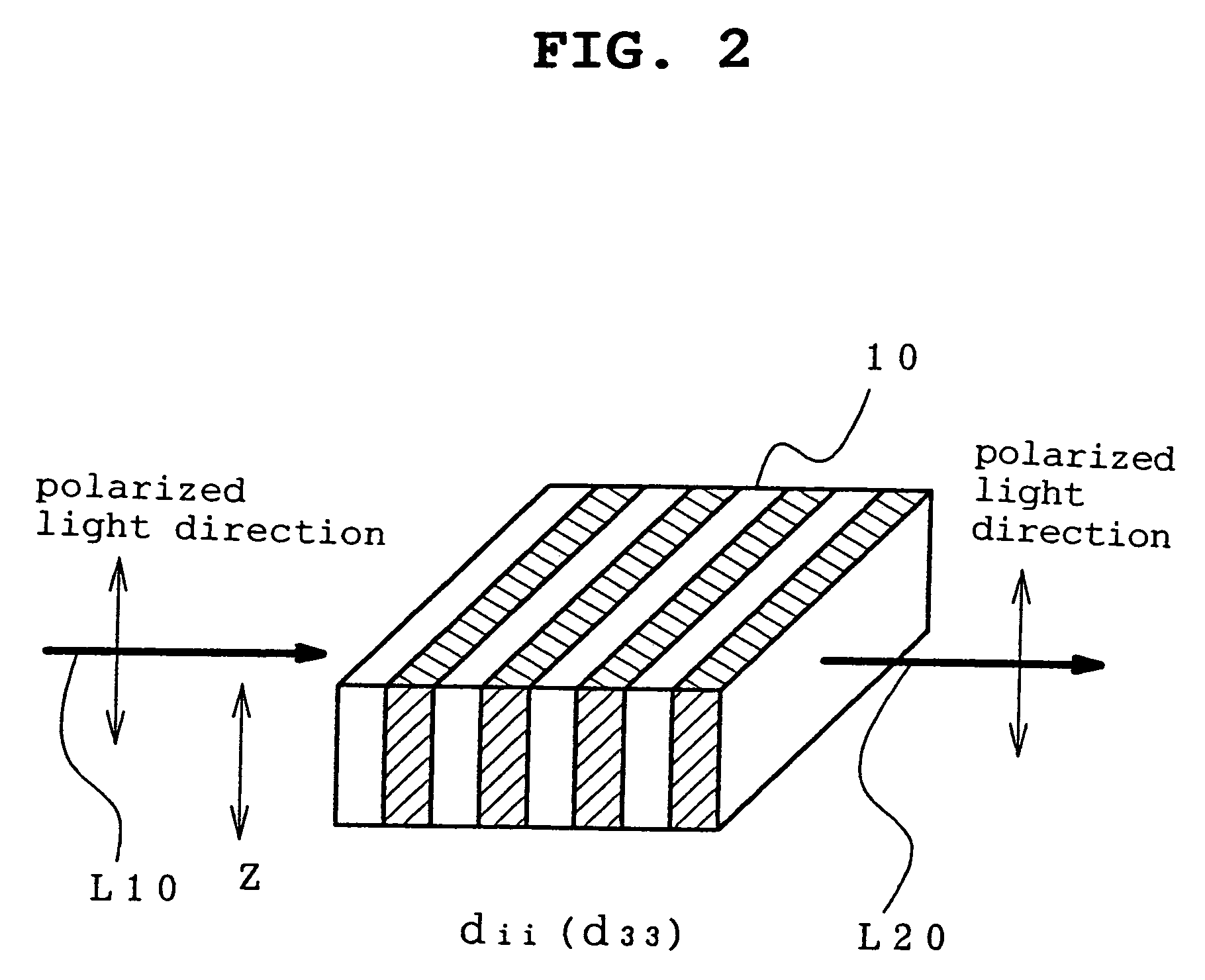
[0033]The polarization reversal period was set to 20 μm, the polarized light direction of the incident light and the outgoing light (SHG light: 0.78 μm) was determined, and the nonlinear optical constant d31 of MgO doped LiNbO3 was utilized to satisfy the group velocity matching conditions and quasi-phase matching conditions of the incident light and the outgoing light. The production step is shown in detail in the following.

[0034]As the crystal substrate material, a +z cut MgO doped LiNbO3 crystal substrate processed into a single domain and having a thickness of 0.5 mm and the entire length in the optical path direction (=element length) of 10 mm was used. The +Z-plane and −Z-plane of the crystal substrate were optically polis...

the structure of the environmentally friendly knitted fabric provided by the present invention; figure 2 Flow chart of the yarn wrapping machine for environmentally friendly knitted fabrics and storage devices; image 3 Is the parameter map of the yarn covering machine
Login to View More

PUM

PropertyMeasurementUnit
wavelengthaaaaaaaaaa
lengthaaaaaaaaaa
Login to View More

Abstract

When forming a periodically-poled structure on a nonlinear optical crystal 1 that permits wavelength conversion and / or optical computing, the group velocity matching conditions are determined to synchronize the group velocity of the incident light L1 with that of the outgoing light L2, and the polarization reversal period of the periodically-poled structure is determined to satisfy quasi-phase matching conditions for the aforementioned wavelength conversion and / or optical computing. As a result, the problems associated with wavelength conversion of the pulsed light due to a difference in the group velocity are suppressed.

Description

TECHNICAL FIELD[0001]The present invention belongs to the technical field of a nonlinear optical crystal and particularly relates to an element for wavelength conversion and / or optical computing, which is equipped with a periodically-poled structure for wavelength conversion or optical computing by a quasi-phase matching method.BACKGROUND ART[0002]Nonlinear optical crystals such as LiNbO3, LiTaO3 and the like have been preferably used as materials of elements used for wavelength conversion such as second harmonic generation (SHG), optical parametric oscillation, optical parametric generation (including amplification), difference frequency generation, sum-frequency generation and the like.[0003]As a means for satisfying the phase matching conditions for such wavelength conversion, quasi-phase matching (QPM) including formation of a periodically-poled structure (hereinafter to be also referred to as a “poled structure”) on a nonlinear optical crystal has been actively conducted in rec...

Claims

the structure of the environmentally friendly knitted fabric provided by the present invention; figure 2 Flow chart of the yarn wrapping machine for environmentally friendly knitted fabrics and storage devices; image 3 Is the parameter map of the yarn covering machine
Login to View More

Application Information

Patent Timeline
no application Login to View More
Patent Type & Authority Patents(United States)
IPC IPC(8): G02F1/355G02F1/37G02F1/377G02F1/39G02F3/00
CPCG02F1/3775
Inventor KURIMURA, SUNAOTAIRA, TAKUNORITANIGUCHI, HIROKAZU
Owner INTER UNIV RES INST NAT INST OF NATURAL SCI
Features
  • R&D
  • Intellectual Property
  • Life Sciences
  • Materials
  • Tech Scout
Why Patsnap Eureka
  • Unparalleled Data Quality
  • Higher Quality Content
  • 60% Fewer Hallucinations
Social media
Patsnap Eureka Blog
Learn More