Efficient, robust file handle invalidation

a file handle and robust technology, applied in the field of storage systems, can solve the problems of data recovery problems, failure of filer's backup nvram, power loss, etc., and achieve the effect of reducing coding overhead, reducing processing costs, and fast performan

US7117303B1Active Publication Date: 2006-10-03NETWORK APPLIANCE INC
7 Cites 31 Cited by

Patent Information

Authority / Receiving Office
US · United States
Current Assignee / Owner
Publication Date
2006-10-03

Smart Images

  • Figure 1
    Figure 1
  • Figure 2
    Figure 2
  • Figure 3
    Figure 3
Patent Text Reader

Abstract

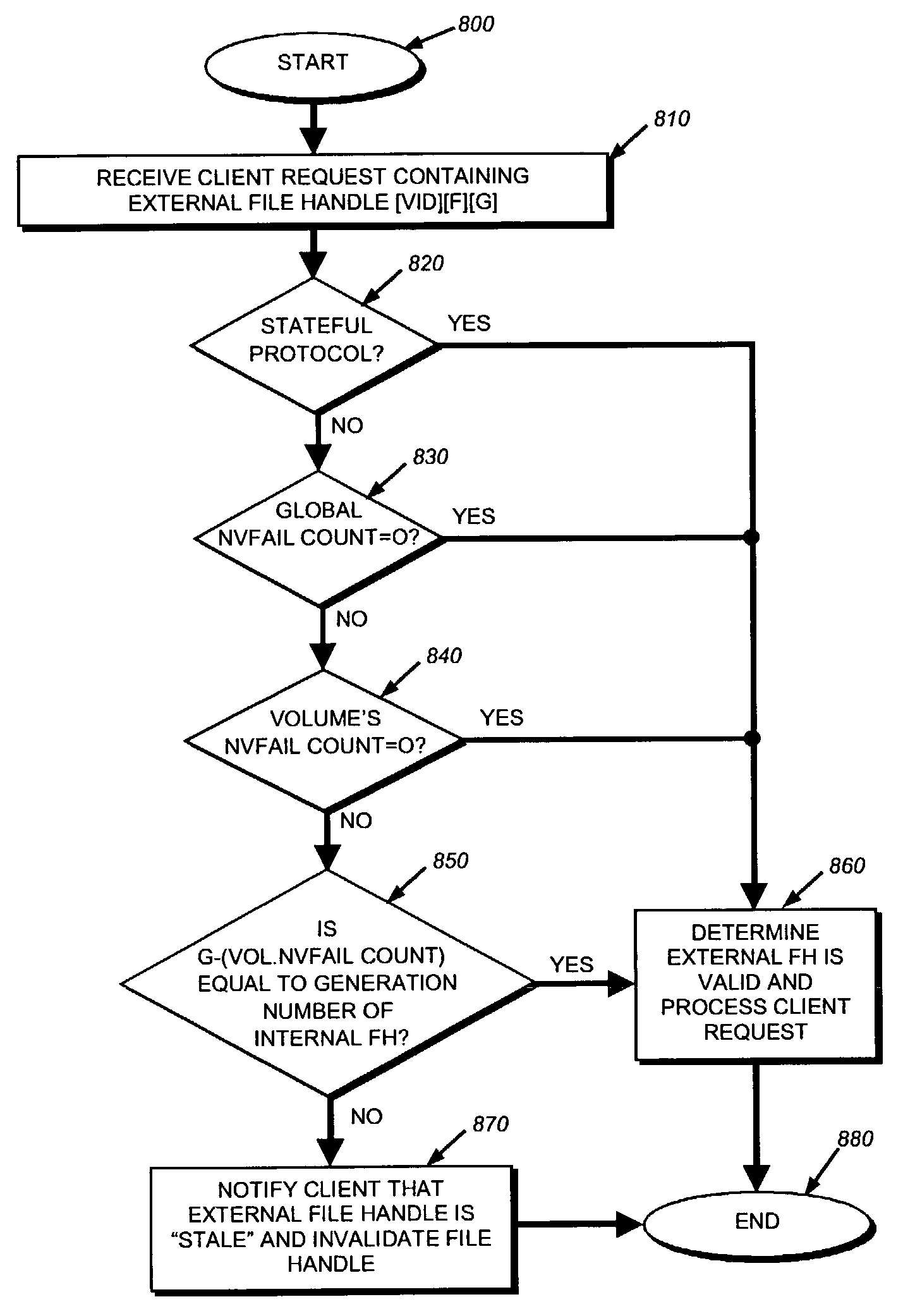
The present invention provides a technique for efficiently generating and validating external file handles at a storage operating system of a filer. According to one aspect of the technique, the storage operating system associates a unique internal file handle with each file or directory stored in the filer. This unique internal file handle is used to generate a corresponding external file handle. Unlike previous approaches, the internal file handles' representations do not change depending on the location of their corresponding files or directories, e.g., on-disk or in-core, within the filer, thereby simplifying file management within the filer. According to another aspect of the inventive technique, the filer executes a file-handle validation procedure to determine whether an external file handle received with a file access request has become invalid (or “stale”) as a result of an NVRAM failure in the filer. The file-handle validation procedure enables the filer to efficiently determine the validity of the external file handle without having to perform conventional time-consuming and processing-intensive operations. Advantageously, the inventive technique is preferably only applied to generation and validation of external file handles configured in accordance with a stateless file-system protocol, such as the NFS protocol. In this way, there is no overhead added to the filer's storage operating system for generating and validating external file handles configured in accordance with stateful file-system protocols.
Need to check novelty before this filing date? Find Prior Art

Description

FIELD OF THE INVENTION

[0001] The present invention relates to storage systems and, more specifically, to a technique for generating and validating file handles used to access files stored on a storage system.BACKGROUND OF THE INVENTION

[0002] A file server is a computer that provides file service relating to the organization of information on storage devices, such as disks. The file server or filer may be embodied as a storage system including a storage operating system that implements a file system to logically organize the information as a hierarchical structure of directories and files on the disks. Each “on-disk” file may be implemented as a set of disk blocks configured to store information, such as text, whereas the directory may be implemented as a specially-formatted file in which information about other files and directories are stored.

[0003] As used herein, the term storage operating system generally refers to the computer-executable code operable on a storage system that mana...

Examples

Embodiment Construction

A. Storage System Environment

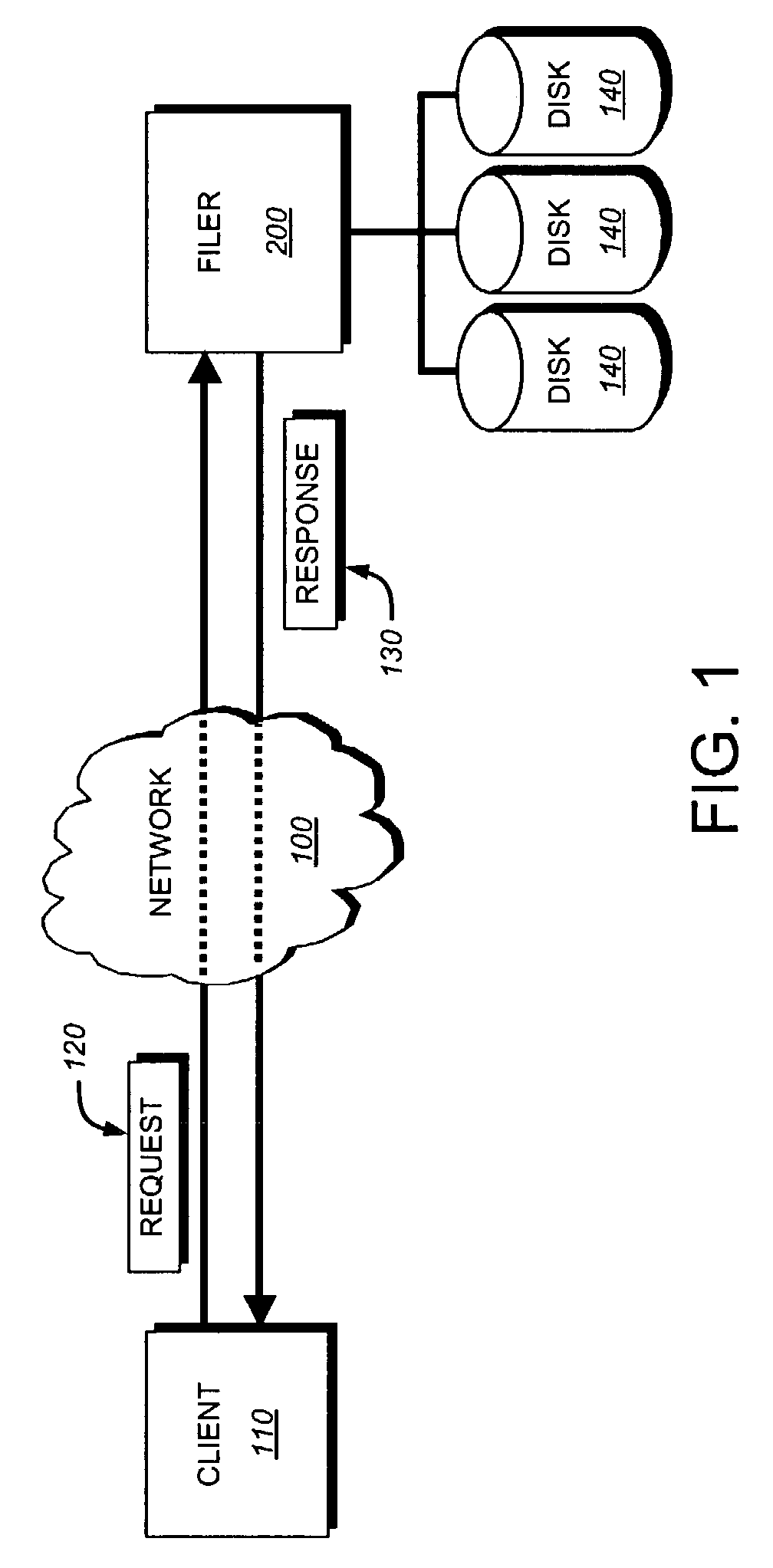
[0033]FIG. 1 is a schematic block diagram of a storage system environment that includes a network 100 through which a client 110 may communicate with a server, e.g., a file server 200. The network may comprise one or more point-to-point links, shared local area networks (LAN), wide area networks (WAN), and the like. The filer server or “filer”200 is a computer that provides file service relating to the organization of information on storage devices, such as storage disks 140. In operation, the client may send the filer a request 120 to access a specific file or directory, e.g., stored in the disks 140. The request may be “packetized” and formatted according to predetermined communication protocols, such as the Transport Control Protocol (TCP) and Internet Protocol (IP). The filer processes the client request and, when appropriate, transmits a response 130 to the client over the network 100.

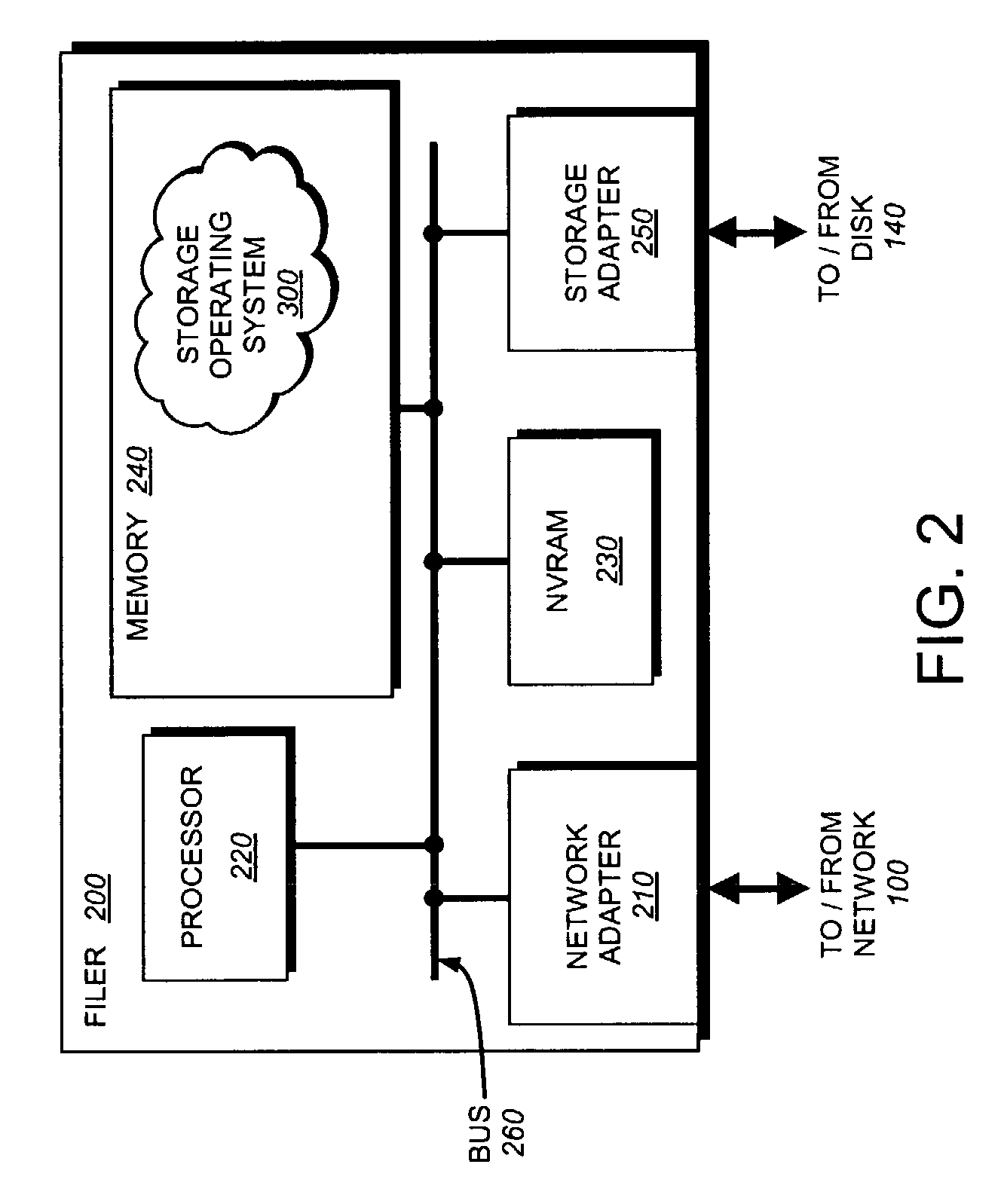
[0034]FIG. 2 is a schematic block diagram of the filer 200 that m...