Unlock instant, AI-driven research and patent intelligence for your innovation.

Method in the decompression of an audio signal

a technology of audio signal and decompression method, which is applied in the field of audio signal decompression method, can solve the problems of requiring a long time for sample transfer, may contain minor errors, etc., and achieve the effect of less processing capacity and efficient decompression of audio signals

Active Publication Date: 2007-01-09
RPX CORP
View PDF13 Cites 5 Cited by
  • Summary
  • Abstract
  • Description
  • Claims
  • Application Information

AI Technical Summary

Benefits of technology

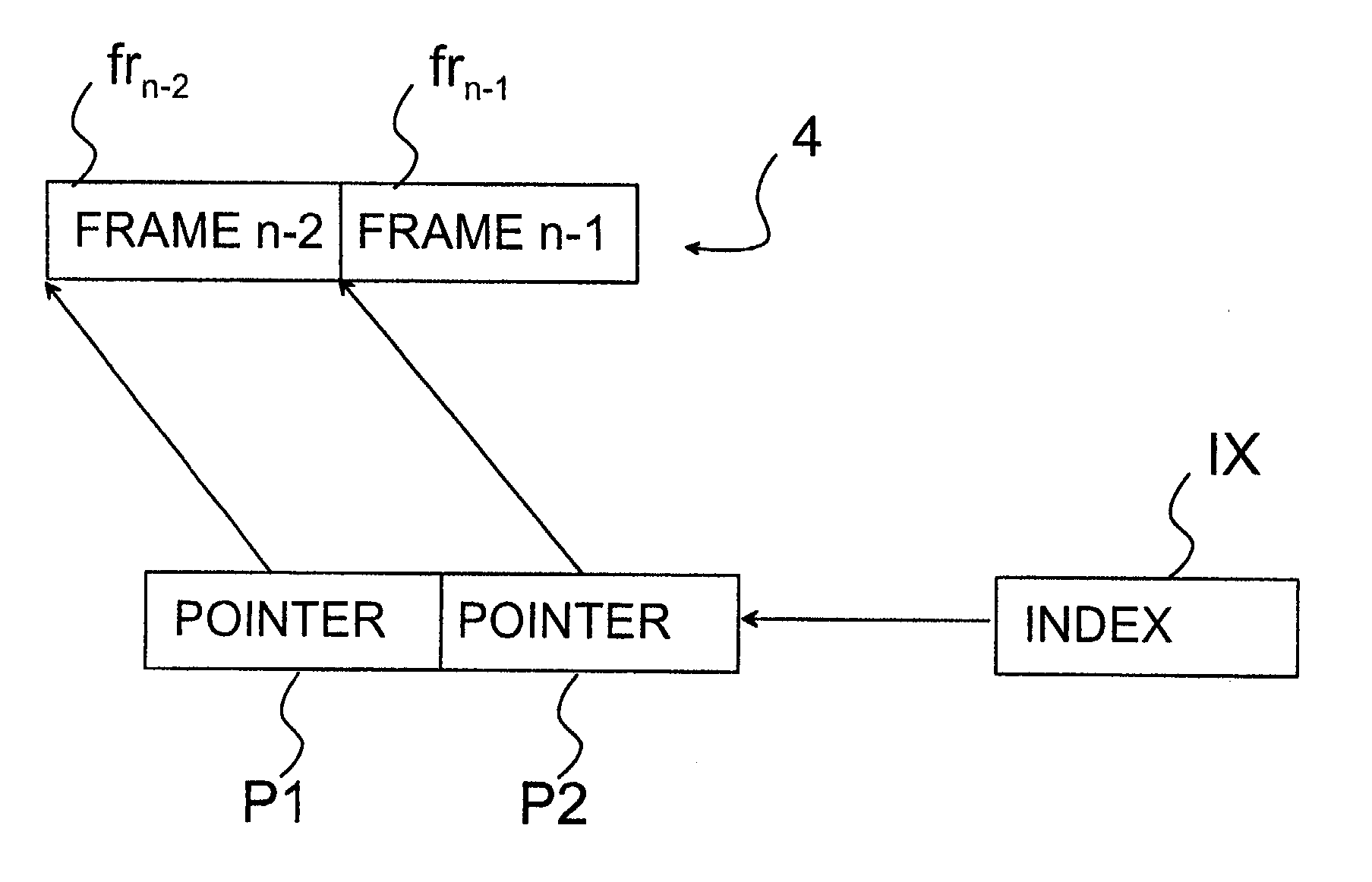
[0012]It is an aim of the present invention to provide a method for making the decompression of audio signals more efficient. The decompression block according to the invention utilizes, for updating the data in the sample buffer, pointers to point at the location required at a time in the buffer, wherein there is no need to transfer the sample sequences in the sample buffer. The method according to the present invention is characterized in that at least a first and a second memory pointer are used to point to the storage location of the frames, and that said memory pointers are used to point to the storage location of the frame preceding the frame processed at the time, and to the storage location of the frame preceding said past frame. The decompressing block according to the present invention is characterized in that the decompressing device comprises at least a first and a second memory pointer to point to the storage location of the frames, and means for using said memory pointers to point to the storage location of the frame preceding the frame processed at the time, and to the storage location of the frame preceding said past frame. The electronic device according to the present invention is further characterized in that the electronic device comprises at least a first and a second memory pointer to indicate the storage location of the frames, and means for using said memory pointers to point to the storage location of the frame preceding the frame processed at the time, and to the storage location of the frame preceding said past frame.
[0013]The present invention shows remarkable advantages compared to solutions of prior art. Using the method of the invention, less processing capacity is required, because there is no need to transfer sample sequences in the sample buffer. Furthermore, it is possible to utilize another possibly existing audio buffer, wherein the sample buffer can be implemented in a simpler way.

Problems solved by technology

After the above-mentioned stages, the output of the decompression block contains a signal which substantially corresponds to the original signal but may, however, contain minor errors, due to errors possibly formed in the prediction as well as to noise caused by the quantization and inverse quantization.
However, the method of updating the sample buffer according to prior art has the drawback that the transfer of samples requires a long time, because it must be performed for all frames.

Method used

the structure of the environmentally friendly knitted fabric provided by the present invention; figure 2 Flow chart of the yarn wrapping machine for environmentally friendly knitted fabrics and storage devices; image 3 Is the parameter map of the yarn covering machine
View more

Image

Smart Image Click on the blue labels to locate them in the text.
Viewing Examples
Smart Image
  • Method in the decompression of an audio signal
  • Method in the decompression of an audio signal
  • Method in the decompression of an audio signal

Examples

Experimental program
Comparison scheme
Effect test

Embodiment Construction

[0020]FIG. 4 shows, in a reduced block chart, a decompression block 1 according to an advantageous embodiment of the invention in a reduced block chart, and FIG. 3 shows the buffer structure to be used in the method according to an advantageous embodiment of the invention in a reduced manner. The decompression block 1 is, for example, a speech decoder of an electronic device 2 (FIG. 5), such as a mobile communication device, for converting a compressed audio signal back into an audio signal preferably in the following way.

[0021]In this first advantageous embodiment of the invention, a memory space is allocated for the storage of samples of frames in the memory means 3 of the electronic device 2. This memory space, which will be called the LTP buffer 4 below in this description, comprises the memory capacity required for storing the samples of, for example, four frames, and is formed, for example, as a so-called ring buffer. The decompression block 1 is also provided with memory poin...

the structure of the environmentally friendly knitted fabric provided by the present invention; figure 2 Flow chart of the yarn wrapping machine for environmentally friendly knitted fabrics and storage devices; image 3 Is the parameter map of the yarn covering machine
Login to View More

PUM

No PUM Login to View More

Abstract

The invention relates to a method in the decompression of a compressed audio signal. In the decompression, a predicting coding has been used, wherein samples taken of the audio signal have been formed into frames, and the samples of the frames have been compared with past samples to find out the prediction error. In the method, frames (frn, frn−1, frn−2) of the compressed audio signal are stored, and a predicting decoding is used to decompress the audio signal compressed with the predicting coding, on the basis of said stored frames (frn, frn−1, frn−2). In the method, at least one memory pointer is used to indicate the storage location of the frames (frn, frn−1, frn−2). Said memory pointers (P1, P2) are used to point to the storage location of the frame (frn−1) preceding the frame (frn) being processed at the time, and to the storage location of the frame (frn−2) preceding said past frame (frn−1).

Description

BACKGROUND OF THE INVENTION[0001]The present invention relates to a method in the decompression of a compressed audio signal, in which compression a predicting coding has been used, wherein samples taken from the audio signal have been formed into frames, and samples of the frames have been compared with samples of at least one previous frame to find out the prediction error, in which method frames of the compressed audio signal are stored, and predicting decoding is used to decompress the audio signal compressed with the coding on the basis of said stored frames. The invention also relates to a decompressing device for decompressing a compressed audio signal, in which compression a predicting coding has been used, wherein samples taken from the audio signal have been formed into frames, and samples of the frames have been compared with samples of at least one past frame to find out the prediction error, which decompressing device comprises memory means for forming at least one buff...

Claims

the structure of the environmentally friendly knitted fabric provided by the present invention; figure 2 Flow chart of the yarn wrapping machine for environmentally friendly knitted fabrics and storage devices; image 3 Is the parameter map of the yarn covering machine
Login to View More

Application Information

Patent Timeline
no application Login to View More
IPC IPC(8): G10L19/04G10L19/14H03M7/46
CPCG10L19/04
Inventor OJANPERA, JUHA
Owner RPX CORP