[0009]In accordance with the present invention, techniques are provided for facilitating and reducing the costs associated with the installation of a
wireless broadband communications system. In the presently disclosed embodiment, the
wireless broadband communications system is a
multiple input multiple output (
MIMO) system including a plurality of transceivers and a plurality of antennas operable to transmit and receive signals over a plurality of communications channels. In the preferred embodiment, the
MIMO wireless communications system is a 2:2
MIMO system comprising two antennas disposed at each end of a communications link. The 2:2 MIMO system can be implemented as a non-line-of-
sight (NLOS) system or a line-of-
sight (LOS) system. In the event the 2:2 MIMO system is implemented as a NLOS system, the communications link can be deployed in a high scattering environment, for example, an
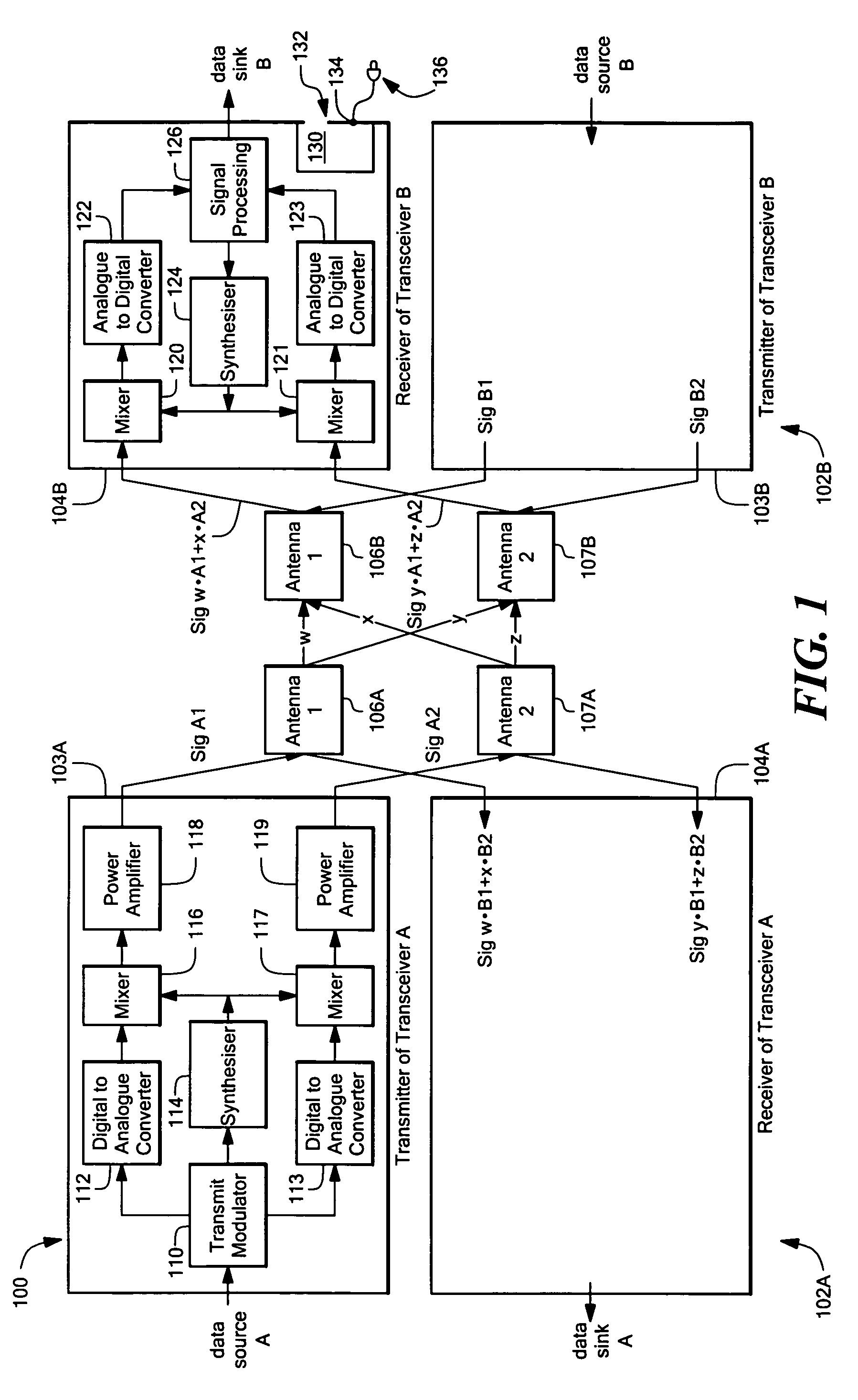
urban environment including numerous scattering objects and obstructions such as buildings, trees, hills, and / or automobiles. In this embodiment, the NLOS system is configured to transmit signals over the plurality of channels along four
signal paths between the respective ends of the link. The transmitted signals undergo multi-path propagation while being scattered by the various objects within the environment. In the event the 2:2 MIMO system is implemented as a LOS system, the link can be deployed in a reduced scattering environment such as a suburban or rural location. In this embodiment, the two antennas disposed at each end of the link are configured to transmit signals over the plurality of channels along two
signal paths.
[0010]The presently disclosed NLOS wireless communications system employs a combination of space-time coding and multiple diversity techniques to achieve increased de-correlation of the multiple
signal paths. For example, the two antennas disposed at each end of the communications link can employ
horizontal and vertical polarization, respectively, to provide
polarization diversity. Further, each transceiver at the respective ends of the link can be configured to transmit at least one signal via a first antenna and a delayed version of the signal via a second antenna to provide
delay diversity. Moreover, the two antennas disposed at each end of the link can have a predetermined spacing to provide spatial diversity. The two antennas at each end of the link can also be implemented as a single
dual polarized antenna, thereby achieving
polarization diversity while reducing
space requirements.
[0011]The presently disclosed LOS wireless communications system includes a single
dual polarized antenna disposed at one end of the communications link, and two vertically separated and horizontally and vertically polarized antennas disposed at the other end of the link, thereby providing polarization and spatial diversity. The LOS system employs a combination of space-time coding and spatial /
polarization diversity techniques to minimize water and
ground bounce nulls. By employing space-time coding and
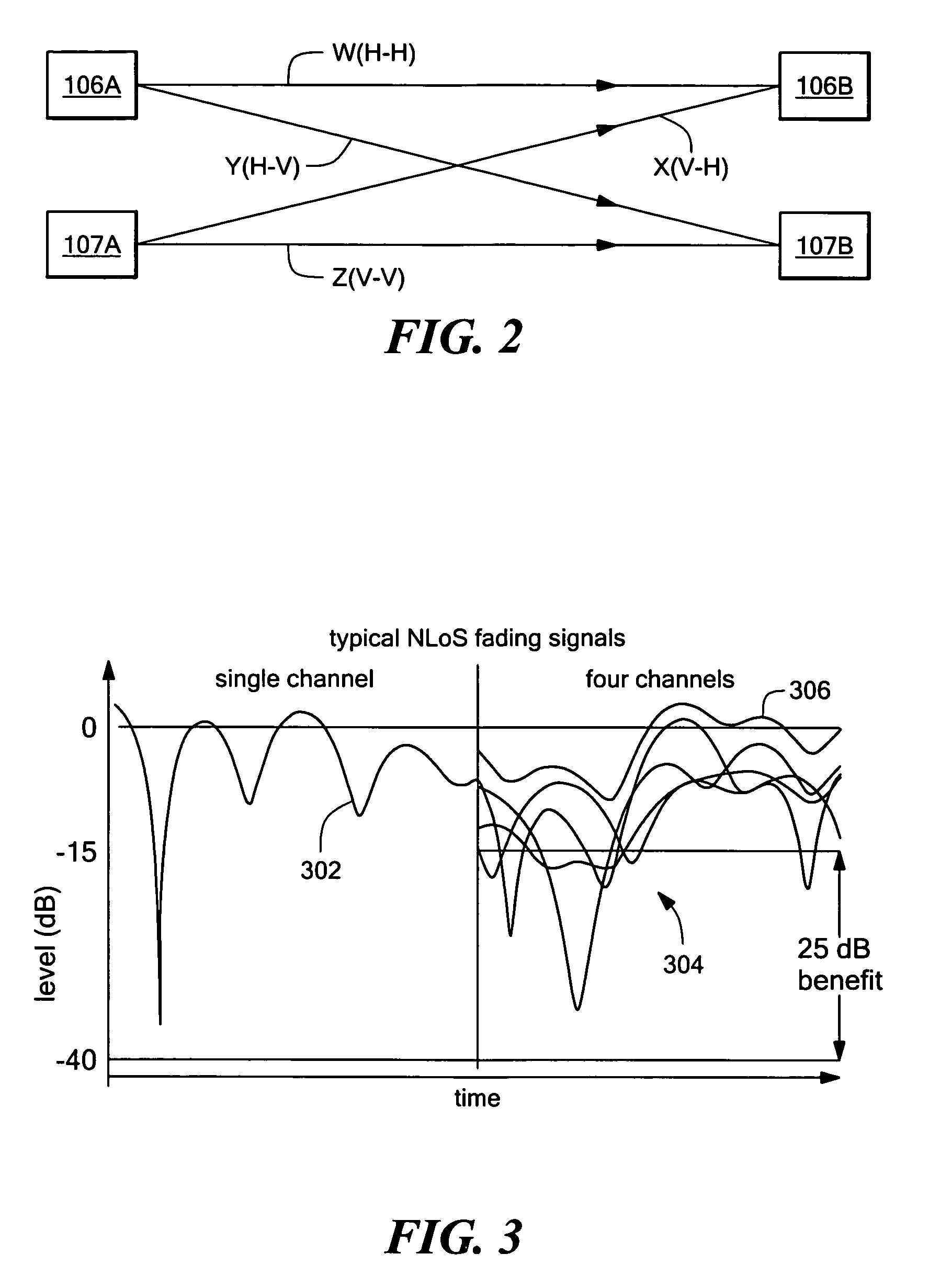
multiple modes of diversity in the presently disclosed NLOS and LOS systems, de-correlation of the signal paths is increased, and the effectiveness of space-time coding for increasing the
gain in the received
signal strength and for reducing signal
fading is enhanced.
[0012]In one mode of operation, the presently disclosed
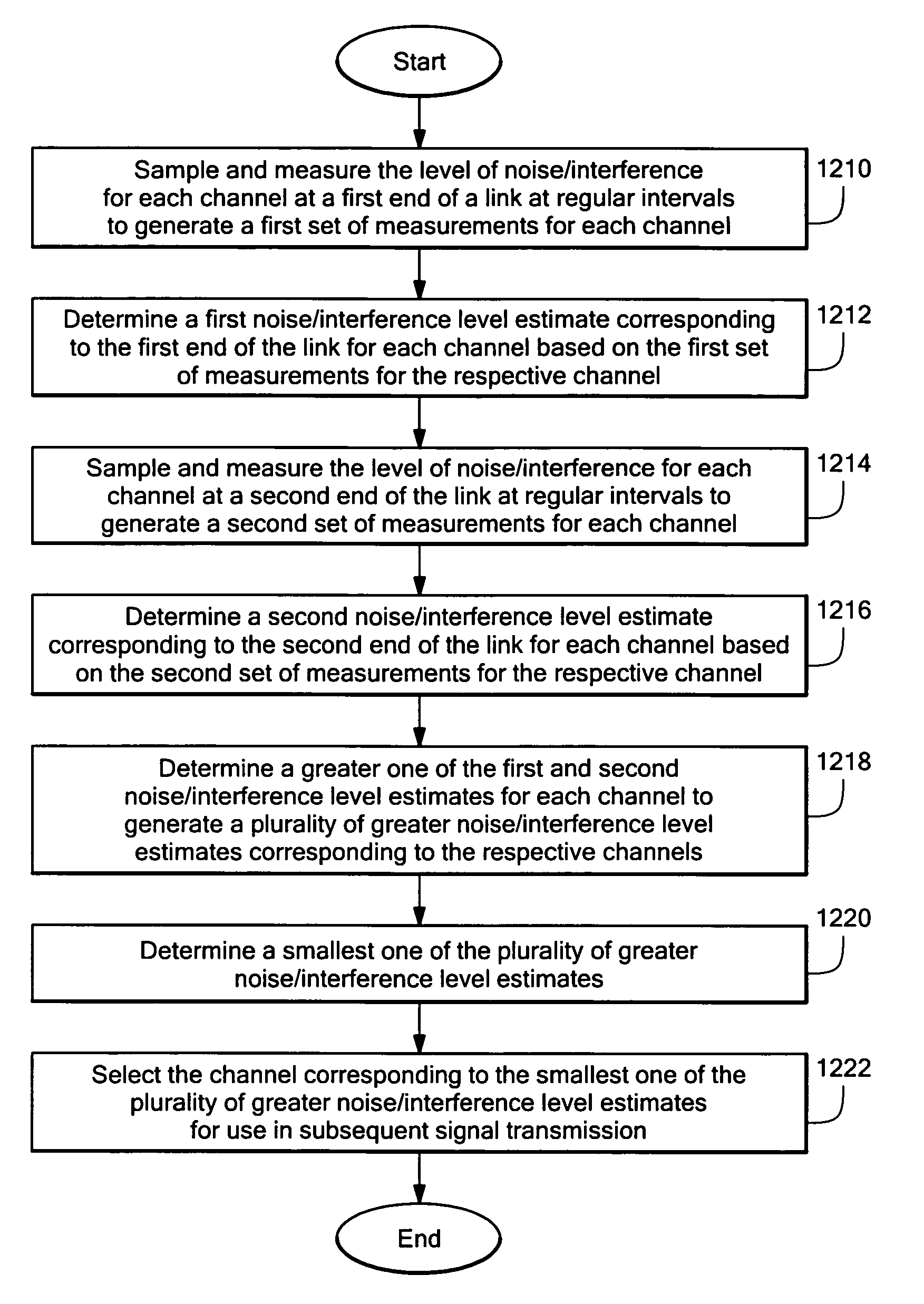
wireless broadband communications system provides for easier and less costly system installation by employing a first transceiver to identify a predetermined number n (n>1) of a plurality of communications channels having the n lowest levels of noise and interference associated therewith. Next, the first transceiver transmits a predetermined code over the n identified channels to a second transceiver, which simultaneously monitors the n channels. In the event the second transceiver captures the transmission by the first transceiver on at least one of the n channels, the second transceiver attempts to identify the predetermined code within the captured transmission. In the event the second transceiver correctly identifies the predetermined code within the captured transmission on at least one of the n channels, the second transceiver measures a
noise level and / or an interference level associated with the corresponding channel or channels. The channel having the lowest noise and interference level is then selected for use in system installation.


 Login to View More
  Login to View More