Magnetic control device for timepiece

a control device and timepiece technology, applied in the direction of electric winding, instruments, horology, etc., can solve the problems of not being able to reduce the size of the prior art device, certain defects in the device, etc., and achieve the effect of reducing the cost price and being more compa

US7404667B2Active Publication Date: 2008-07-29THE SWATCH GRP RES & DEVELONMENT LTD
9 Cites 92 Cited by

Patent Information

Authority / Receiving Office
US · United States
Patent Type
Patents(United States)
Current Assignee / Owner
Publication Date
2008-07-29

Smart Images

  • Figure 1
    Figure 1
  • Figure 2
    Figure 2
  • Figure 3
    Figure 3
Patent Text Reader

Abstract

The magnetic control device (1) for a timepiece comprises a sealed tube (3) which comprises a blind end inserted into an opening of the timepiece, whereas the other end of the tube opens towards the outside. A control stem (12) is provided in order to slide inside the tube (3). It carries a magnet (21) which is displaced integrally with the stem inside the tube. By manipulating the end of the stem which emerges from the tube (3), the wearer of the watch can make the magnet selectively occupy three positions. A first and a second magnetic sensor (22, 23) with two states are disposed inside the timepiece along the sealed tube so that three different combinations of a state of the first sensor (22) with a state of the second sensor (23) are respectively associated with three predefined positions of the first magnet (21).
Need to check novelty before this filing date? Find Prior Art

Description

[0001] This application claims priority from European Patent Application No. 06123744.2, filed Nov. 9, 2006, the entire disclosure of which is incorporated herein by reference.FIELD OF THE INVENTION

[0002] The present invention relates to a magnetic control device for a timepiece and more particularly to a magnetic device comprising a manually actuatable control member and able to occupy selectively a plurality of positions and to move from one to the other via a translational movement.BACKGROUND OF THE INVENTION

[0003] Such magnetic control devices are already known to the person skilled in the art. The patent document U.S. Pat. No. 4,038,814 describes in particular several embodiments of such a device. In particular, the embodiment described with reference to FIGS. 6 and 7 relates to a wristwatch of a generally rectangular exterior form, and one of the sides of which carries a guide rail. A plastic cursor containing a magnet is provided in order to slide along this rail. A non-specifie...

Examples

Embodiment Construction

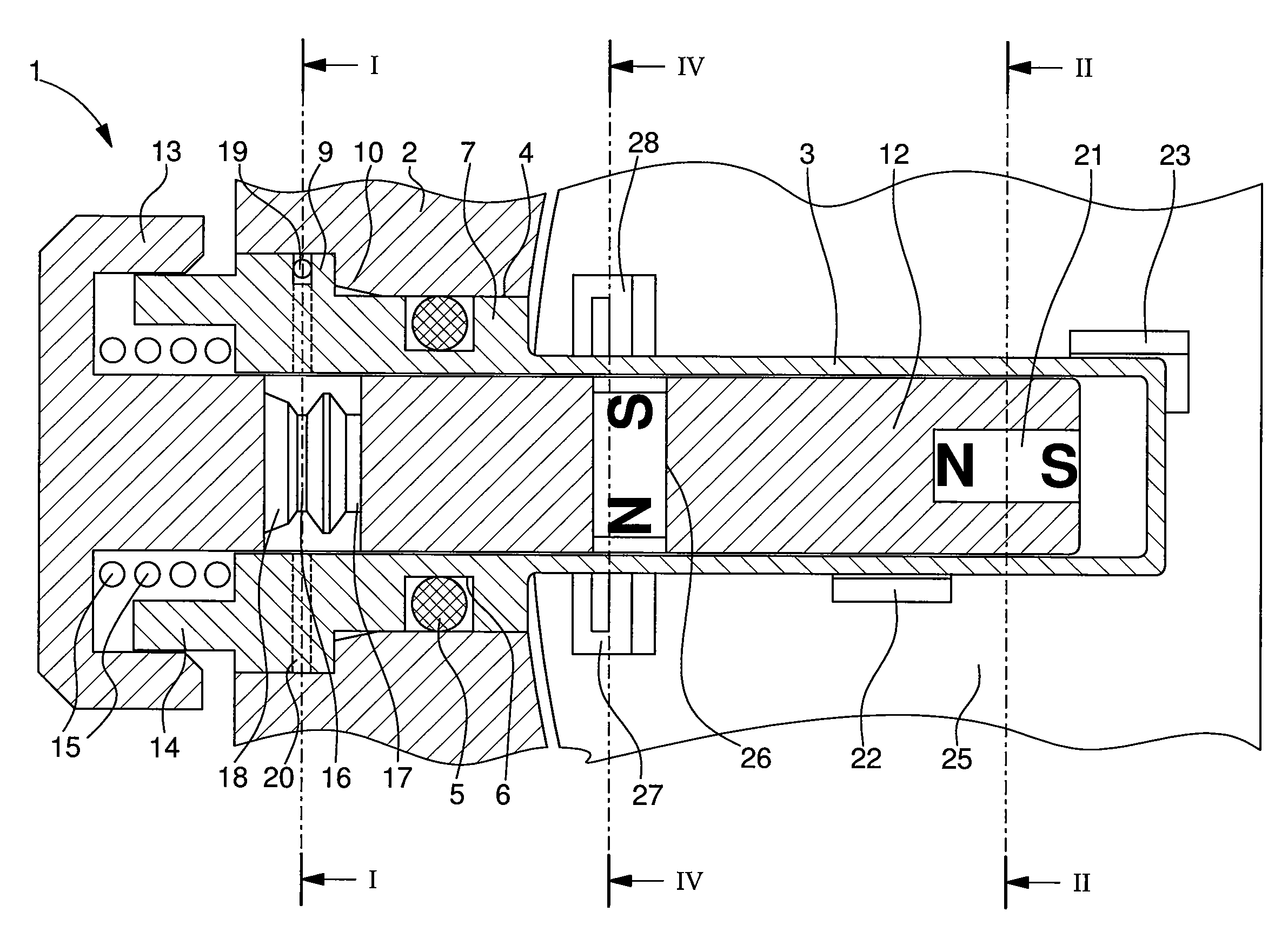
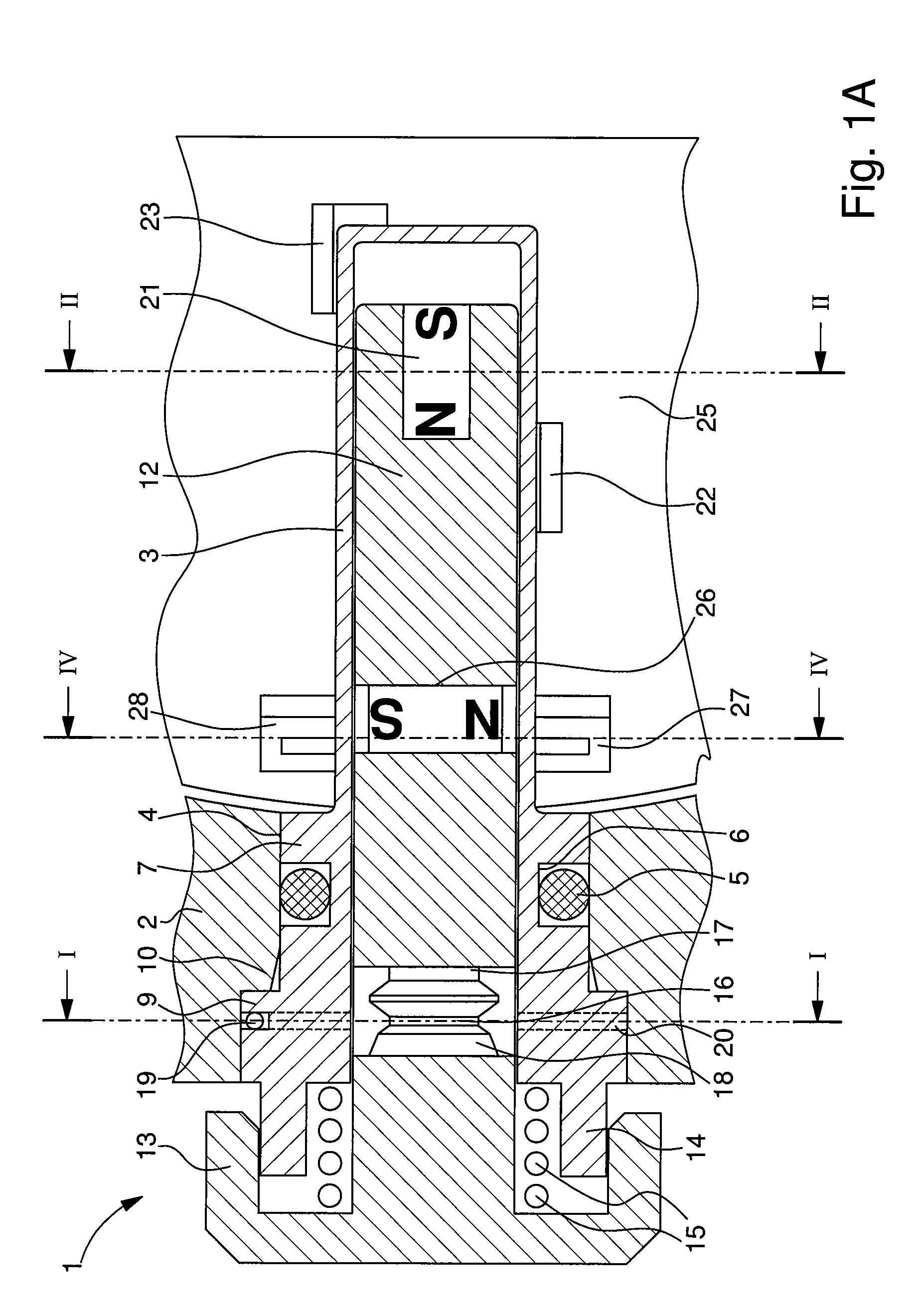
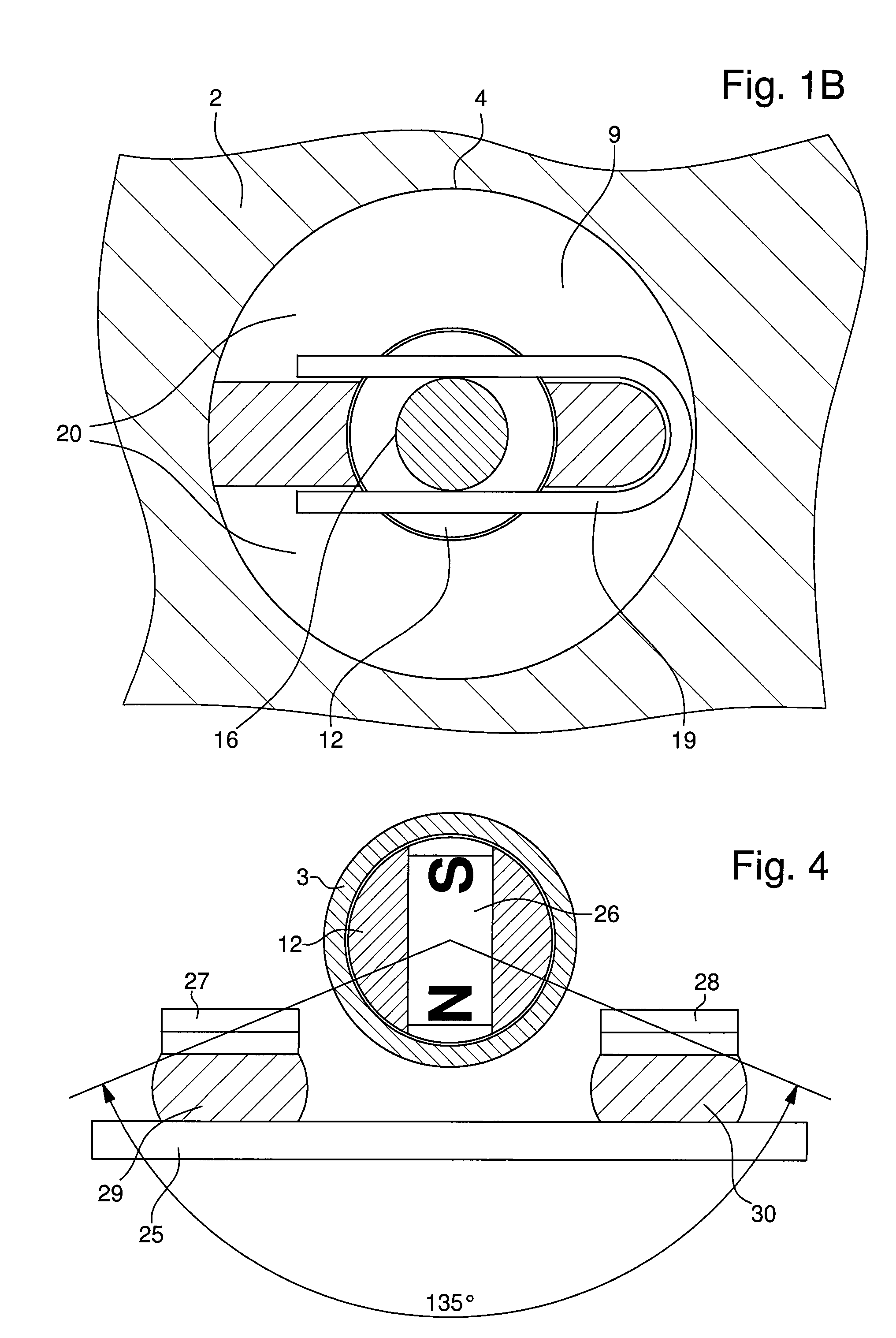
[0023]FIG. 1A represents a particular embodiment of the control device according to the present invention. In this example, the magnetic control device 1 is mounted in the middle part 2 of a watch. It can be seen in the drawing that a tube (reference number 3) is inserted into an opening 4 provided in the edge of the middle part 2. The tube 3 is produced in a non-magnetic material, such as stainless steel for example. The tube is airtight and is open at only one of its ends. It can be seen in FIG. 1A that, in the embodiment which is the subject of the present example, the tube 3 is practically entirely contained inside the middle part. Only the open end of the tube opens to the exterior of the watch. However it will be understood that, according to other embodiments of the present invention, it is possible that only the distal part of the tube, near the closed end (or blind end), is inserted in the middle part. In these conditions, the proximal part of the tube, close to the open en...