[0010]Some of the advantages of the present invention are illustrated by means of an example wherein the invention is applied to packet-mode communication of push-to-talk type, such as the PoC in a WCDMA environment. In accordance with the basic principles of the invention, the
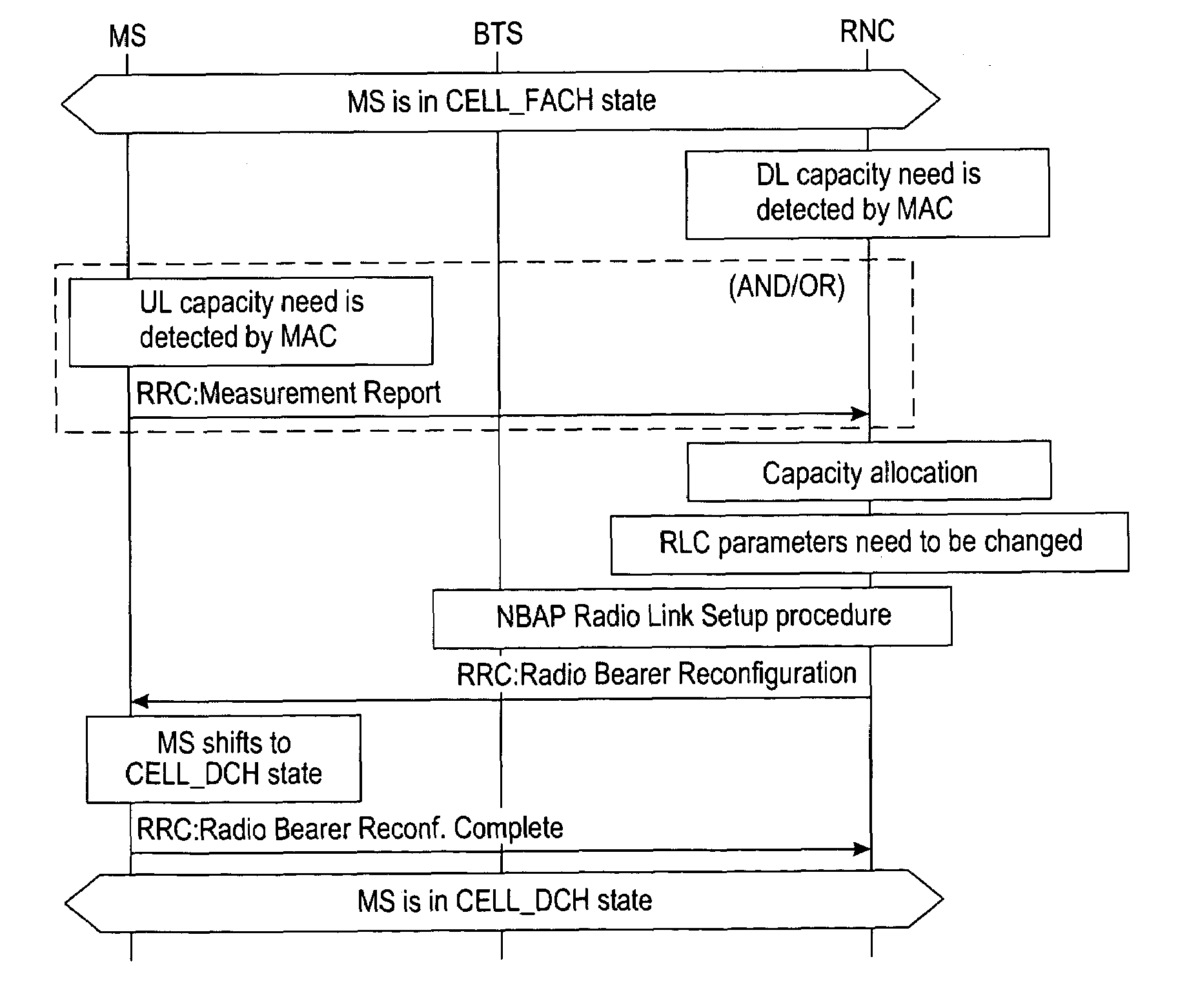
user equipment can be kept in a connected mode (the real-time bearer assigned) during a PoC call but is shifted to a common channel (such as
CELL_FACH,
CELL_PCH or URA_PCH) state during voice inactivity. When someone starts to talk, s / he presses a push-to-talk tangent and her / his
user equipment starts the transmission. As a consequence, e.g. via normal packet call reservation mechanisms, the
user equipment is shifted to the dedicated channel state (e.g.
CELL_DCH state) with a dedicated channel for speech transmission so that communication between the parties is possible. When the talking stops (none of the parties is transmitting any more), the dedicated channel is released and the user equipment is shifted back to a common channel state. When the user equipment is in the common channel state during the voice inactivity, the radio,
base station radio or transmission capacity is not consumed. Also, the terminal battery is saved because nothing is transmitted or received. A state transition from a common channel state to a dedicated channel state may take a few hundred milliseconds, which is expected to be fast enough for smooth operation of the PoC service. Thus, a fast activation time of the radio connections after pushing the tangent button is achieved, which improves the total QoS of the PoC service. The activation of the radio connections only requires
radio resource control (RRC) signaling between the terminal and the
access network. No signaling between the terminal and the core network is needed. Only small modifications to the existing functionality of 3G terminals and network are needed due to the invention. Some memory capacity in the network is consumed, however, due to preserving the RRC connection in the
radio access network and the packet data protocol context in the core network during the inactive periods.
[0011]The assignment of the new type of real-time access bearer is preferably made in response to receiving an access bearer assignment message indicating that the real-time media session requires a real-time access bearer of that type. Otherwise, the
radio access network could not know which
Radio Access Bearer (RAB) is used for the PoC service so that it could utilize the state transitions between dedicated channel and common channel states. During active speech sessions, the PoC requires a real-time connection having the characteristics of the streaming or conversational traffic class RAB. On the other hand, during voice inactivity the real-time connection has to be freed and the
transition time from voice inactivity to
voice activity does not need to fulfill the strict
delay requirements of the real-
time data transmission, which is not a preferred operation of the conventional real-time services. The new indication according to the invention enables the access network to distinguish between the conventional real-time access bearers and the novel real-time access bearers.



 Login to View More
  Login to View More