ESD protection circuit with active triggering
a protection circuit and active triggering technology, applied in the direction of transistors, semiconductor devices, electrical apparatus, etc., can solve the problem that devices are more vulnerable to electrostatic discharg
- Summary
- Abstract
- Description
- Claims
- Application Information
AI Technical Summary
Benefits of technology
Problems solved by technology
Method used
Image

Examples
first embodiment
[0043]Please refer to FIG. 7, which illustrates the ESD protection circuit in the first embodiment according to the invention. This ESD protection circuit 70 includes a discharging component 72, a diode D1, and an ESD detection circuit 74. The discharging component 72 is coupled between an input / output pad and a first power line (VSS) of the IC in which the ESD protection circuit 70 is set. The diode D1 is coupled between the input / output pad and a second power line (VDD) of the IC in a forward direction toward the second power line.
[0044]The ESD detection circuit 74 includes a resistor R1, a capacitor C1, and a triggering component. In this embodiment, the triggering component is an inverter labeled as INV_1. The resistor R1 and the capacitor C1 are formed in series and coupled between the first power line and the second power line. As shown in FIG. 7, the inverter INV_1 has a positive power end coupled to the input / output pad and a negative power end coupled to the first power lin...
second embodiment
[0048]Please refer to FIG. 8, which illustrates the ESD protection circuit in the second embodiment according to the invention. This ESD protection circuit 80 includes a discharging component 82, a diode, and an ESD detection circuit 84. The discharging component 82 is coupled between an input / output pad and a first power line (VDD) of an IC. The diode is coupled between the input / output pad and a second power line (VSS) of the IC in a forward direction toward the input / output pad.
[0049]The ESD detection circuit 84 includes a capacitor C1, a resistor R1, and a triggering component. In this embodiment, the triggering component is composed of two inverters, INV_2 and INV_3, coupled in series. The capacitor C1 and resistor R1 are formed in series between the first power line and the second power line. As shown in FIG. 8, the inverters respectively have a positive power end coupled to the first power line and a negative power end coupled to the input / output pad. Besides, the input of th...
third embodiment
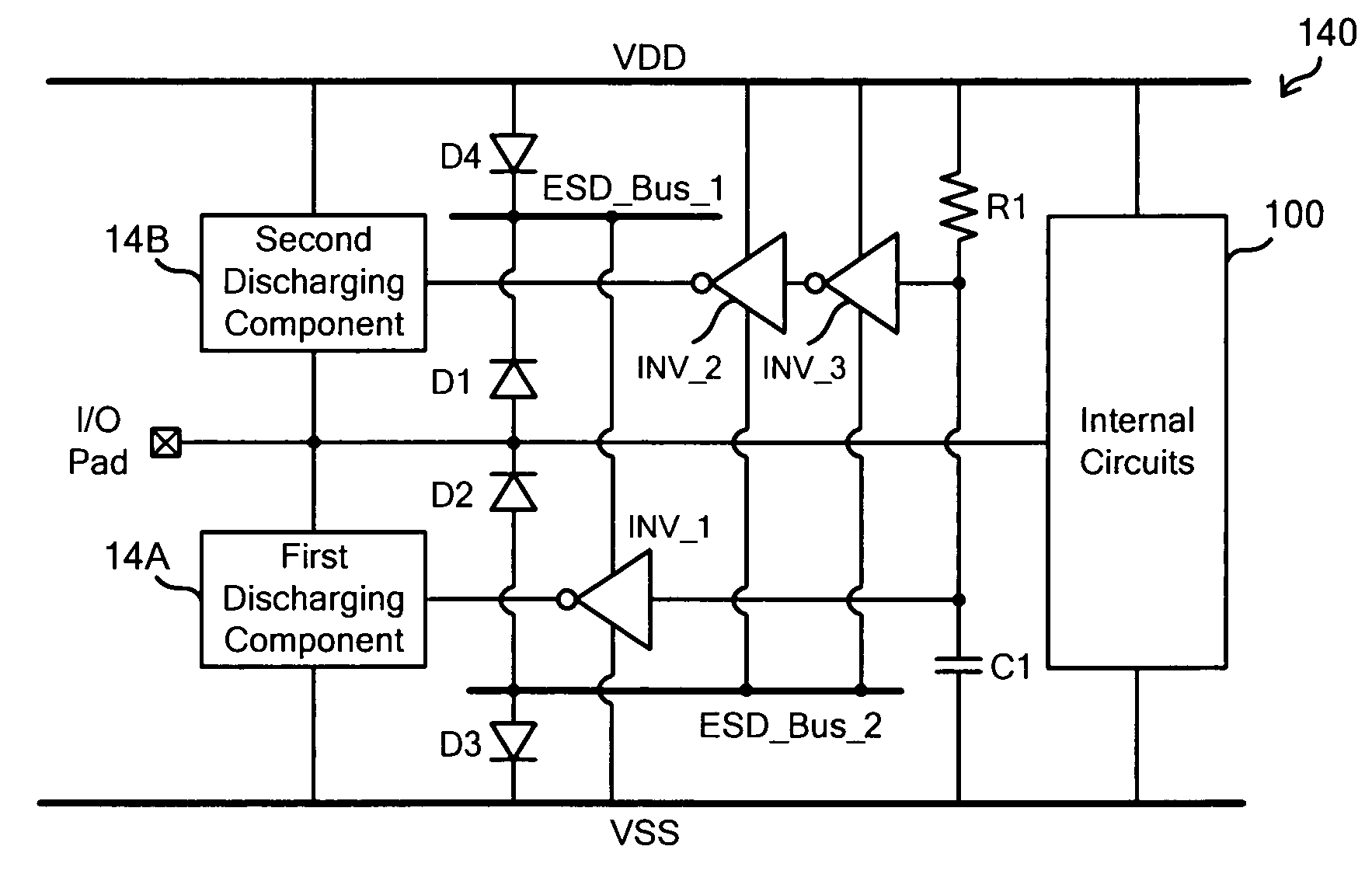
[0053]Please refer to FIG. 11, which illustrates the ESD protection circuit in the third embodiment according to the invention. In this embodiment, the circuits in FIG. 7 and FIG. 8 are combined to cope with all ESD conditions (PD-mode, PS-mode, ND-mode, and NS-mode).
[0054]As shown in FIG. 11, the ESD protection circuit 110 includes a first discharging component 92, a second discharging component 94, and an ESD detection circuit 96. The first discharging component 92 is coupled between an input / output pad and a first power line (VSS) of an IC. The second discharging component 94 is coupled between the input / output pad and a second power line (VDD) of the IC.
[0055]The ESD detection circuit 96 includes a capacitor C1, a resistor R1, and three inverters. The first inverter INV_1 has a first positive power end coupled to the input / output pad and a first negative power end coupled to the first power line. The input of the first inverter INV_1 is coupled to the node between the capacitor ...
PUM
 Login to View More
 Abstract
Description
Claims
Application Information
 Login to View More