
Cyr61 as a biomarker for diagnosis and prognosis of cancers of epithelial origin
a biomarker and epithelial origin technology, applied in the direction of instruments, peptides, organic chemistry, etc., can solve the problems of increased likelihood of cancer in patients and poor prognosis of patients
- Summary
- Abstract
- Description
- Claims
- Application Information
AI Technical Summary
Benefits of technology
Problems solved by technology
Method used
Image

Examples
example 1
Identification of Cyr61 as a Urinary Biomarker for Ovarian and Breast Cancer
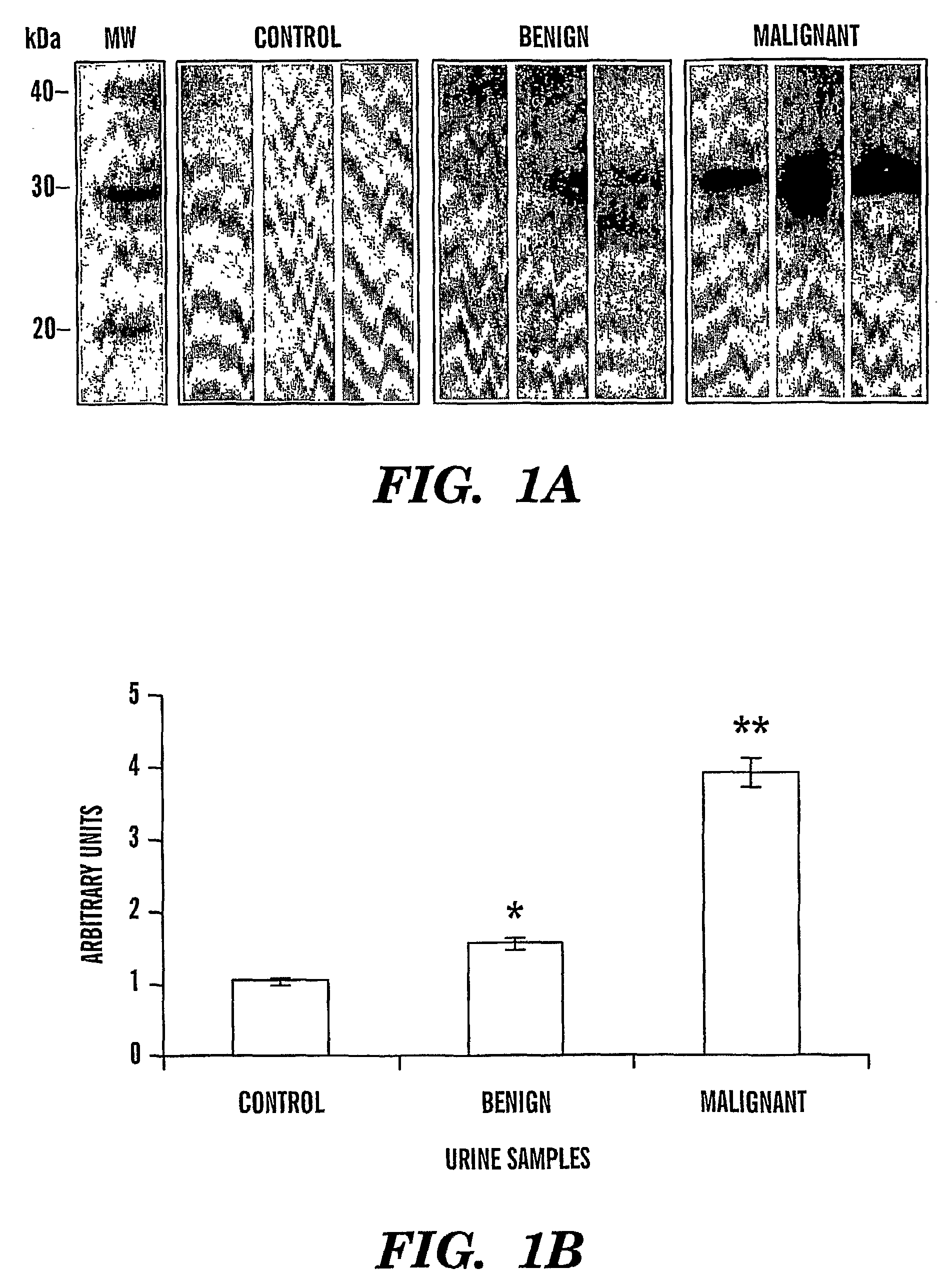
[0081]We have identified that Cyr61 protein serves a biomarker for ovarian cancer. In particular, we show that there is an increase in levels of Cyr61 in urine samples from patients that have benign and malignant ovarian cancer, as compared to control urine samples from patients that do not have cancer (FIGS. 1a and 1b). FIG. 1a shows immunoblot detection of ovarian cancer; Control lanes, control samples; Benign lanes, urine from a patients with benign cancer; lanes Malignant lanes, urine from a patients with malignant cancer. FIG. 1b shows a bar graph quantitation of the immunoblots detecting Cyr61 immunoreactive protein in urine from ovarian cancer patients (n=12 for each stage).
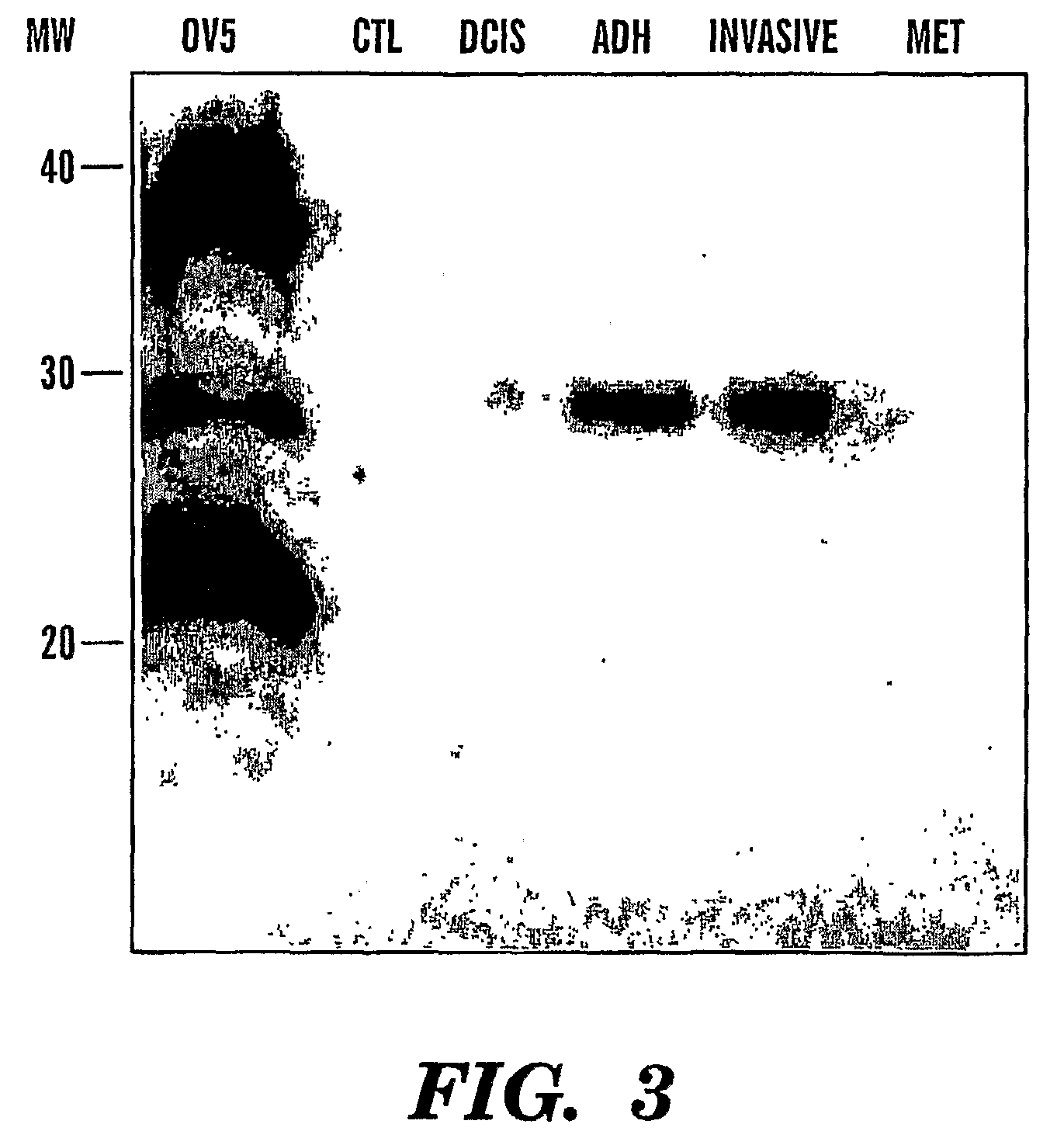
[0082]We also performed Western blotting of Cyr61 in urines from breast cancer patients (FIG. 3). There is an increase in levels of Cyr61 in urine samples from patients that have noninvasive (DCIS) and invasive breast cancer, as we...
example 2
Cyr61 as a Regulator of the Angiogneic Switch
[0083]The formation and demise of the corpus luteum are accompanied with dramatic blood vessel formation and regression processes, respectively. This endocrine gland is therefore useful as a research model for elucidating the molecular mechanisms turning angiogenesis on and off. In the present study, we used PGF2α to induce regression of day 6 and day 10 corpus lutea. Luteal tissues were collected 30 minutes after PGF2α administration. Gene microarray analysis demonstrated Cyr61, an antiogenic inducer, was differentially expressed in both day 6 and 10 CL after PGF2α injection. Semi-quantitative RT-PCR further showed this gene was expressed at a significant higher (p<0.01) level in the early CL than the mid and late stages. In addition, Cyr61 expression was decreased during luteal regression. Immunohistochemistry revealed that Cyr61 protein was localized in both luteal endothelial and steroidogenic cells. To study the regulation of Cyr61, ...
example iii
Cyr61 As A Regulator Of In Epithelial Mesenchymal Transition (EMT)
[0084]To assess the potential role of Cyr61 in the development of aggressive cancer, we prepared stable OV5 (ovarian cell) cell lines that overexpress Cyr61 (OV5-Cyr61). We found that many molecules known to be involved in Epithelial Mesenchymal Transition (EMT) and migration / invasion are regulated by Cry61. Using RT-PCR and the cell lines that overexpress Cyr61, we found that upregulation of Cyr61 alters the expression of steroid receptors, integrin receptors, VEGF, and metalloprotienases (data not shown). For example, steroid receptor ERα expression is upregulated while AR expression is downregulated; MMP-9 expression (RT-PCR) and activity (via zymogram) are upregulated, as well as MMP-1, MMP-8, MMP-3, MMP-23, MMP-19 expression, while there appears to be no effect on MMP-13, MMP-10 and MT1-MMP expression; MMP-7 expression is downregulated; β6, β3, α6 and αV integrin expression are upregulated; and VEGF-A and VEGF-C ...
PUM
| Property | Measurement | Unit |
|---|---|---|
| mass spectrometric analysis | aaaaa | aaaaa |
| PSA | aaaaa | aaaaa |
| ultrasound | aaaaa | aaaaa |
Abstract
Description
Claims
Application Information
 Login to View More