AI technical title is built by Patsnap AI team. It summarizes the technical point description of the patent document.
a technology for protecting garments and nuclear environments, applied in chemical protection, nuclear engineering, nuclear elements, etc., can solve problems such as releasing contaminants in reusable products, and achieve the effects of simplifying the number of different coversalls, simplifying the disposal requirements of facilities, and improving comfor
Active Publication Date: 2011-07-05
INT ENVIROGUARD INC
View PDF17 Cites 8 Cited by
Summary
Abstract
Description
Claims
Application Information
AI Technical Summary
This helps you quickly interpret patents by identifying the three key elements:
Problems solved by technology
Method used
Benefits of technology
Benefits of technology
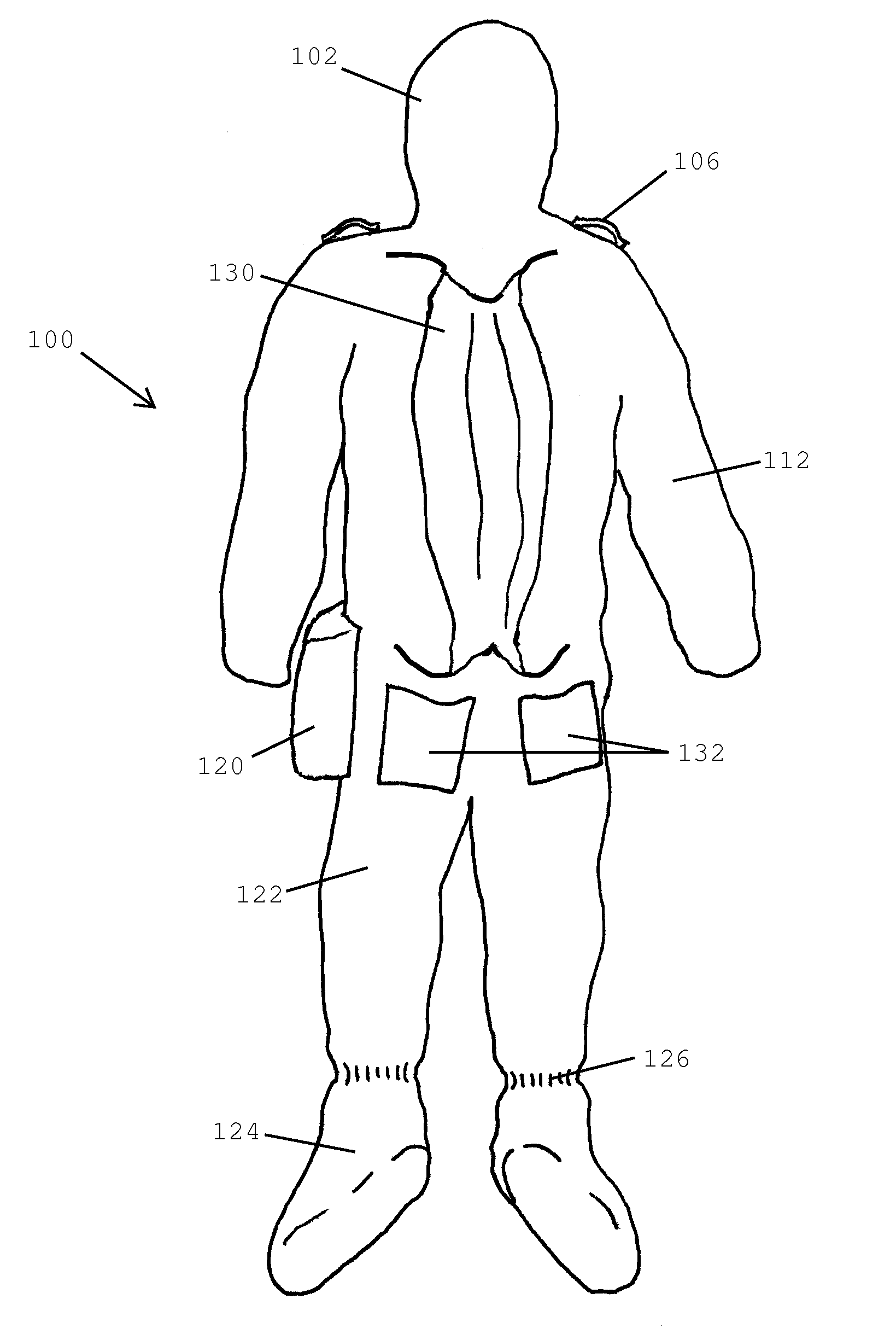
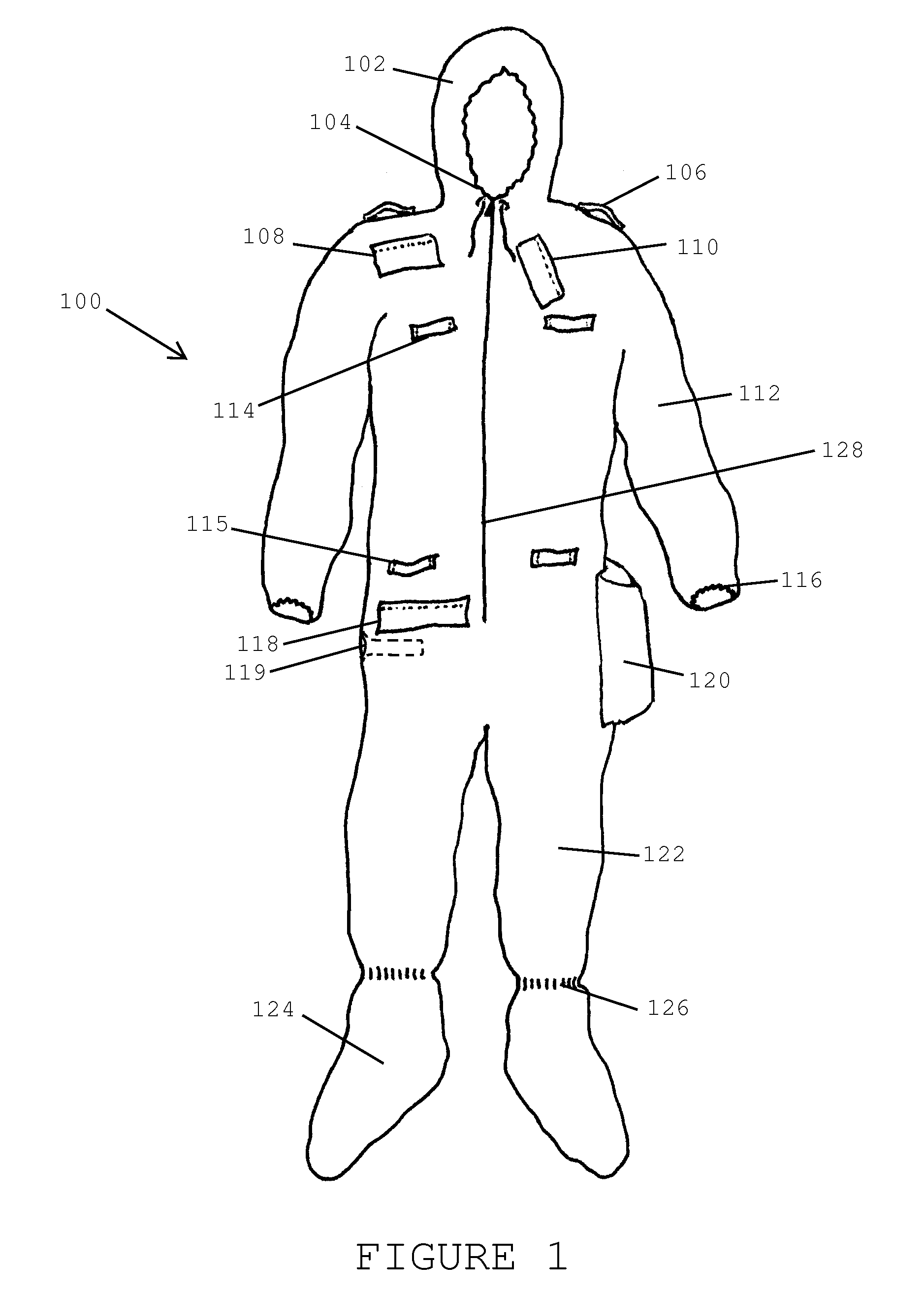
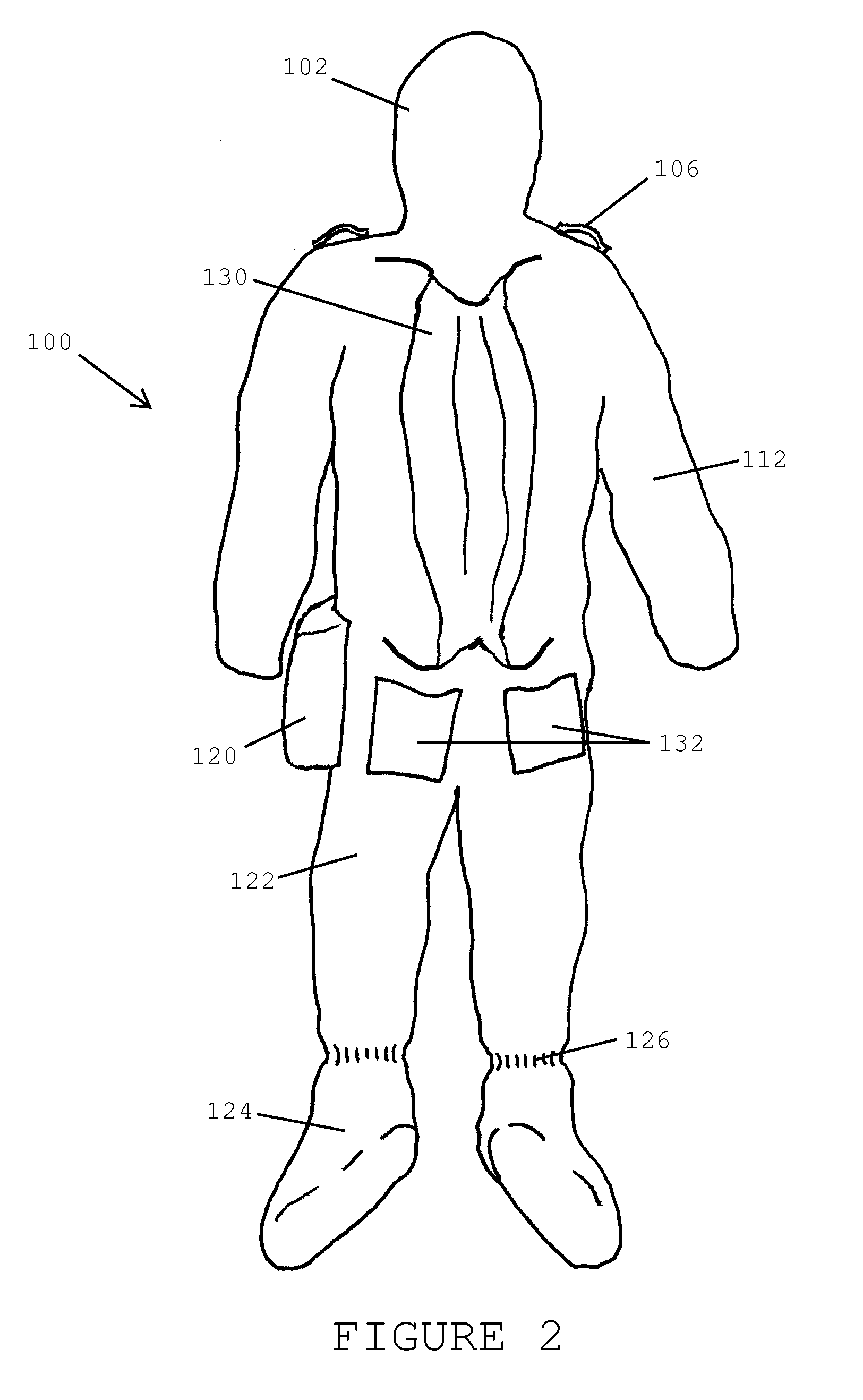
[0011]In an embodiment, the coverall is a made of a tri-laminate 30 / 30 / 30 water resistant fabric which can be fabricated in various colors. The tri-laminate 30 / 30 / 30 fabric comprises 30 grams per square meter of spunbond polypropylene, 30 grams per square meter of microporous film and 30 grams per square meter of spunbond polypropylene that are laminated together to produce a breathable, water resistant fabric. The coverall includes a zipper front, lock stitch / ultrasonically welded seams, and an expanded back for a self contained breathing apparatus (SCBA). The coverall has an attached draw string hood for covering the head and drawing tight against a breathing mask. To prevent contamination from other openings, the coverall includes attached boots with elastic at the ankle and sleeves with elastic at the wrists.
[0013]The tri-laminate fabric used in an embodiment eliminates the need for multiple layers and improves comfort by being thin and breathable (i.e., vapor permeable based on the microporous film). The inclusion of multiple features allow a single, universal coverall to be used in multiple applications in facilities such as nuclear plants, in both indoor and outdoor environments, thus simplifying the number of different coveralls that a facility needs to stock. The coverall also simplifies disposal requirements for the facility since all used coveralls can simply be incinerated for disposal.
Problems solved by technology
The limited reusable products release contaminants during the washing process.
Method used
the structure of the environmentally friendly knitted fabric provided by the present invention; figure 2 Flow chart of the yarn wrapping machine for environmentally friendly knitted fabrics and storage devices; image 3 Is the parameter map of the yarn covering machine
View more
Image
Smart Image Click on the blue labels to locate them in the text.
Viewing Examples
Smart Image
Click on the blue label to locate the original text in one second.
Reading with bidirectional positioning of images and text.
Smart Image
Examples
Experimental program
Comparison scheme
Effect test
Embodiment Construction
[0017]One embodiment of a protective garment (hereinafter a “coverall”) for use in nuclear environments, is disclosed in FIG. 1, which illustrates a front view of the coverall 100. The coverall 100 is constructed from a tri-laminate 30 / 30 / 30 water resistant fabric which can be fabricated in various colors. Preferred construction techniques include lock stitch / ultrasonically welded seams, although other methods, such as use of serged seams or a two-needle felled stitch with taped seams, are also contemplated. The coverall 100 includes a hood 102, sleeves 112, and legs 122 that are attached to the body portion of the coverall 100 and are accessed by a user through a front opening operated by a zipper 128. The front of hood 102 has a draw string opening 104 for drawing the hood 102 tight against a breathing mask. To prevent contamination from other openings, the legs 122 of the coverall include attached boots 124 with elastic 126 at the ankle, and the sleeves 112 include elastic 116 at...
the structure of the environmentally friendly knitted fabric provided by the present invention; figure 2 Flow chart of the yarn wrapping machine for environmentally friendly knitted fabrics and storage devices; image 3 Is the parameter map of the yarn covering machine
Login to View More
PUM
Login to View More
Abstract
A protective garment for nuclear environments is formed of a tri-laminate 30 / 30 / 30 water resistant barrier fabric. The garment can be incinerated so as to provide a disposable, one time use coverall particularly adapted for use in nuclear / radioactive environments. The coverall provides integrated elements for water resistant (i.e., splashproof), breathable, comfortable contamination protection. It is adapted for use with various types of breathing apparatuses, included external air lines, back-mounted self-contained breathing apparatuses (SCBA), and emergency breathing bottles or apparatuses. Air tanks and bottles are covered by the garment and thus do not need to be decontaminated. The garment also includes elements for use with air sampling devices and / or dosimetry equipment that are often worn by such workers.
Description
BACKGROUND[0001]The present invention relates to disposable protective clothing for use in nuclear / radioactive environments.[0002]Prior art protective clothing is disclosed in U.S. Pat. Nos. 4,901,370, 4,943,475, 5,626,947, 6,460,198, 6,792,625, and 7,203,974.[0003]U.S. Pat. No. 4,901,370 discloses a garment for protection against environmental contamination. The garment is formed of a laminate and includes a built-in hood with a transparent window and filtered openings for ingress of breathing air. A mouthpiece and conduit with a check valve are used for exhalation so as to avoid the use of an external air supply.[0004]U.S. Pat. No. 4,943,475 discloses a multilayer composite protective fabric material and its use in protective clothing. The composite fabric material includes a fabric support layer and a composite permselective membrane layer that is permeable to water vapor but impermeable to toxic organic vapors.[0005]U.S. Pat. No. 5,626,947 discloses composite chemical barrier fi...
Claims
the structure of the environmentally friendly knitted fabric provided by the present invention; figure 2 Flow chart of the yarn wrapping machine for environmentally friendly knitted fabrics and storage devices; image 3 Is the parameter map of the yarn covering machine
Login to View More
Application Information
Patent Timeline
Application Date:The date an application was filed.
Publication Date:The date a patent or application was officially published.
First Publication Date:The earliest publication date of a patent with the same application number.
Issue Date:Publication date of the patent grant document.
PCT Entry Date:The Entry date of PCT National Phase.
Estimated Expiry Date:The statutory expiry date of a patent right according to the Patent Law, and it is the longest term of protection that the patent right can achieve without the termination of the patent right due to other reasons(Term extension factor has been taken into account ).
Invalid Date:Actual expiry date is based on effective date or publication date of legal transaction data of invalid patent.



 Login to View More
  Login to View More