
Method for the production of a cell and/or tissue and/or disease phase specific medicament
a cell and/or tissue and disease phase technology, applied in the field of the method, can solve the problems of afflicting a high rate of unwanted side effects, no current available established therapies against chronic inflammation meet these criteria in an optimal way, and subsequent defective immune system regulation, etc., to achieve high cell and/or tissue and/or disease phase specificity and selectivity, negligible antigenicity, and high stability of molecules
- Summary
- Abstract
- Description
- Claims
- Application Information
AI Technical Summary
Benefits of technology
Problems solved by technology
Method used
Image

Examples
example 1
GATA-3
[0146]a) Identification of Ribonucleic Acid Molecules the Expression of which is Different in a Target Cell than Compared to a Control Cell Expression
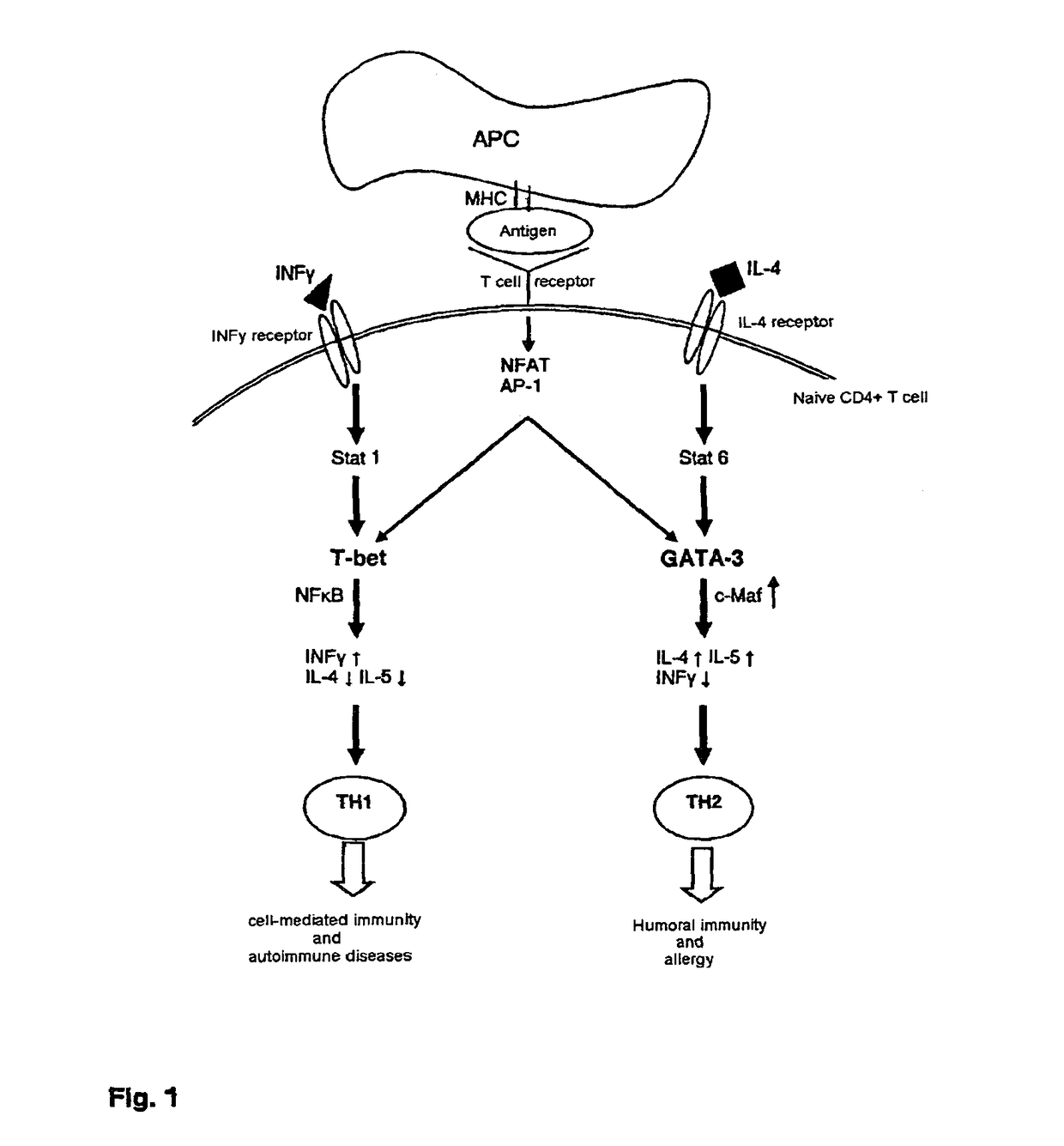
[0147]i) The naive CD4+ cells responsible for the development of chronic inflammatory reactions are used as target cells.
[0148]ii) The CD4+ target cells are isolated using magnetic beads (from Miltenyi (Macs System) Dynal (DynaBeads) or BD-Bioscience (iMAG)), alternatively on cell sorters by means of fluorescent labelled antibodies, e.g. from the companies Cytomation (MOFLO) or BD Bioscience (FACSVantage).
[0149]iii) RNA isolation is carried out according to standard methods; see Sambrook and Russell, Molecular Cloning, A Laboratory Manual, 3. edition, Cold Spring Harbor Laboratory (2001), New York and Ausubel et al., Current Protocols in Molecular Biology, John Wiley & Sons (1998), New York.
[0150]Alternatively, an RNeasy kit from the company Qiagen is used, or the mRNA is isolated directly from CD4+ target cells using the Oligote...
example 2
DNAzyme Against T-bet
[0184]a) Identification of Ribonucleic Acid Molecules the Expression of which is Different in a Target Cell than Compared to a Control Cell Expression
[0185]The identification takes place according to the procedure described above. The expression of T-bet is different in the target cell (Th1 cell) in comparison with the expression in a control cell (Th0 cell).
[0186]b) Design of Specific Ribonucleic Acid Molecules which Bind To Ribonucleic Acid Molecules from Step a) and Functionally Inactivate Them
[0187]The identification of cleavage sites for cleavage of T-bet is carried out as described for GATA-3.
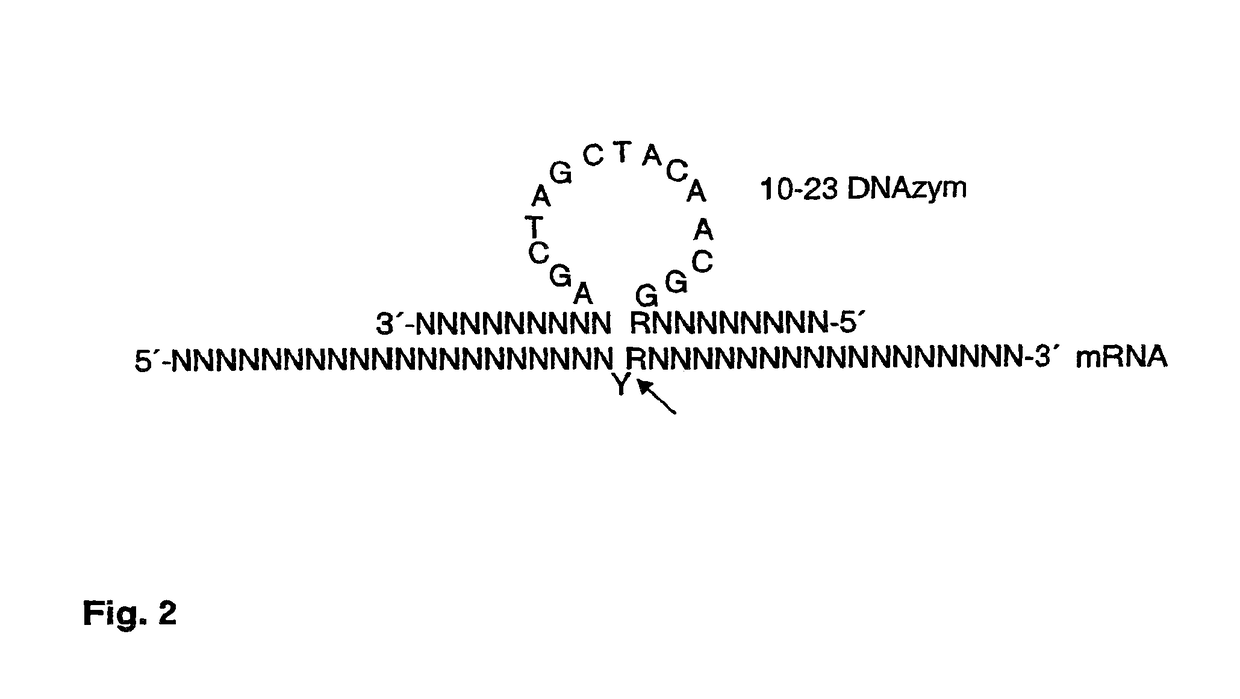
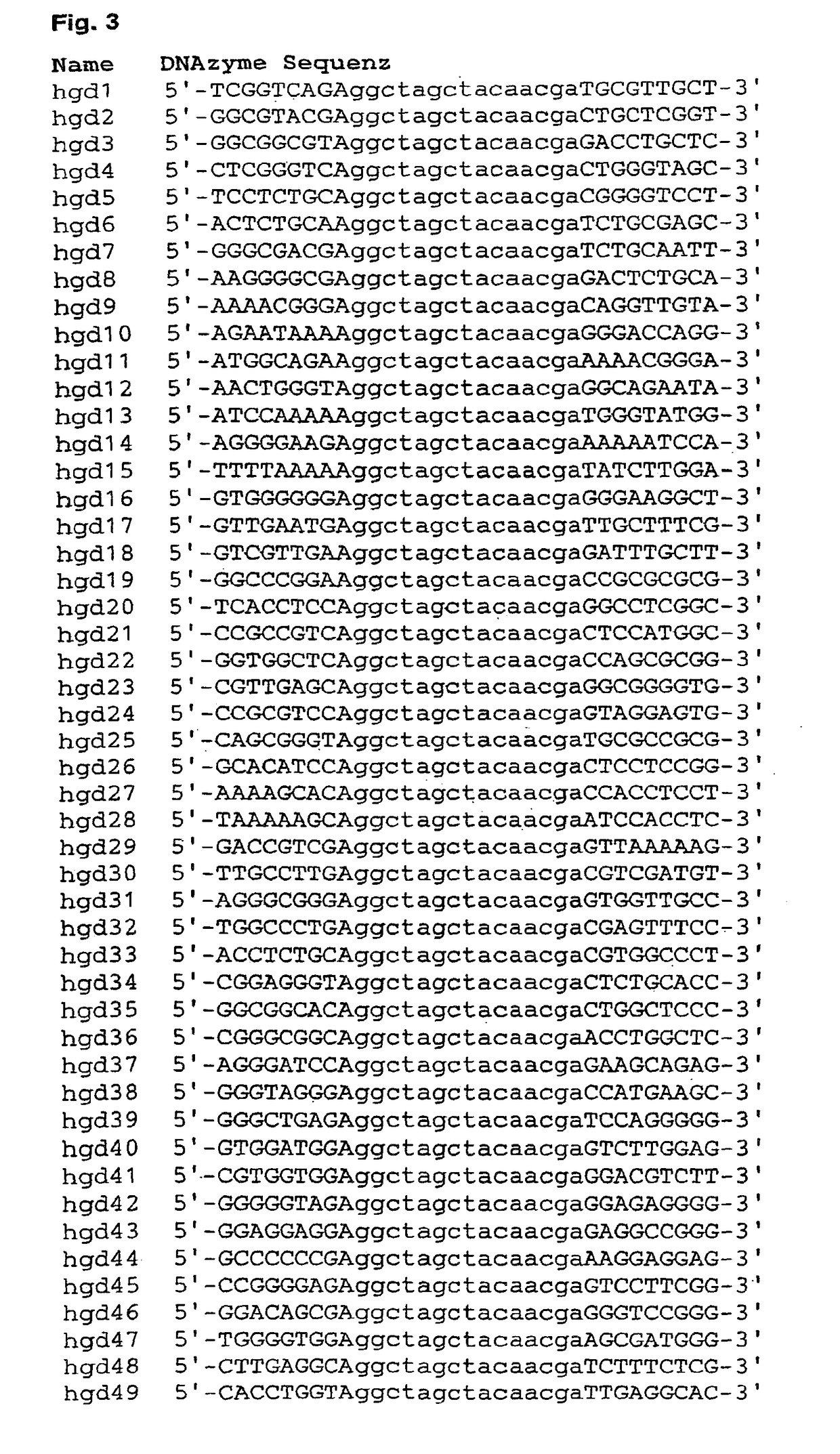
[0188]FIG. 7 shows the pool td1-td78 of specific DNAzymes according to the present invention against T-bet mRNA. The DNAzymes have a total length of 33 nucleotides, with the central catalytic domain corresponding to 15 nucleotides (in lowercase letters) of the catalytic domain of the known 10-23 DNAzyme (FIG. 2). This catalytic domain is flanked by two right and left ...
PUM
 Login to View More
 Abstract
Description
Claims
Application Information
 Login to View More