
Biodegradable resin bottle and method of producing the same
a biodegradable resin and bottle body technology, applied in the direction of synthetic resin layered products, rigid containers, packaging, etc., can solve the problems of thermal deformation and thermal deformation of the bottle wall, lack of flexibility, and brittleness of vacuum-evaporated film of silicon oxide, so as to avoid thermal deformation of the bottle, low heat resistance, and low glass transition point
- Summary
- Abstract
- Description
- Claims
- Application Information
AI Technical Summary
Benefits of technology
Problems solved by technology
Method used
Image

Examples
examples
[0057]Next, the invention will be described by way of Examples.
[0058]Described below are the method of producing the vacuum-evaporated PLA bottles, method of evaluating properties of the bottles and method of analyzing the vacuum-evaporated films used in the following Examples and Comparative Examples.
(Bottles for Vacuum Evaporation Testing)
[0059]Use was made of polylactic acid bottles (PLA bottles) having a content of 400 ml obtained by biaxially draw-blow-forming preforms made from a polylactic acid (PLA) resin.
(Vacuum Evaporation Treatment)
[0060]Vacuum evaporation (film-forming) was effected by the plasma CVD in a customary manner. A plastic container on which a film is to be formed was held in a chamber maintaining a predetermined degree of vacuum, a test gas was fed therein and predetermined microwaves were fed to prepare a film. As the starting gas, acetylene was introduced at a rate of 30 sccm into the plastic container, and microwaves of 2.45 GHz were output for 0.5 to 5 sec...
examples 1 to 11
Comparative Examples 1 and 2
[0080]By using the PLA bottles described above for testing the vacuum evaporation, films were vacuum-evaporated in accordance with the method described above by employing the film-forming conditions shown in Tables 1 and 2 to obtain the vacuum-evaporated PLA bottles.
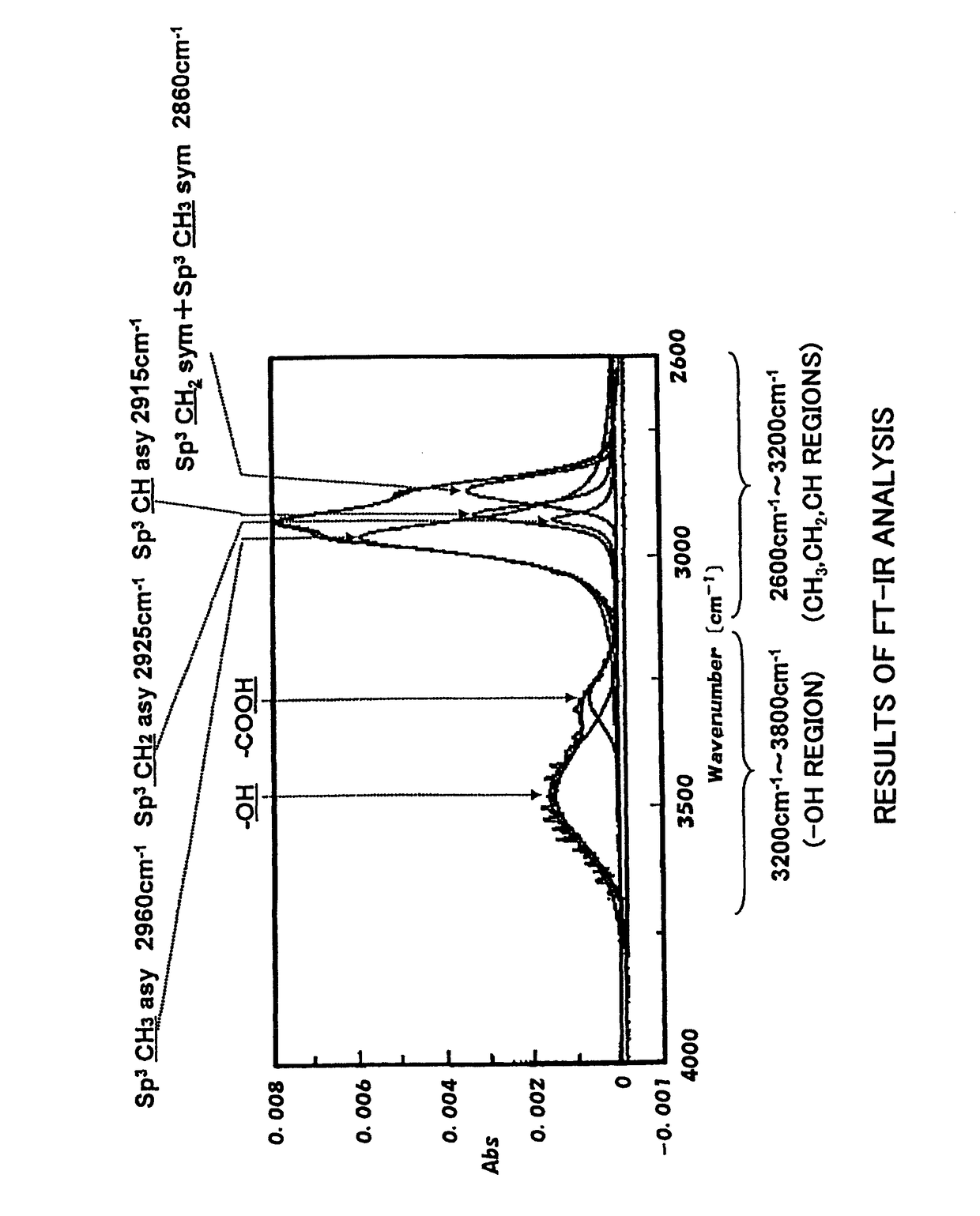
[0081]The obtained bottles were evaluated concerning the above-mentioned various properties to obtain results as shown in Tables 1 and 2. FIG. 1 is an FT-IR chart of the hydrocarbon vacuum-evaporated film formed on the PLA bottle of Example 6.
[0082]
TABLE 1Blank 1Ex. 1Ex. 2Ex. 3Ex. 4Ex. 5Ex. 6Ex. 7Ex. 8ConditionPLAPLAPLAPLAPLAPLAPLAPLAPLAHydrocarbonvacuum-evaporatedlayerAcetylene gas (SCCM)030303029.728.826.726.726.7Ethanol gas (SCCM)00000.31.23.300Methanol gas (SCCM)00000003.30Acetone gas (SCCM)000000003.3Microwave output (W)—615600545615615615615615Time for vacuum—33333333evaporation (sec)Film thickness (nm)135130138133132130135133Structural % CH3—7550437374727472Structural % CH2—4243255554St...
PUM
| Property | Measurement | Unit |
|---|---|---|
| thickness | aaaaa | aaaaa |
| film-forming | aaaaa | aaaaa |
| Tg | aaaaa | aaaaa |
Abstract
Description
Claims
Application Information
 Login to View More