[0014]The present invention provides reticles that provide means for selecting secondary aiming points that accurately target an intended target at any desired range, including extreme distances. In particular, the reticles of the present invention provide markings or other indications that allow a user, for example, to associate a first aiming point of the reticle with an intended target (e.g., the aiming point created by the cross-section of primary vertical and horizontal cross-hairs), and to identify a second aiming point (e.g., identified by a generated aiming dot, an electronic aiming dot, or an aiming point created by secondary vertical and / or horizontal cross-hairs) that represents a point to insure an accurate shot to hit the target.
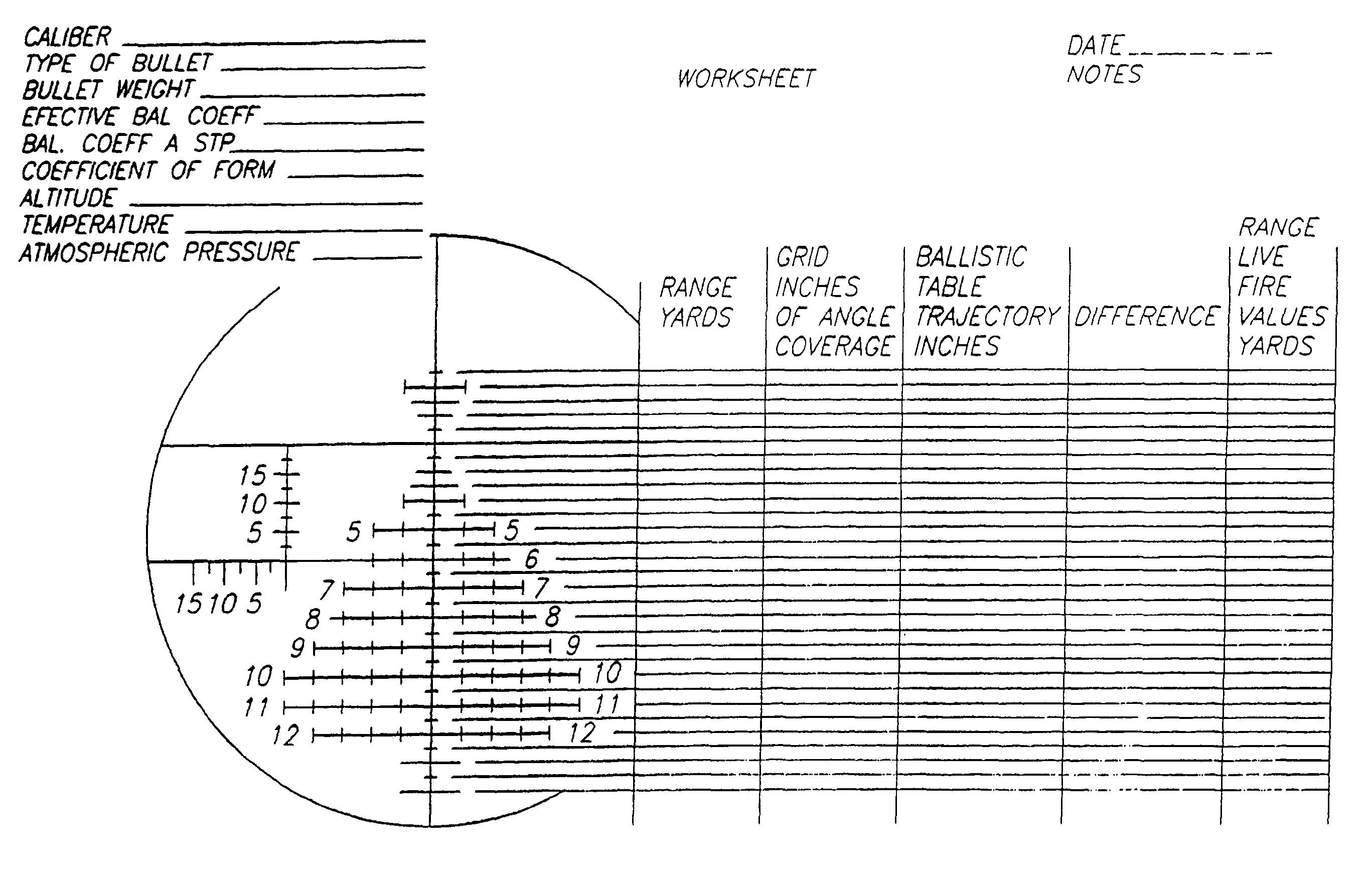
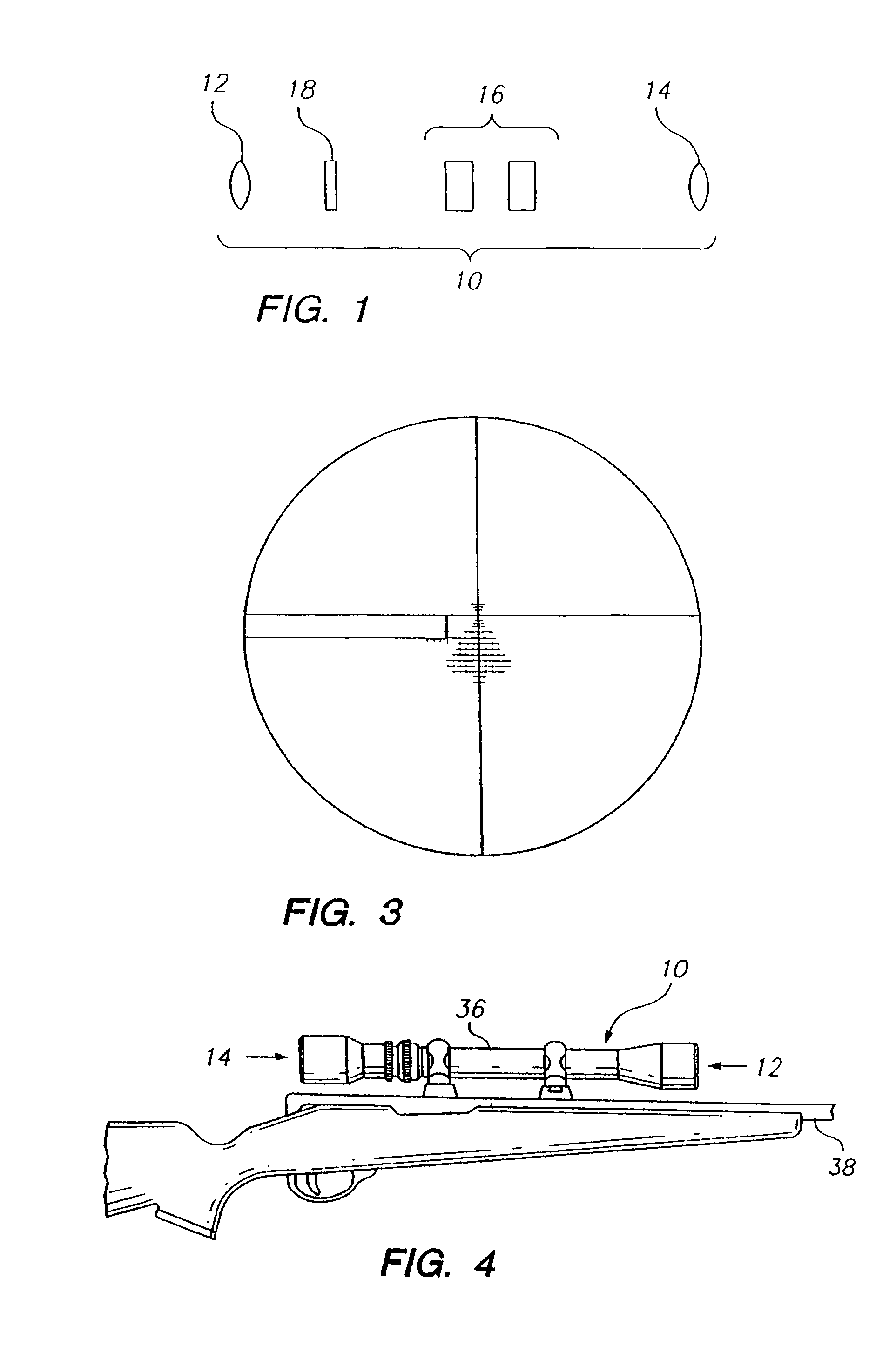
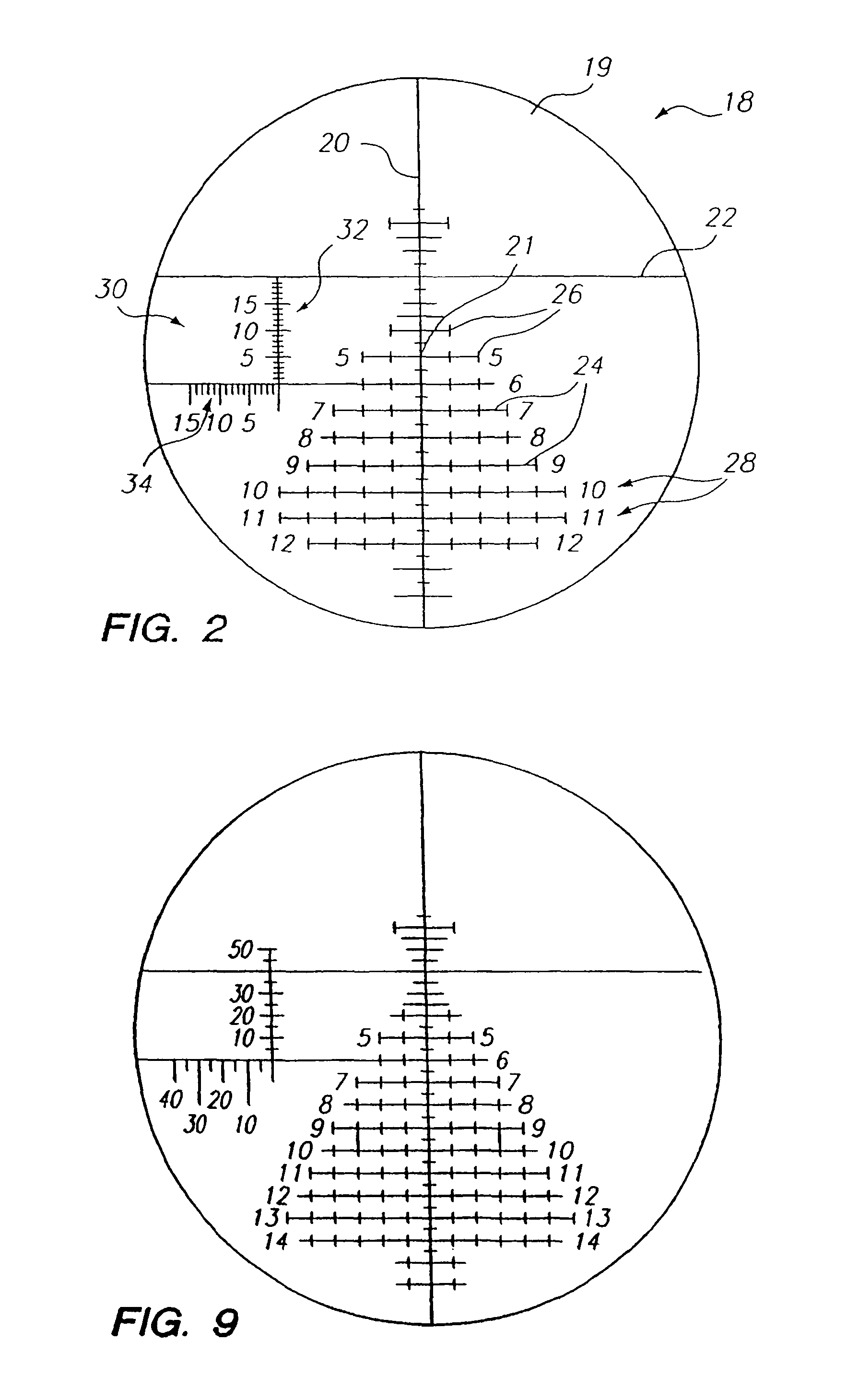
[0018]In a preferred embodiment, the reticle of the present invention is constructed from an optically transparent wafer or electronically generated disc having an optical center that coincides with a center of a field of vision when the wafer is mounted in a scope. In one embodiment, a primary vertical cross-hair having a predetermined thickness bisects the disc, intersecting the optical center of the disc, or intersecting at a point offset from the optical center of the disc. In another embodiment, a primary horizontal cross-hair having a predetermined thickness intersects the primary vertical cross-hair, most preferably above the optical center of the disc, to form an upper right sector (for example, quadrant), an upperleft sector, a lower right sector, and a lower left sector. A plurality of secondary horizontal cross-hairs having predetermined thickness are spaced along the primary vertical cross-hair. In a particularly preferred embodiment, at least some of these secondary horizontal cross-hairs are identified with a unique identifier, to aid the shooter in calibrating the horizontal cross-hairs by range, and in locating the appropriate horizontal cross-hair to use in selecting an aiming point. A plurality of secondary vertical cross-hairs having predetermined thickness are spaced along at least some of said secondary horizontal cross-hairs to aid in making accurate windage adjustments. In a further embodiment a separate range-finding means is positioned on the reticle to aid the shooter in determining the range to target. In a still further embodiment employing military reticles, the shooter uses the distance subtended by the vertical or horizontal lines to calculate the range to the target.
[0021]While the reticles of the present invention find particular use in long-range target acquisition devices they can be used with equal effectiveness at close and medium ranges. In one embodiment, the reticle of the present invention is adapted for use in a mid-range telescopic gunsight, or close range telescopic gunsight, or other device. A mid-range reticle, similar to the long-range reticle described above, is constructed in accordance with this invention. Since the mid-range reticle requires less lower field area, in some embodiments, the primary horizontal cross-hair can be conventionally positioned at the optical center of the reticle. The mid-range reticle can then be calibrated and used in the same manner as a long-range reticle.
[0022]In an additional embodiment, the reticle is provided with a circumscribing ring visible through the target acquisition device, to aid in centering the eye relative to the target acquisition device. This ring helps reduce shooting inaccuracy caused by the misalignment of the shooter's line of sight through the target acquisition device. The ring assures a repeatable check weld to the firearm that is beneficial to repeatable shooting. By providing a visual means to align the reticle within the target acquisition device, the shooter is able to produce more accurate and more repeatable results.
[0023]In one embodiment, the reticle is provided with an aiming dot. The aiming dot may be located at the optical center of the reticle for rapid acquisition of a target at extreme, medium and close range, and for aiding the shooter in centering her or his eye relative to the field of view. In a further embodiment, the aiming dot is projected on the reticle, for example, electronically from the ballistic calculator of the present invention, or for example, optically from a mirror, a split image, holographic image, or by other means such as an electronic grid plate. In a still further embodiment the projected aiming dot is a virtual aiming dot indicating correct barrel position to the shooter in the absence of a line of sight to the target.
[0024]In yet another embodiment, a portion of the primary vertical cross-hair or the primary horizontal cross-hair, or both, is provided with rangefinder markings to eliminate the need for a separate rangefinder means in one of the sectors formed by the intersection of the primary vertical and horizontal cross-hairs.


 Login to View More
  Login to View More