Unlock instant, AI-driven research and patent intelligence for your innovation.

Edge based template matching

a template matching and template technology, applied in the field of image template matching, can solve the problems of preventing generating valid homography, pixel-by-pixel template matching is very time-consuming and computationally expensive, and it is not possible to produce valid homography

Active Publication Date: 2014-10-21
SHARP KK
View PDF12 Cites 3 Cited by
  • Summary
  • Abstract
  • Description
  • Claims
  • Application Information

AI Technical Summary

Benefits of technology

The present invention relates to a method for template matching for image processing. The invention aims to provide a computationally efficient edge based matching technique that reduces the likelihood of failure when matching objects with few or no interesting feature points. The invention also includes various techniques for extracting object discriminative interesting points, matching them with reference images, and refining the homography transformation to improve matching accuracy. The invention is useful for recognizing content in images in a variety of situations, such as when objects contain a sufficient number of interesting feature points or are very simple or symmetric.

Problems solved by technology

It typically fails to produce a valid homography when the target object in the input or model image contains few or no interesting points (e.g. corners), or the target object is very simple (e.g. target object consists of only edges, like paper clip) or symmetric, or the target object contains repetitive patterns (e.g. machine screw).
In these situations, too many ambiguous matches prevents generating a valid homography.
Pixel-by-pixel template matching is very time-consuming and computationally expensive.
When searching for an object with arbitrary orientation, one technique is to do template matching with the model image rotated in every possible orientation, which makes the matching scheme far more computationally expensive.

Method used

the structure of the environmentally friendly knitted fabric provided by the present invention; figure 2 Flow chart of the yarn wrapping machine for environmentally friendly knitted fabrics and storage devices; image 3 Is the parameter map of the yarn covering machine
View more

Image

Smart Image Click on the blue labels to locate them in the text.
Viewing Examples
Smart Image
  • Edge based template matching
  • Edge based template matching
  • Edge based template matching

Examples

Experimental program
Comparison scheme
Effect test

Embodiment Construction

[0035]Referring to FIG. 2, in many cases a model image has a limited set of feature points but tends to have relatively sharp edge features. One such example is a paperclip. Then using a suitable matching technique it is desirable to find a matching object in one or more input images, in a computationally efficient manner. The matching object may be at an unknown position and at an unknown rotation.

[0036]Referring to FIG. 3, in many cases the input image may have one or more matching objects of interest, which may be overlapping with one another. Then using a suitable matching technique it is desirable to find matching objects in one or more input images, in a computationally efficient manner. The matching objects may be at an unknown position and at an unknown rotation.

[0037]Referring to FIG. 4, in many cases the input image may have one or more matching objects of interest, which may be overlapping with one another. Then using a suitable matching technique it is desirable to find ...

the structure of the environmentally friendly knitted fabric provided by the present invention; figure 2 Flow chart of the yarn wrapping machine for environmentally friendly knitted fabrics and storage devices; image 3 Is the parameter map of the yarn covering machine
Login to View More

PUM

No PUM Login to View More

Abstract

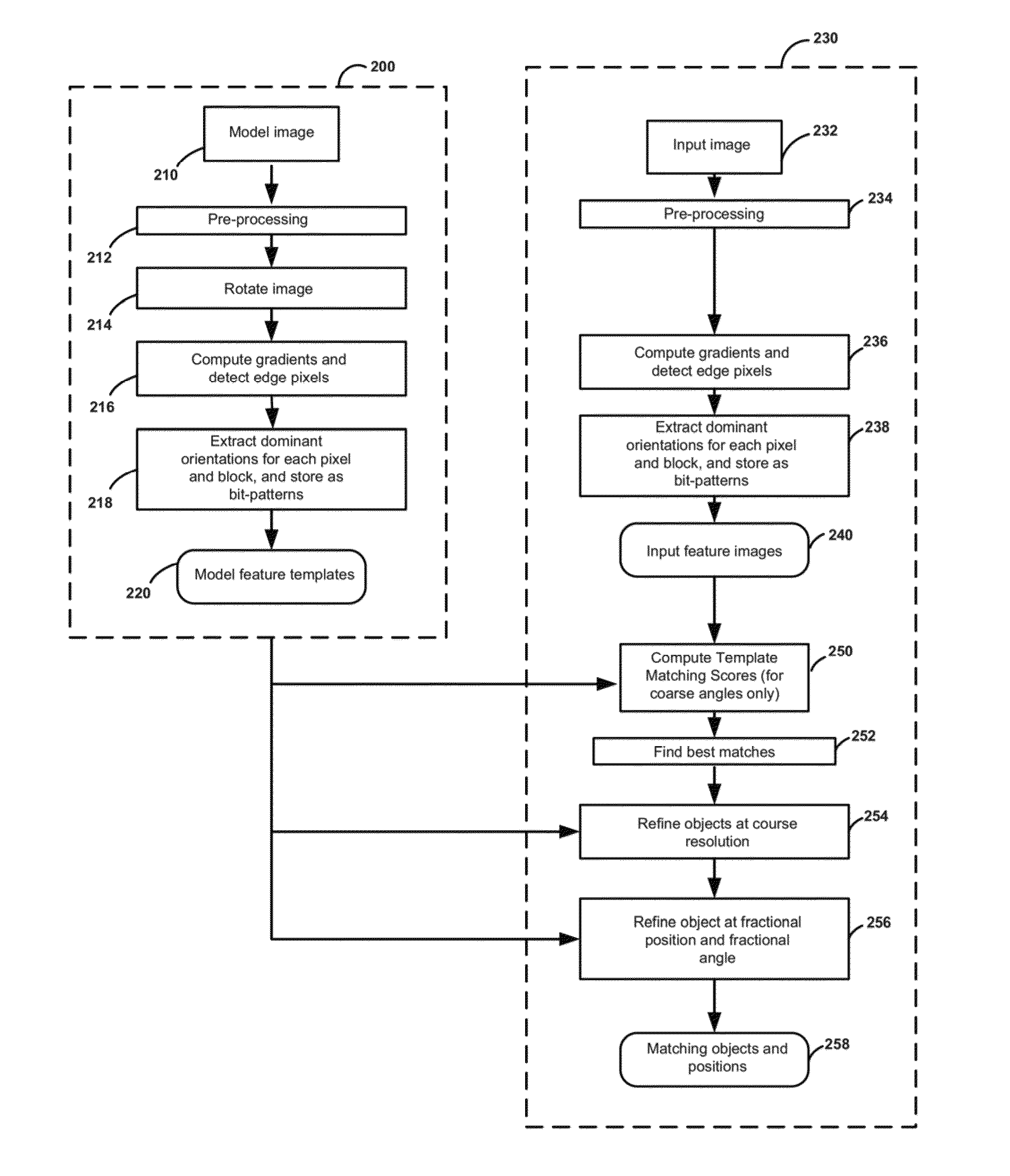
A method for image processing includes determining edge pixels of a model image and determining features for the edge pixels of the model image. The image processing includes determining edge pixels of an input image and determining features for the edge pixels of the input image. The system matches the features of the model image with the features of the input image to determine candidate locations of an object within the input image.

Description

CROSS-REFERENCE TO RELATED APPLICATIONS[0001]None.BACKGROUND OF THE INVENTION[0002]The present invention relates generally to template matching for an image.[0003]Referring to FIG. 1, template matching is a commonly used technique in order to recognize content in an image. The template matching technique includes a given target object in a model image, automatically finding the position, orientation, and scaling of the target object in input images. Generally, the input images undergo geometric transforms (rotation, zoom, etc.) and photometric changes (brightness / contrast changes, blur, noise, etc.). In the context of template matching, the relevant characteristics of the target object in the model image may be assumed to be known before the template matching to the target image is performed. Such characteristics of the target object may be extracted, modeled, and learned previously in a manner that may be considered “off-line,” while the matching of those characteristics to the inp...

Claims

the structure of the environmentally friendly knitted fabric provided by the present invention; figure 2 Flow chart of the yarn wrapping machine for environmentally friendly knitted fabrics and storage devices; image 3 Is the parameter map of the yarn covering machine
Login to View More

Application Information

Patent Timeline
no application Login to View More
Patent Type & Authority Patents(United States)
IPC IPC(8): G06K9/48
CPCG06K9/6211G06V10/757
Inventor VAN BEEK, PETRUS J. L.XU, XINYUYUAN, CHANGFENG, XIAO-FAN
Owner SHARP KK