[0013]Therefore, it is an aspect of the present disclosure to provide a washing machine which may suppress variation of horizontal vibration of the spin basket caused by maldistribution of the balancing balls when the rate of rotation of the spin basket passes the first resonance section, even without moving the balancing balls to positions where weight balance is formed between the balancing balls and the viscous fluid.
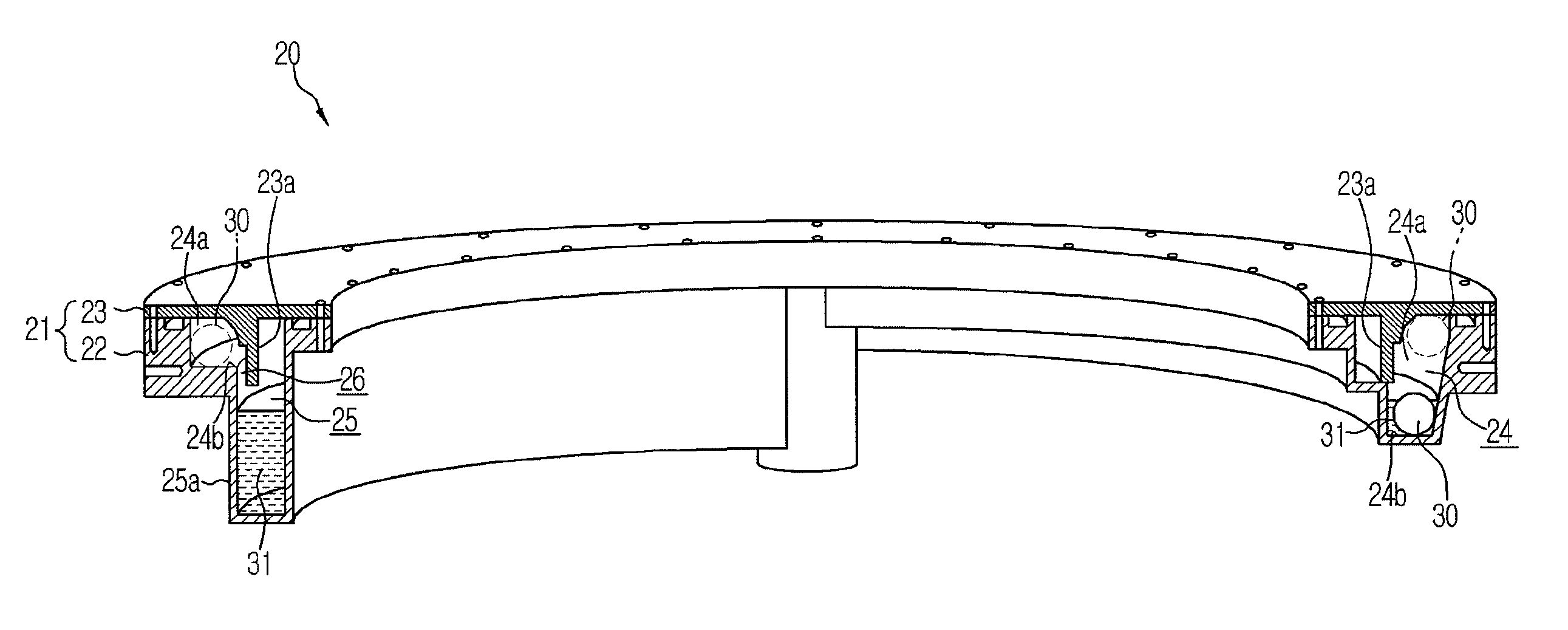
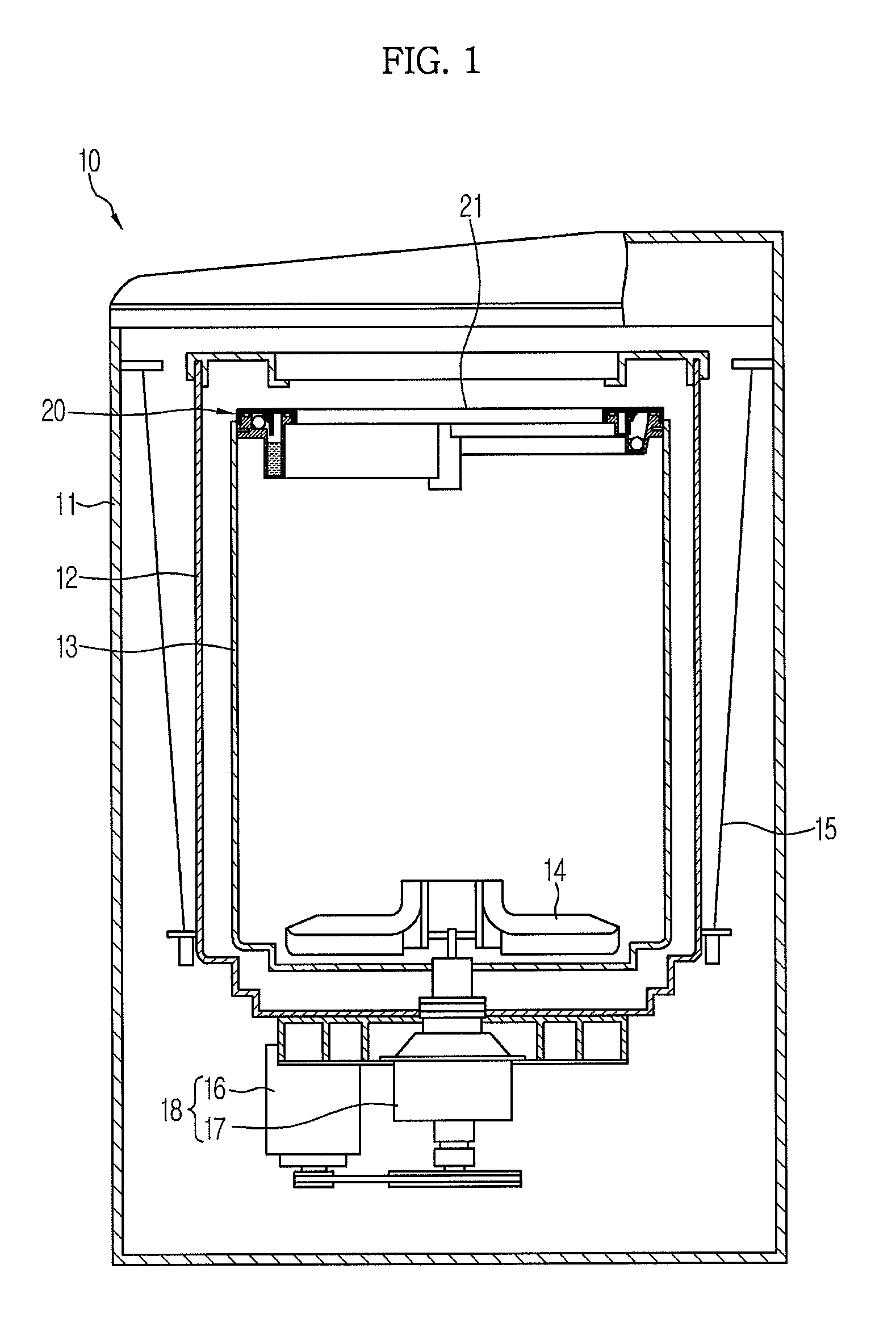
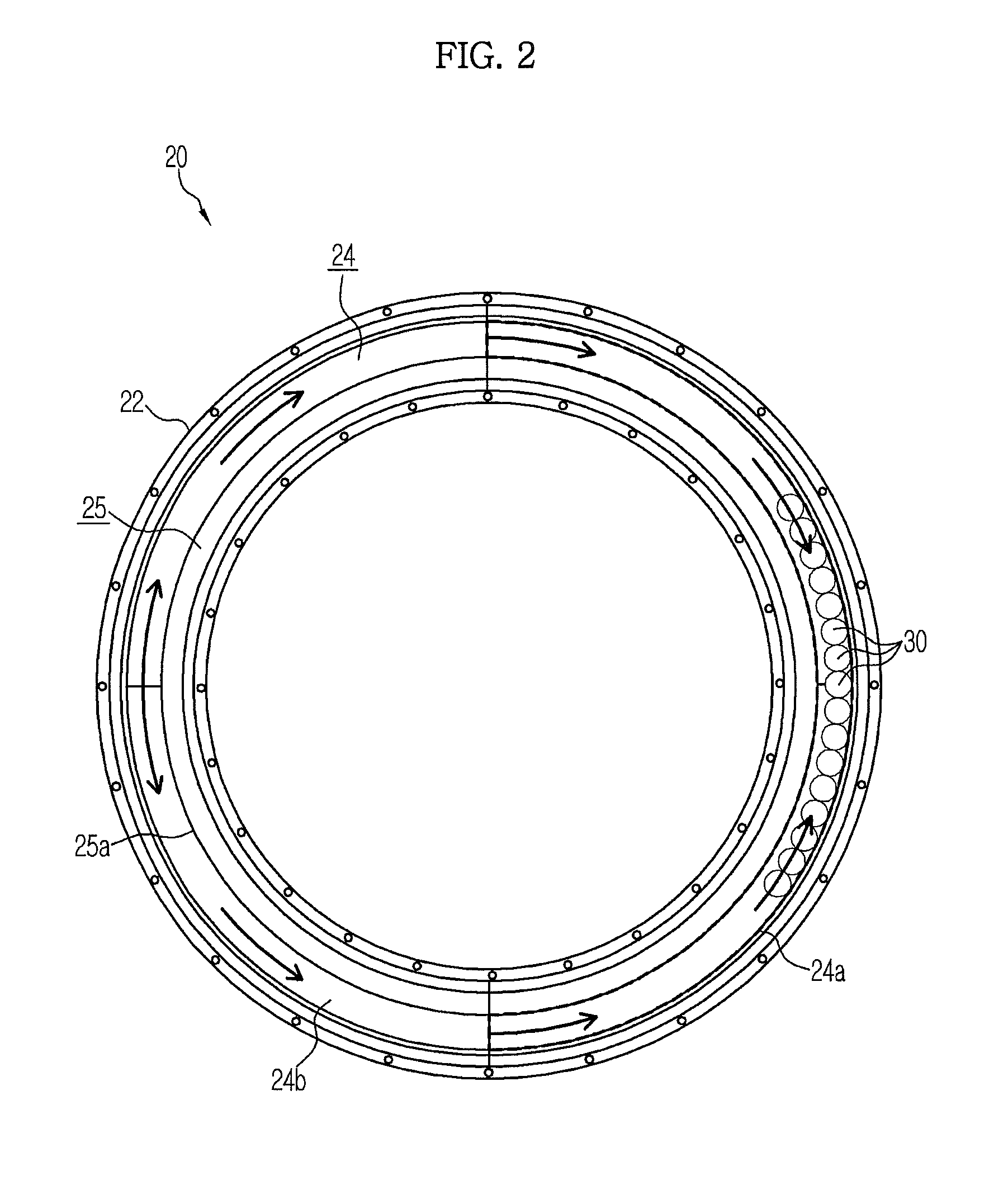
[0020]According to the above description, the balancing device is configured such that weight balance is formed, when rotation of the spin basket is stopped, among the balancing balls having gathered at the opposite position to the fluid accommodation portion, the viscous fluid in the ball accommodation portion, and the viscous fluid in the fluid accommodation portion. Thereby, when rotation of the spin basket is stopped, weight balance is automatically formed among the balancing balls, the viscous fluid in the ball accommodation portion, and the viscous fluid in the fluid accommodation portion. As a result, variation in horizontal vibration of the spin basket due to maldistribution of the balancing balls may be suppressed when the rate of rotation of the spin basket passes (crosses) the first resonance section, even without moving the balancing balls to a position at which weight balance is formed between the balancing balls and the viscous fluid.
[0026]According to the above description, the ball accommodation portion in the casing is provided with a plurality of concave portions having different radial widths and integrally stacked in a vertical direction, and the radial width of the ball accommodation portion is reduced as it extends downward. In addition, a balancing ball group including balancing balls having a diameter corresponding to the radial width of a corresponding concave portion with a bottom surface inclined in a circumferential direction is accommodated in the corresponding concave portion. The balancing balls accommodated in the corresponding concave portion move by rolling on the bottom surface in a circumferential direction of the concave portion and gather when rotation of the spin basket is stopped, such that the center of gravity of the balancing ball groups coincides with the axis of rotation of the spin basket. Since the balancing balls roll on the bottom surfaces of the respective concave portions and gather at one place due to gravity, thereby automatically forming weight balance, special control is not needed as in conventional cases. Accordingly, waste of time and energy may be prevented.
[0027]In addition, the balancing device has a simple structure in which ring-shaped concave portions having different radial widths are vertically stacked, a ball accommodation portion has concave portions each of which has a bottom surface inclined in a circumferential direction, and a plurality of balancing balls is accommodated in the respective concave portions, manufacture may be facilitated and manufacturing cost may be lowered.
[0031]That is, since the bottom surface of each concave portion is inclined downward in a radially outward direction, small-diameter balancing balls move by rolling on this bottom surface in a radially outward direction and fall on a concave portion below each concave portion. Accordingly, the small-diameter balancing balls may be prevented from staying on the bottom surface of each concave portion.
[0033]According to the above description, two kinds of ball balancing groups are used, and accordingly the ball accommodation portion has at least two steps. Therefore, a compact balancing device may be realized. In addition, since the ratio of the diameter of the small-diameter balancing balls to the diameter of the large-diameter balancing balls is between about 0.25 and about 0.9, the area of the portion of the large-diameter balancing ball stuck in the concave portion accommodating the small-diameter balancing balls decreases, and therefore, the large-diameter balancing balls may move easily in a circumferential direction.



 Login to View More
  Login to View More