
Substituted pyrimidines for treatment of acute cough, chronic cough and urge to cough
a technology of p2x purinergic receptors and substituted pyrimidines, which is applied in the direction of amide active ingredients, drug compositions, dispersed delivery, etc., can solve the problems of distressing chronic cough and functionally disabling cough, and achieve the effect of suppressing central modulation of symptom perception, reducing the activity of afferent nerves, and highly selective p2x3
- Summary
- Abstract
- Description
- Claims
- Application Information
AI Technical Summary
Benefits of technology
Problems solved by technology
Method used
Image

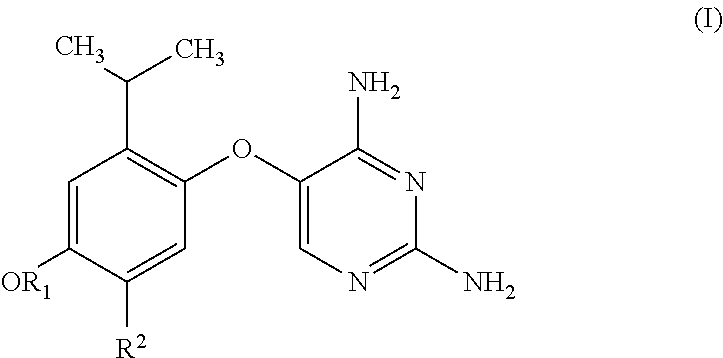
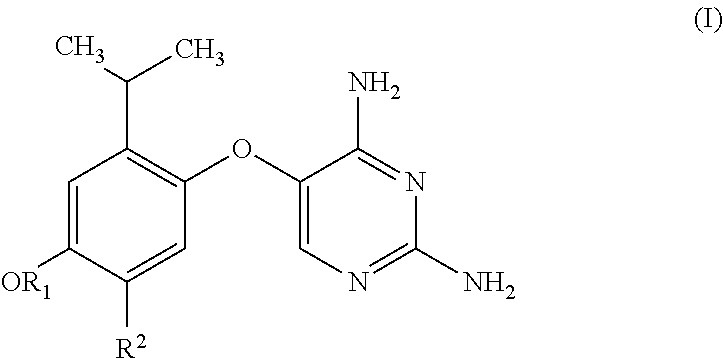
Examples
example 1
5-(5-Bromo-2-isopropyl-4-methoxy-phenoxy)-pyrimidine-2,4-diamine
[0152]The synthetic procedure used in this Example is outlined in Scheme B.
[0153]
Step 1. 2-Bromo-5-isopropyl-phenol
[0154]A solution of 3-isopropyl phenol (4.975 g, 36.5 mmol) in 37 mL of CCl4 was cooled to −20° C. Bromine (1.9 mL, 38.4 mmol) was dissolved in 5.0 mL CCl4 and added drop-wise at such a rate that the internal temperature was maintained below −10° C. The mixture was allowed to warm to room temperature. After 12 hours the mixture was taken up in 100 mL CH2Cl2, washed with H2O and then with brine. The combined organics were dried over Na2SO4, filtered and concentrated in vacuo to give 8.663 g of a 1:1 mixture of 2-bromo-5-isopropyl-phenol and 4-bromo-5-isopropyl phenol as a dark oil). These two isomers were inseparable and were used together in step 2 below.
Step 2. 1-Bromo-4-isopropyl-2-methoxy-benzene
[0155]To a mixture of 2-bromo-5-isopropyl-phenol and 4-bromo-5-isopropyl phenol from step 1 (8.663 g, 40.3 mmo...
example 2
5-(2-Isopropyl-5-methanesulfonyl-4-methoxy-phenoxy)-pyrimidine-2,4-diamine
[0161]
[0162]To a mixture of 5-(2-isopropyl-4-methoxy-phenoxy)-pyrimidine-2,4-diamine (0.32 g, 1.17 mmol), prepared according to Example 2, and methanesulfonic anhydride (0.81 g, 4.67 mmol) was added trifluoromethanesulfonic acid (0.45 g, 3.00 mmol), and the mixture was heated at 80° C. for 16 hrs. The reaction mixture was poured into ice water, basified with saturated NaHCO3 solution and extracted into dichloromethane, which was dried over Na2SO4, filtered and concentrated in vacuo. The residue was purified via flash chromatography on silica gel (3% CH3OH in CH2Cl2 with 0.1% NH4OH) gave 5-(2-isopropyl-5-methanesulfonyl-4-methoxy-phenoxy)-pyrimidine-2,4-diamine as a white solid (0.248 g, 90%; 0.107 g), MS (M+H): 353.
example 3
5-(5-Iodo-2-isopropyl-4-methoxy-phenoxy)-pyrimidine-2,4-diamine
[0163]
[0164]To a solution of 5-(2-isopropyl-4-methoxy-phenoxy)-pyrimidine-2,4-diamine (0.40 g, 1.44 mmol) in glacial acetic acid (4 ml) at room temperature was added a solution of iodine monochloride (0.28 g, 1.76 mmol) in glacial acetic acid (4 ml). Water (6 ml) was also added, and the reaction was stirred for 16 hours, after which another portion of iodine monochloride (0.4 g, 2.47 mmol) in glacial acetic acid (4 ml) was added. The reaction mixture was stirred for an additional hour at room temperature. The acidic mixture was basified with saturated NaHCO3 solution and extracted into dichloromethane. The organic layer was dried over Na2SO4, filtered and concentrated in vacuo. The residue was purified via flash chromatography (5% CH3OH in CH2CL2 with 0.1% NH4OH) to give 5-(5-iodo-2-isopropyl-4-methoxy-phenoxy)-pyrimidine-2,4-diamine as beige colored solid (0.536 g, 92%). M+H 400.
PUM
| Property | Measurement | Unit |
|---|---|---|
| temperature | aaaaa | aaaaa |
| temperature | aaaaa | aaaaa |
| temperature | aaaaa | aaaaa |
Abstract
Description
Claims
Application Information
 Login to View More