Unlock instant, AI-driven research and patent intelligence for your innovation.

Hands-free pointer system

a pointer system and hand-free technology, applied in the field of hand-free pointer systems, can solve the problems of physical difficulty of users, permanent or temporary loss of motor skills, and users without hands, and achieve the effect of accurate tracking and quick movement of the pointer across the field of a monitor

Active Publication Date: 2017-10-24
LONDON HEALTH SCI CENT RES
View PDF16 Cites 3 Cited by
  • Summary
  • Abstract
  • Description
  • Claims
  • Application Information

AI Technical Summary

Benefits of technology

[0020]One or more advantages of at least some of the aspects described herein include: (1) a system that provides hands-free control of an object such as a pointer on a display device, (2) a system that provides high tracking accuracy of the object at all speeds, (3) a system that is not susceptible to external interference, (4) a system that is compact and easy to install, (5) a system that does not cause any loss of image resolution due to the addition of the object, (6) a system that does not require a personal computer or laptop.

Problems solved by technology

Physically challenged users (e.g., users without hands, or with permanent or temporary loss of motor skills) may have difficulty operating keyboards and conventional pointing devices.
This is a time consuming, disorientating, and potentially uncomfortable practice.
A problem with the use of IR light is that its use is susceptible to glare (J. Hargrave-Wright, “Improvements in hands-free access to computers,”Joint Information Systems Committee (JISC) Technology and Standards Watch, Report # TSW 02-06, October 2002.
This system demonstrated several difficulties including: accurate positioning of the pointer at the target site, degradation of the image quality and size, and cumbersome and complicated installation of required equipment.
The pointer systems of the prior art are insufficient in that: hand-held laser pointers systems are cumbersome and can only be used to point to one monitor at a time; there is no commercially available system for surgical training; pointer systems developed for remote collaboration require the use of a hand or a finger to actuate; most hands-free systems have been designed for disabled people, requiring movement of certain muscles or image processing to identify certain features on the user's face, which is not feasible for surgical applications since the surgeon is wearing a face mask, eye protection and a head lamp such that facial features are not exposed for tracking; systems based on gyroscopes or accelerometers have poor resolution and control at low speeds, although accuracy is critical in surgical training; systems based on infrared light are susceptible to glare or reflections occurring on other objects in the field of view of the light source leading to potentially critical errors; no system currently available combines marker tracking technology with inertial sensors; and none of the systems address the issue of velocity-dependent motion control providing precise pointer control at low speeds and large pointer displacement at high speeds.
In addition, none of the above mentioned hands-free devices have been adapted for specific situations such as during video-assisted operative procedures such as laparoscopic surgery and robotics-assisted surgery wherein the surgeon's hands are occupied manipulating surgical tools and the surgeon and trainee(s) may be using different monitors for guidance.

Method used

the structure of the environmentally friendly knitted fabric provided by the present invention; figure 2 Flow chart of the yarn wrapping machine for environmentally friendly knitted fabrics and storage devices; image 3 Is the parameter map of the yarn covering machine
View more

Image

Smart Image Click on the blue labels to locate them in the text.
Viewing Examples
Smart Image
  • Hands-free pointer system
  • Hands-free pointer system
  • Hands-free pointer system

Examples

Experimental program
Comparison scheme
Effect test

Embodiment Construction

Overview

[0027]The present invention relates to systems, devices and methods for controlling the movement of a cursor relative to a target displayed on one or more display devices. The target may, for example, be an area of interest of an image displayed on the display device. In one aspect of the present invention it provides a hands-free controller of a cursor whose motion and position needs to be controlled.

[0028]A cursor includes any computerized reference point with respect to a display device, including for example a text cursor, pointer, crosshair, dot, arrow, plane indicator, triangle, or hollow circle. Furthermore, properties of cursor may be adjustable, including for example orientation, size, color and shape. The cursor may also be a plurality of cursors that can be individually activated for individual movement and adjustment.

[0029]In one aspect of the present invention it provides a system for controlling the movement of a cursor relative to a target displayed on one or ...

the structure of the environmentally friendly knitted fabric provided by the present invention; figure 2 Flow chart of the yarn wrapping machine for environmentally friendly knitted fabrics and storage devices; image 3 Is the parameter map of the yarn covering machine
Login to View More

PUM

No PUM Login to View More

Abstract

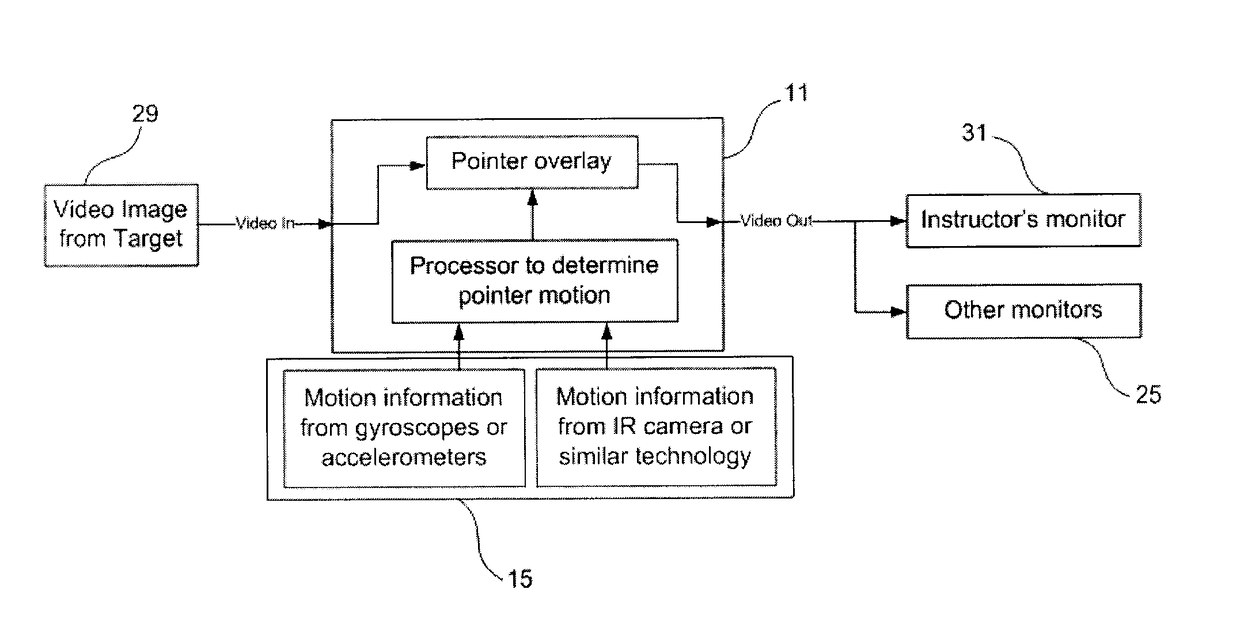
The present invention describes a hands-free system for controlling the movement of a cursor on one or more display devices. A tracking device including a traceable marker and one or more accelerometers and gyroscopes are used to track position and acceleration of the marker relative to a target of interest. A processing means processes the motion signals from the tracking device to determine the location of the cursor on the operator's monitor, which may also be displayed on more monitors. The tracking device is worn by the operator, optimally on the operator's head. The operator's head movements determine movement of the cursor.

Description

CROSS REFERENCE TO RELATED APPLICATIONS[0001]This application is a national stage application under 35 U.S.C. §371 of International Application No. PCT / CA2009 / 001667, filed Nov. 20, 2009, which in turn claims the benefit under 35 U.S.C. §119(e) of U.S. Provisional Application Ser. No. 61 / 116,675, filed Nov. 21, 2008, the contents of each of which is hereby incorporated by reference into the present disclosure.FIELD OF THE INVENTION[0002]The present invention relates to novel systems, methods and devices useful for controlling the movement of a cursor on one or more display devices. Specifically, the present invention relates to novel hands-free systems, methods and devices useful for controlling the movement of a pointer on one or more display devices. The present invention more specifically relates to hands-free pointer systems, methods and devices to be used in situations wherein an operator controls a pointer on his or her monitor and the pointer is displayed on one or more monit...

Claims

the structure of the environmentally friendly knitted fabric provided by the present invention; figure 2 Flow chart of the yarn wrapping machine for environmentally friendly knitted fabrics and storage devices; image 3 Is the parameter map of the yarn covering machine
Login to View More

Application Information

Patent Timeline
no application Login to View More
Patent Type & Authority Patents(United States)
IPC IPC(8): G06F3/01A61B1/00
CPCA61B1/00039G06F3/012G06F3/011G06F3/0346A61B1/0004
Inventor SCHLACHTA, CHRISTOPHER M.PATEL, RAJNIKANT V.TREJOS, ANA LUISANAISH, MICHAEL DAVID
Owner LONDON HEALTH SCI CENT RES