
Preparation of multi-organophosphor universal antibody and universal envelope antigen
A technology of coating antigens and organophosphorus, applied in the field of residual pesticide detection, can solve the problem of not analyzing ELISA kits at the same time, and achieve the effect of simple pretreatment process and improved sensitivity
- Summary
- Abstract
- Description
- Claims
- Application Information
AI Technical Summary
Problems solved by technology
Method used
Image


Examples
Embodiment Construction
[0034] The present invention will be further described below with embodiment:
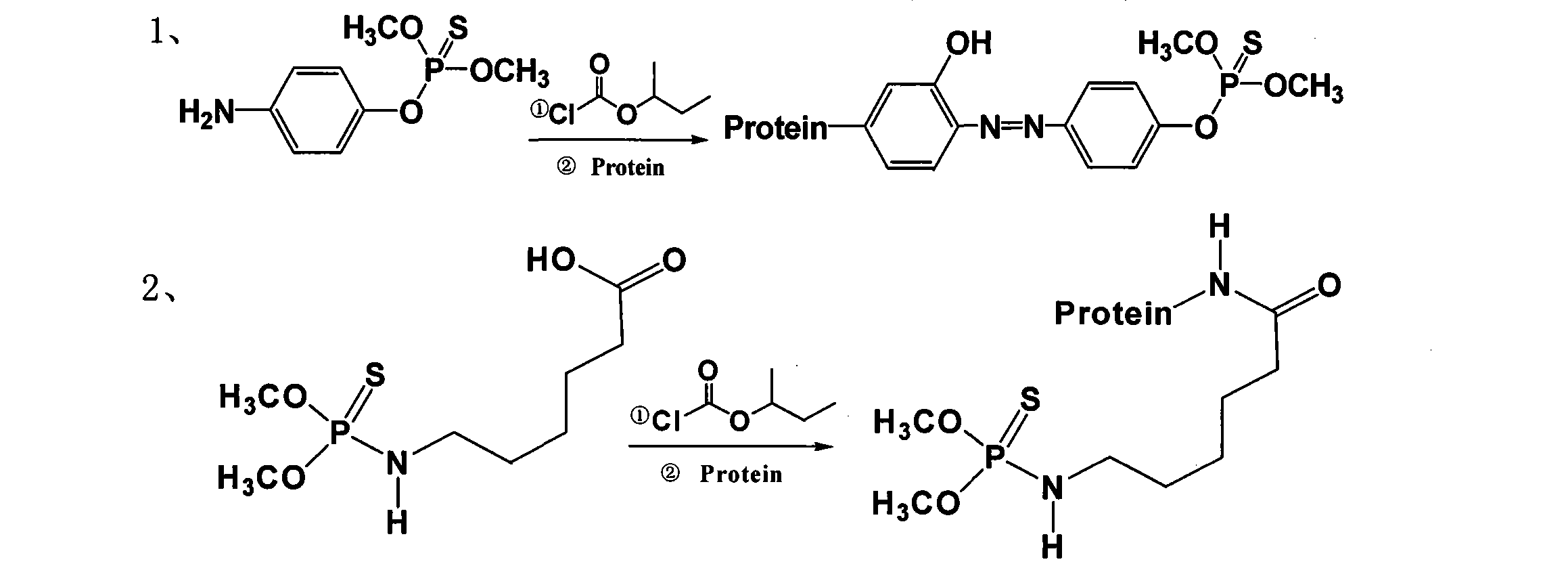
[0035] Artificial antigen preparation: d aryl phosphorothioate artificial hapten, direct phosphorothioate artificial hapten 60mg, 72mg were dissolved in 5.0ml DMF. Dissolve 0.2 mL of tri-n-butylamine in 5.0 mL of DMF, and add e to d to obtain f. Dissolve 0.16 mL of isobutyl chloroformate in 10 mL of DMF, add dropwise to f at 4°C, and react for 1 hour to obtain g. 120 mg of bovine serum albumin was dissolved in 60 mL of borate buffer solution with pH=8.7 and 0.05 M, then g was added dropwise to it below 18°C, and reacted at room temperature (~20°C) for 12 hours. The obtained reaction solution was put into a dialysis bag, and dialyzed in PH=7.4, 0.01M buffer solution at 4°C for 60 hours, and the PBS dialysate was changed every 8 hours, 1 L each time. Until no hapten UV absorbance (OD 282 ). Accurately measure the volume of the protein solution after dialysis, determine the protein concentration a...
PUM
 Login to View More
 Abstract
Description
Claims
Application Information
 Login to View More