
Process for treating saponification wastewater by chlorohydrination
A technology of wastewater treatment and treatment method, applied in the field of chemical treatment
- Summary
- Abstract
- Description
- Claims
- Application Information
AI Technical Summary
Problems solved by technology
Method used
Image

Examples
Embodiment 1
[0045] Design, install and debug each treatment device of the whole process with a treatment capacity of 2 tons per hour, and finally conduct a field test on the saponification wastewater of a propylene oxide plant:
[0046] It has been determined that the discharge of saponification wastewater is about 10,000 tons / day, the pH of saponification wastewater is 11.8, the salt content is 2.9%wt, COD Cr 1800mg / L, suspended solids SS 2800mg / L, water temperature 81°C; follow the steps below:
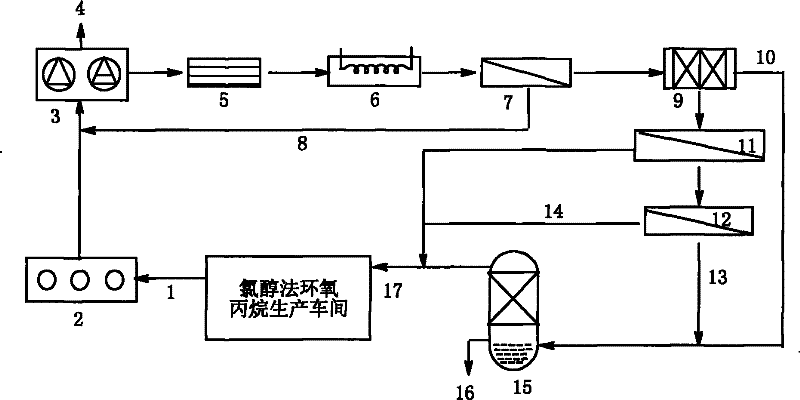
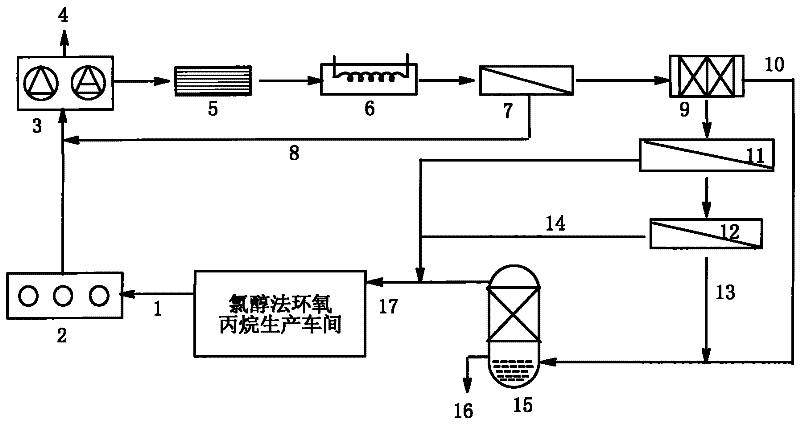
[0047] 1. The saponification wastewater is pumped into the thickening tank 2 through the sludge pump to recover the gray milk. The SS value of the supernatant is determined to be 850mg / L, and the supernatant enters the turbine type air flotation sedimentation combined tank 3 to remove some small particles Suspended matter and large particle suspended matter, the settling time is 1.5 hours, and the sediment is pressed into a filter cake with a filter press and shipped out. After air flotation an...
PUM
 Login to View More
 Abstract
Description
Claims
Application Information
 Login to View More