Traditional Chinese medicine for tonifying kidneys, strengthening heart, dissipating blood stasis and activating collaterals

A technology for removing blood stasis and dredging collaterals and traditional Chinese medicine, which is applied in the directions of drug combination, pharmaceutical formula, cardiovascular system diseases, etc., can solve the problems of high recurrence rate, aggravation, insignificant relief of symptoms of coronary heart disease and angina pectoris, etc., and achieves low price and exact curative effect. , the effect of easy availability of raw materials

CN101732562AInactive Publication Date: 2010-06-16四川省中医药科学院中医研究所
0 Cites 6 Cited by

Patent Information

Authority / Receiving Office
CN · China
Patent Type
Applications(China)
Current Assignee / Owner
Publication Date
2010-06-16
Estimated Expiration
Not applicable · inactive patent

Smart Images

  • Figure 1
    Figure 1
Patent Text Reader

Abstract

The invention relates to a traditional Chinese medicine for tonifying the kidneys, strengthening the heart, dissipating the blood stasis and activating the collaterals, which is a new high-efficiency, cheap, safe and convenient pure traditional Chinese medicine specifically used for treating coronary heart disease and stenocardia the symptoms of which comprise the failure and deficiency of the heart and the kidneys and the stasis of the blood vessels. The traditional Chinese medicine is prepared by comprising the components of epimedium, radix salviae miltiorrhizae, cassia twig, radix astragali, radix psuedostellariae, ophiopogon root, magnolia vine fruit, angelica, radix paeoniae rubra, hemlock parsley and safflower. Based on the heart-kidney correlation theory, the invention recognizes the coronary heart disease and the stenocardia with an angle that the failure and the deficiency of the heart and the kidneys are caused by the blood stasis of the vessels, and provides a theory that tonifying the kidneys, strengthening the heart, dissipating the blood stasis and activating the collaterals is a basic treating rule for preventing and treating the coronary heart disease and the stenocardia. The prescription uses the epimedium and the radix salviae miltiorrhizae as the monarch drug to tonify the kidneys and dissipating the blood stasis, uses the cassia twig, the astragali, the radix psuedostellariae, the angelica, the radix paeoniae rubra and the like as the minister drug to assist the monarch drug to supplement the qi, activate the yang, activate the blood circulation and dissipate the blood stasis, and uses the ophiopogon root and the magnolia vine fruit as the assistant and guide drug to nourish the yin and moisten the lung. When taking the medicine for a long term, patients suffering from the chest obstruction can improve the symptoms such as chest pain, chest distress, palpitation, limp and aching lumbus and knees and frequent urination at night and the like.
Need to check novelty before this filing date? Find Prior Art

Description

technical field

[0001] The invention relates to a traditional Chinese medicine for invigorating the kidney and strengthening the heart, removing blood stasis and dredging collaterals, and specially treating angina pectoris of coronary heart disease of heart and kidney deficiency and blood stasis type. Background technique

[0002] With the industrialization of society and population aging, the morbidity and mortality of coronary heart disease and angina pectoris rank among the best among geriatric diseases, and are on the rise, seriously threatening the health and life of middle-aged and elderly people. Coronary heart disease angina pectoris, also known as ischemic heart disease, is a clinical syndrome caused by acute and temporary myocardial hypoxia due to insufficient coronary blood supply. The cause is insufficient blood supply caused by coronary atherosclerosis or spasm. 95% of them are caused by coronary atherosclerotic heart disease. In recent years, with the advancem...

Examples

Embodiment

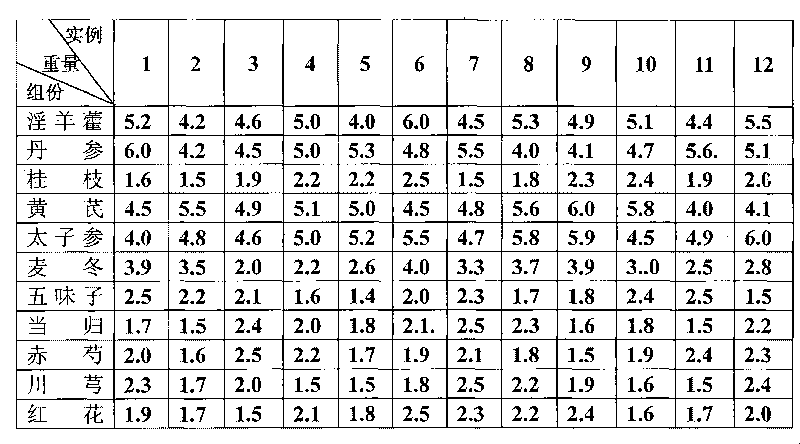
[0034] The present invention provides twelve examples in tabular form with different weight ratios of prescriptions of Epimedium, Danshen, Guizhi, Astragalus, Radix Pseudostellaria, Ophiopogon japonicus, Schisandra, Angelica, Radix Paeoniae Rubra, Rhizoma Chuanxiong, and Safflower, wherein The weight unit can be kg or g.

[0035] Table 1

[0036]

[0037] The Chinese medicine prescription production process in the foregoing embodiment is as follows:

[0038] Eleven medicinal materials, epimedium, salvia miltiorrhiza, heterophylla, schisandra, red peony, astragalus plus 10 times the amount of 70% ethanol reflux extraction twice, the first time 1.5h, the second time 1h, filter, combine the liquid, Discard the dregs of the medicine; recover ethanol under reduced pressure until there is no alcohol smell, and prepare the medicine liquid for later use; add 14 times the amount of water to decoct Angelica, Chuanxiong, Ophiopogon japonicus, Safflower, and Guizhi three times, each t...

example 1

[0040] Case 1: Mo Moumou, male, 73 years old. First visit on May 18, 2005:

[0041] Chief Complaint: Squeeze-like discomfort in the chest area for more than 2 weeks, induced by activities, accompanied by palpitation, palpitations, and cold sweats, each attack lasted from several minutes to more than ten minutes, relieved after rest, 10 attacks per day More than times, no attack at night. I once went to the outpatient clinic of another hospital to perform ECG prompts: sinus rate, HR77 beats / min, regular rhythm, occasional premature room, ST segment (II, III, AVF, V3-6) level shift ≥ 0.05mv, the outpatient doctor gave Danshen tablets, Drugs such as Xiaoxin Pain, the effect is not good after taking it. He had a history of hypertension in the past, and his blood pressure was well controlled. He denied a history of diabetes. Dietary intake, loose stools, frequent urination, poor night sleep.

[0042] Tongue pulse: Pale tongue and dark stasis, slightly fat tongue body, thin whit...