
Enterovirus 71 (EV71) monoclonal antibody and application thereof
A monoclonal antibody and virus technology, applied in the field of virus immunity biomedicine, can solve the problems of high test cost, long detection time, difficult to popularize and use, etc., and achieve the effect of strong guiding significance, high neutralization activity and so on.
- Summary
- Abstract
- Description
- Claims
- Application Information
AI Technical Summary
Problems solved by technology
Method used
Image

Examples
Embodiment 1
[0039] The establishment of embodiment 1 anti-EV71 monoclonal antibody cell line
[0040] 1. Immunogen preparation: the immunogen is EV71 inactivated virus (the virus was preserved in the General Microbiology Center (CGMCC) of China Microbiological Culture Collection Management Committee (CGMCC) on May 8, 2009, and the preservation number is CGMCC No.3062) to inoculate Vero cells , obtained through culture, inactivation and purification.
[0041] 2. Animal immunization: BALB / c mice were immunized with EV71 inactivated virus. For the first time, animals were immunized with complete Freund's adjuvant mixed with EV71 emulsified according to methods known in the art; 10 days later, mice were boosted with Freund's incomplete adjuvant mixed with EV71 emulsified; one week later, serum anti-EV71 activity was measured by indirect ELISA. The mouse with the highest antibody titer was boosted intraperitoneally with EV71 purified solution.
[0042] 3. Cell fusion strain establishment: 3 ...
Embodiment 2
[0044] The preparation of embodiment 2 monoclonal antibody
[0045] BALB / c mice were immunoparaffinized intraperitoneally. Hybridoma cells were cultured, collected, centrifuged and washed once, resuspended in serum-free culture medium, cell density was adjusted, and sensitized mice were injected intraperitoneally for 7 days. About 7-12 days after the inoculation, the abdominal cavity of the mouse was obviously swollen. The ascites was collected with a syringe, centrifuged at 1500rpm for 10 minutes to collect the ascites, and the monoclonal antibody cell line was established and stored in liquid nitrogen.
Embodiment 3
[0046] The specificity determination of embodiment 3 monoclonal antibody
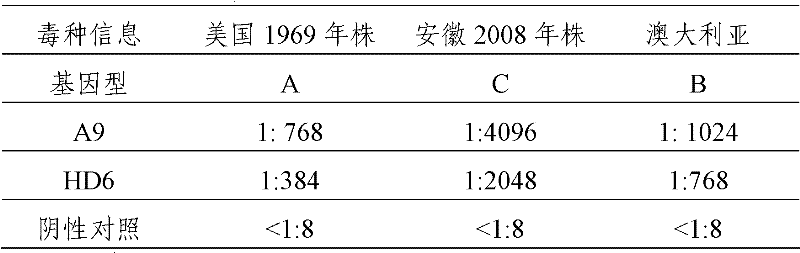
[0047] Use A9 monoclonal antibody purified by ammonium sulfate to coat the microtiter plate, add EV71 inactivation solution of A, B, C three genotypes, Cox A16 virus, hepatitis A virus, Japanese encephalitis virus, varicella virus, etc., and mark with HRP The rabbit anti-EV71 polyclonal antibody is a labeled antibody for antigen detection. The results showed that only EV71 virus reacted, and the monoclonal antibody had no cross-reaction with other enteroviruses and other hand-foot-mouth viruses such as Cox A16, and the specificity was good.
PUM
 Login to View More
 Abstract
Description
Claims
Application Information
 Login to View More