Glasses-free three-dimensional image display method and device
An image display device and naked-eye three-dimensional technology, which is applied in image communication, static indicators, instruments, etc., can solve the problem of resolution reduction of lenticular 3D displays, and achieve the effect of avoiding resolution reduction
- Summary
- Abstract
- Description
- Claims
- Application Information
AI Technical Summary
Problems solved by technology
Method used
Image



Examples
Embodiment 1
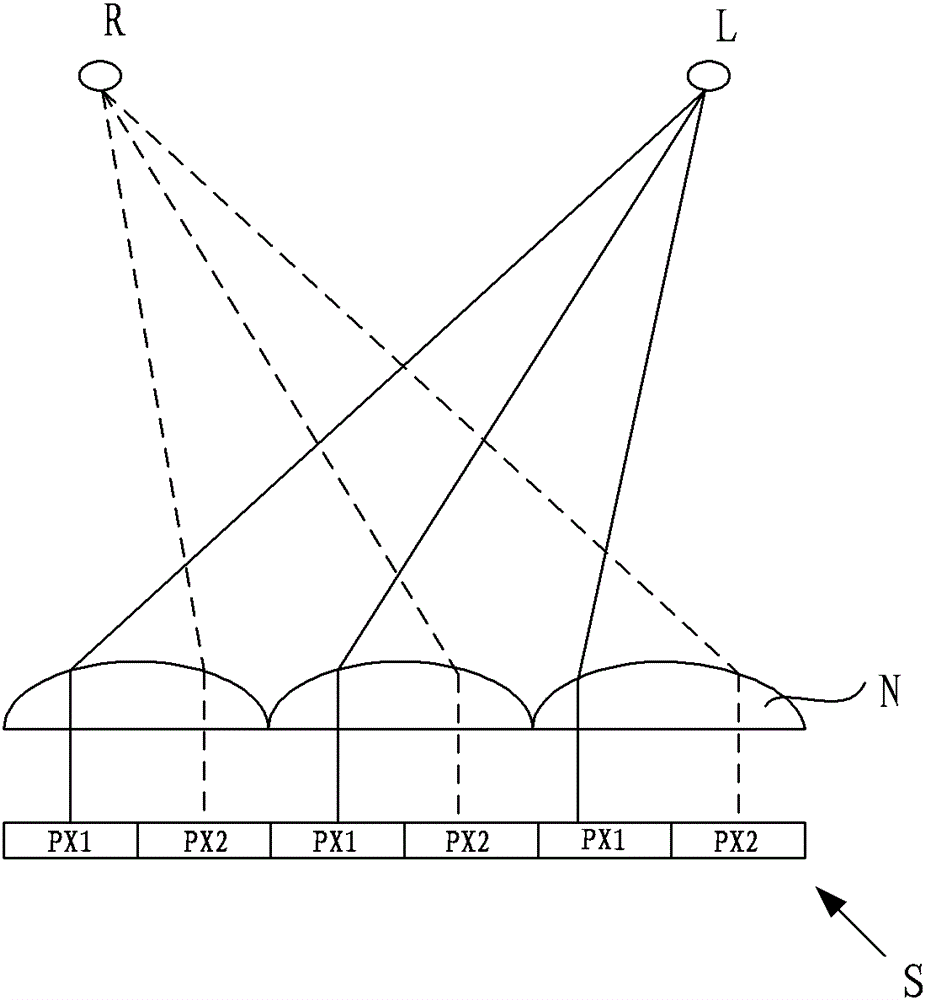
[0024] This embodiment provides a naked-eye three-dimensional image display method, which is an improvement on the existing lenticular 3D display technology, see below figure 2 ~ Figure 5 describes the method in detail.
[0025] 201. The control device makes the two-dimensional display screen display the left-eye image at the first moment, and simultaneously applies a first set of voltages to the liquid crystal lens above the two-dimensional display screen, so that the left-eye image passes through the The liquid crystal lens projects to the viewer's left eye.
[0026] Specifically, such as image 3 As shown, the liquid crystal lens can be an electrically controlled lens, which includes a first transparent electrode 31, a second transparent electrode 32, and a liquid crystal layer 33 sandwiched between the two transparent electrodes. A substrate 34 is attached. The liquid crystal lens utilizes the characteristic that the liquid crystal molecules 35 rotate around the rotati...
Embodiment 2
[0041] This embodiment provides a naked-eye three-dimensional image display device, which improves the existing lenticular 3D display, see below Figure 6 This device will be described in detail.
[0042] The naked-eye three-dimensional image display device includes: a two-dimensional display screen 61 for displaying two-dimensional images, a control device 62, and a liquid crystal lens 63 located on the light-emitting surface of the two-dimensional display screen. Those skilled in the art can understand that the light-emitting surface refers to the side of the two-dimensional display screen on which images are displayed.
[0043] Wherein, the control device 62 is used to make the two-dimensional display screen 61 display the left-eye image at the first moment, and apply a first set of voltages to the liquid crystal lens 63 synchronously, so that the left-eye image can be transmitted through The liquid crystal lens 63 is projected to the left eye of the observer; the control ...
PUM
 Login to View More
 Abstract
Description
Claims
Application Information
 Login to View More