
Recombinant DNA (deoxyribonucleic acid) fragment containing roundup ready gene and application thereof
A glyphosate-resistant and fragment-resistant technology, applied in the field of recombinant DNA fragments, can solve problems such as low expression levels
- Summary
- Abstract
- Description
- Claims
- Application Information
AI Technical Summary
Problems solved by technology
Method used
Image

Examples
Embodiment 1
[0041] Example 1. Obtaining of codon-optimized glyphosate-resistant genes
[0042] This example is based on the amino acid sequence of the G2-aroA gene (Chinese patent, application number 03826892.2, authorized announcement number CN 100429311 C) (the nucleotide sequence is shown in sequence 1 in the sequence table), under the premise of ensuring that the amino acid sequence remains unchanged , first artificially optimized the G2-aroA gene by adopting maize-biased codons. Try to avoid using maize rare codons, and adjust the codon usage frequency (Table 1), so that the codon usage frequency of G2-aroA protein is close to the usage frequency in maize (Table 1). On this basis, the typical AT-rich sequence that causes instability of plant gene transcripts in the DNA sequence is removed, and the hairpin structure is removed, and the new nucleotide sequence obtained is sequence 2 in the sequence listing. The homology between sequence 2 and G2-aroA gene (sequence 1) is only 84%, and...
Embodiment 2
[0047] Example 2, the acquisition of mG2-aroA transgenic maize
[0048] 1. Construction of recombinant expression vector
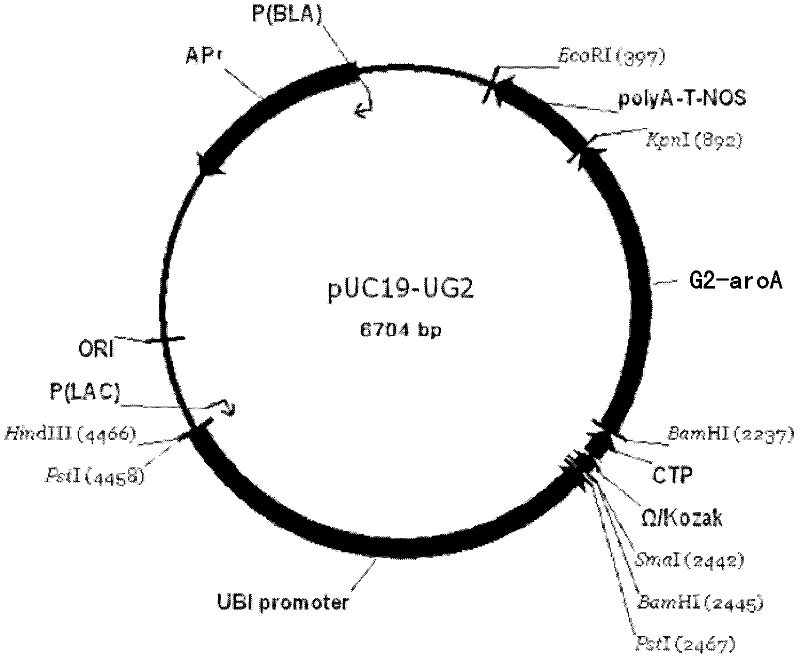
[0049] In order to improve the expression level of the mG2-aroA gene (sequence 2) in the recipient organism, the inventors added an omega sequence and a Kozak sequence to the 5' end of the mG2-aroA gene when constructing the recombinant expression vector of the mG2-aroA gene, The Ω / Kozak sequence (abbreviated as OMK) is shown as sequence 6 in the sequence listing. The Ω sequence is a translation enhancing sequence derived from the coding region of the capsid protein gene of a plant virus. It consists of 67 bp and is enriched in TTAAC sequences. There is a UAUUUUUACAACAA sequence and 4 UUAC sequences at the 5' end, which are formed during the translation process of protein synthesis. Ribosome and rRNA binding sites. Kozak sequence is a sequence encoding ribosome binding protein that promotes the translation process of foreign genes in plant cells. The co...
Embodiment 3
[0100] Example 3, Double Antibody Sandwich ELISA Detection of G2-aroA Protein Expression in Transgenic Maize Plants
[0101] Sample extract: Tris-Cl (pH8.0) 25mM, KCl 10mM, MgCl 2 ·6H 2 O 20mM, DTT 1mM, PMSF 1mM (add before use).
[0102] Coating buffer: Take 1.5g Na 2 CO 3 , 2.93 g NaHCO 3 , and distilled water to 1000mL, pH9.6.
[0103] Washing solution (PBST): take 1mL Tween 20, add phosphate buffer saline (PBS) to make up to 1000mL, pH7.5; phosphate buffer saline (PBS): take 8.0g NaCl, 0.2g KH 2 PO 4 , 2.96 g Na 2 HPO 4 12H 2 O, add 1000mL distilled water, pH7.5.
[0104] Sample buffer solution (PBST): Take 1mL Tween 20, add phosphate buffer saline (PBS) to make it 1000mL, pH7.5; Phosphate buffer saline (PBS): take 8.0g NaCl, 0.2g KH 2 PO 4 , 2.96 g Na 2 HPO 4 12H 2 O, add 1000mL distilled water, pH7.5.
[0105] Substrate buffer: Take 0.1g MgCl 2 or 0.2g MgCl 2 ·6H 2 O, 97.0 mL diethanolamine, dissolved in 1000 mL distilled water, pH 9.8, stored at 4°C. ...
PUM
| Property | Measurement | Unit |
|---|---|---|
| concentration | aaaaa | aaaaa |
Abstract
Description
Claims
Application Information
 Login to View More