
Urban vehicle-mounted network moving switching method based on IPv6 (Internet Protocol Version 6)
A vehicle-mounted network and city technology, applied in network data management, electrical components, wireless communication, etc., can solve the problems that mobile protocols are difficult to work effectively, and achieve the effects of shortening mobile switching delays, ensuring continuity, and reducing communication quality
- Summary
- Abstract
- Description
- Claims
- Application Information
AI Technical Summary
Problems solved by technology
Method used
Image



Examples
Embodiment Construction
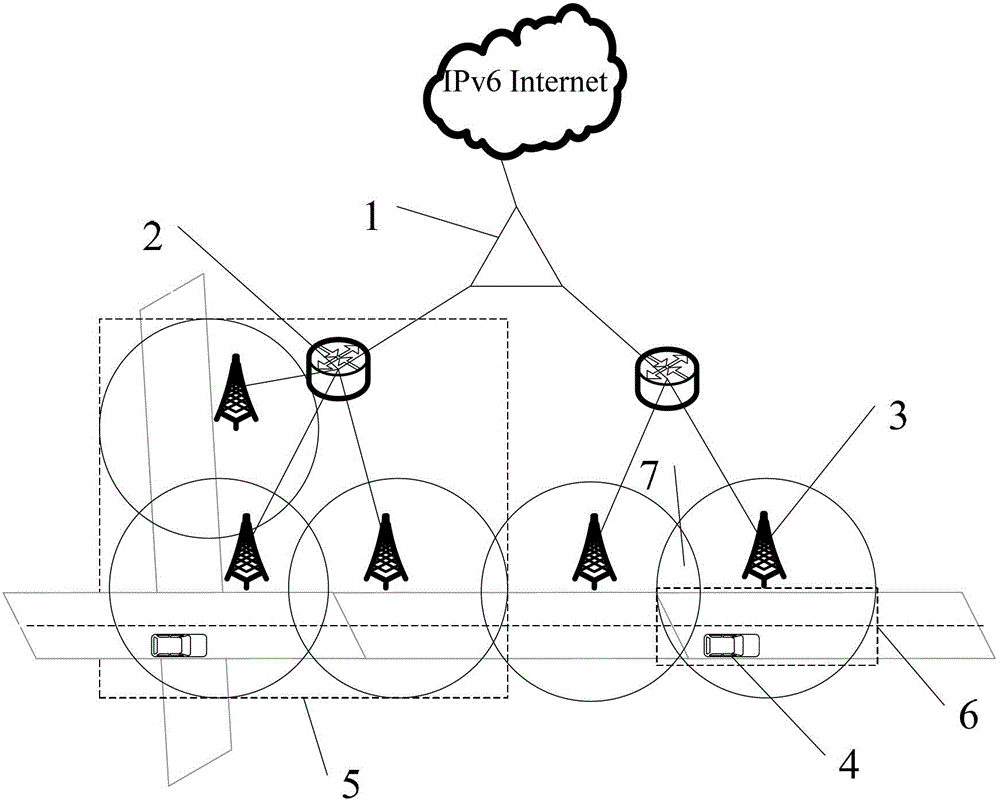
[0046] The invention provides an IPv6-based urban vehicle network mobile switching method, and the realization method can be widely used in the urban vehicle network. In the vehicular network, the vehicle nodes are highly mobile, so the packet loss rate will be caused in the mobile handover, thereby degrading the communication quality. The invention shortens the mobile switching delay of the vehicle node and reduces the packet loss rate of the vehicle node. Through the present invention, the vehicle node can better obtain Internet network services, such as video and audio, etc. during the moving process.
[0047] figure 1 It is a schematic diagram of the topology structure of the IPv6-based urban vehicular network according to the present invention. The urban vehicular network includes a border router 1, an access router 2, an access node 3 and a vehicle node 4; wherein, the border router 1 is connected to the backbone network of the Internet as a border router of an urban v...
PUM
 Login to View More
 Abstract
Description
Claims
Application Information
 Login to View More