Anti-aliasing method for film post-synthesis

A post-synthesis and anti-aliasing technology, applied in image data processing, 3D image processing, instruments, etc., can solve problems such as aliasing and low resolution, and achieve the effect of reducing aliasing distortion

CN103198513BInactive Publication Date: 2015-11-25ZHEJIANG UNIV
6 Cites 0 Cited by

Patent Information

Authority / Receiving Office
CN · China
Patent Type
Patents(China)
Current Assignee / Owner
Publication Date
2015-11-25
Estimated Expiration
Not applicable · inactive patent

Smart Images

  • Figure 1
    Figure 1
  • Figure 2
    Figure 2
  • Figure 3
    Figure 3
Patent Text Reader

Abstract

The invention discloses a movie post-synthesis anti-aliasing method. The movie post-synthesis anti-aliasing method comprises the following steps: (1) aimed at a three-dimensional model to be rendered in each frame, ray tracing is used, the three-dimensional model is rendered by utilizing an illumination model and given material information, and multilayer pictures corresponding to the illumination model and boundaries corresponding to the three-dimensional model in each layer of picture are obtained; (2) according to the three-dimensional model, geometrical information of facets where the boundaries are located are obtained; (3) by utilizing the geometrical information of the facets and aimed at the each layer of picture of the multilayer pictures, anti-aliasing is carried out, and multilayer pictures after anti-aliasing are obtained; and (4) the multilayer pictures after anti-aliasing are mixed to complete the processing of the current frame. The movie post-synthesis anti-aliasing method is suitable for a drawing system in the film industry, achieves raid drawing, preview and synthesis of a movie, and resists against aliasing effectively.
Need to check novelty before this filing date? Find Prior Art

Description

technical field

[0001] The invention relates to the field of computer movie rendering, in particular to an anti-aliasing method for movie post-synthesis. Background technique

[0002] Ray tracing is a method of realistically displaying objects, which was proposed by Appel in 1968. The ray tracing method traces along the opposite direction of the ray reaching the viewpoint, goes through each pixel on the screen, finds the point P0 on the surface of the object that intersects the line of sight, and continues tracing to find out all the light sources that affect the light intensity of P0, so as to calculate The precise light intensity at point P0 is often used to express specular effects in material editing. Ray tracing or ray tracing is one of the core algorithms of computer graphics. In the algorithm, light rays are projected from a light source, and various transformations according to the laws of physical optics are applied to them as they pass through the surface of the ...

Examples

Embodiment Construction

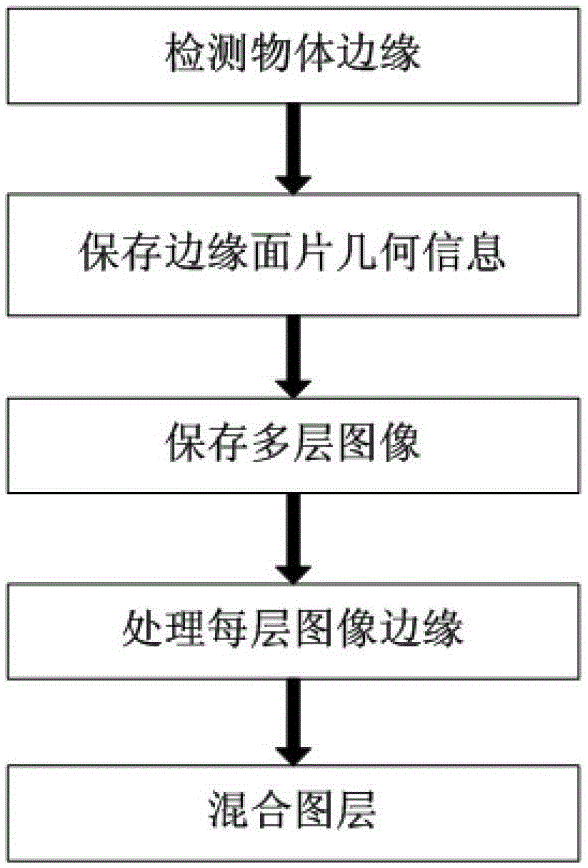
[0031] Such as figure 1 As shown, a film post-synthesis anti-aliasing method includes the following steps:

[0032] 1) For the 3D model to be rendered in each frame, use ray tracing to render the 3D model using the lighting model and given material information to obtain a multi-layer image corresponding to the lighting model, and The boundary corresponding to the 3D model in the layer image;

[0033] In step 1), when ray tracing is used to render the 3D model, the obtained layered image includes ambient color layer, diffuse reflection layer, highlight layer, shadow layer, etc. For the outgoing rays of the pixel, if the outgoing rays of the two intersect the 3D model in different material areas, it is considered that the pixel in the image of this layer is at the boundary of the 3D model. Repeat the above method until all layers are traversed, and each layer can be obtained The boundary corresponding to the 3D model in the image.

[0034] 2) According to the 3D model, obtain...