
A kind of acetate fluorescent probe compound and application thereof
A fluorescent probe, acetate technology, used in fluorescence/phosphorescence, luminescent materials, organic chemistry, etc., can solve the problems of indistinguishability of the three ions, less identification research, etc., and achieve excellent luminescence performance and molecular planarity. Good, the effect of eliminating systematic errors
- Summary
- Abstract
- Description
- Claims
- Application Information
AI Technical Summary
Problems solved by technology
Method used
Image

Examples
Embodiment 1
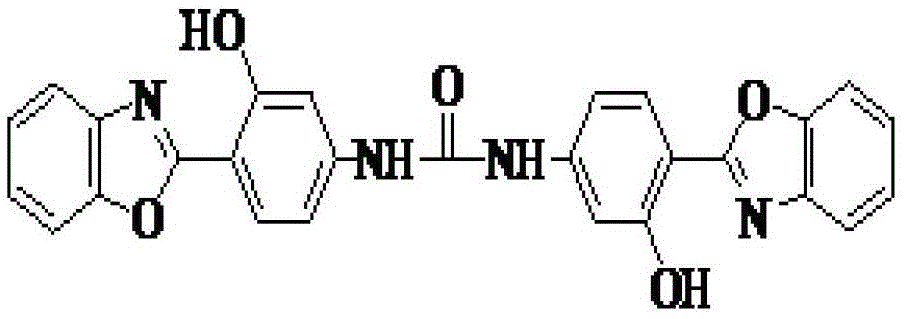
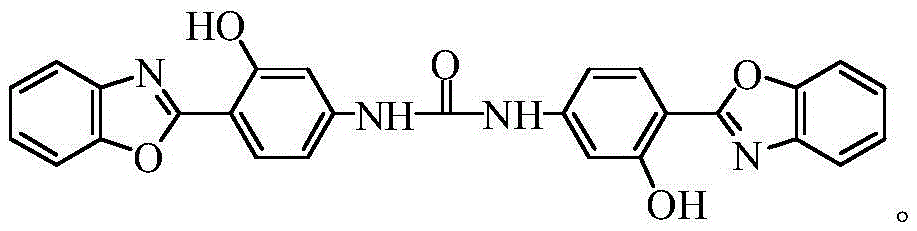
[0019] Add 0.226g (1mmol) 2-(4-amino-2-hydroxyphenyl) benzoxazole and 0.097g (0.6mmol) carbonylimidazole to 20mL toluene, stir and reflux for 12h under the condition of drying and nitrogen protection , a large amount of pale yellow solid appeared, and the reaction was stopped. The crude product was obtained by filtration and purified by crystallization with DMSO to obtain 0.212 g of a yellow solid substance with a yield of 89%.
Embodiment 2
[0021] Add 0.226g (1mmol) 2-(4-amino-2-hydroxyphenyl) benzoxazole and 0.065g (0.4mmol) carbonylimidazole to 15mL toluene, stir and reflux for 15h under the condition of drying and nitrogen protection , a large amount of pale yellow solid appeared, and the reaction was stopped. The crude product was obtained by filtration and purified by crystallization with DMSO to obtain 0.162 g of a yellow solid substance with a yield of 85%.
Embodiment 3
[0023] Add 0.226g (1mmol) 2-(4-amino-2-hydroxyphenyl) benzoxazole and 0.129g (0.8mmol) carbonylimidazole to 25mL toluene, stir and reflux for 8h under the condition of drying and nitrogen protection , a large amount of pale yellow solid appeared, and the reaction was stopped. The crude product was obtained by filtration and purified by crystallization with DMSO to obtain 0.193 g of a yellow solid substance with a yield of 81%.
PUM
 Login to View More
 Abstract
Description
Claims
Application Information
 Login to View More