Unlock instant, AI-driven research and patent intelligence for your innovation.
Data scheduling processing method and device
What is Al technical title?
Al technical title is built by PatSnap Al team. It summarizes the technical point description of the patent document.
A technology of data scheduling and processing methods, applied in the field of communication
Inactive Publication Date: 2018-12-21
ZTE CORP
View PDF2 Cites 0 Cited by
Summary
Abstract
Description
Claims
Application Information
AI Technical Summary
This helps you quickly interpret patents by identifying the three key elements:
Problems solved by technology
Method used
Benefits of technology
Problems solved by technology
[0007] The present invention provides a data scheduling method and device to at least solve the problem of how to effectively alleviate the above-mentioned "SKEW" phenomenon in the prior art
Method used
the structure of the environmentally friendly knitted fabric provided by the present invention; figure 2 Flow chart of the yarn wrapping machine for environmentally friendly knitted fabrics and storage devices; image 3 Is the parameter map of the yarn covering machine
View more
Image
Smart Image Click on the blue labels to locate them in the text.
Viewing Examples
Smart Image
Click on the blue label to locate the original text in one second.
Reading with bidirectional positioning of images and text.
Smart Image
Examples
Experimental program
Comparison scheme
Effect test
Embodiment 1
[0104] Embodiment 1, NodeB reports data sending and receiving status to RNC through 1 HS-DSCH capability allocation frame:
[0105] Step S02, RNC1 receives UE1's user data from CN1, assuming that all the data in RNC1's buffer has been sent, and VT(A) is 0;
[0106] Step S04, RNC1 divides the user data of UE1 into RLC, and its sequence number is 0 to 15, and according to a certain scheduling algorithm, judges that the capability of NodeB1 is greater than that of NodeB2, and divides the PDUs with sequence numbers 0 to 11 by Figure 9 or Figure 10 Framed and sent to NodeB1, the PDUs with serial numbers from 12 to 15 are pressed Figure 9 or Figure 10 Form a frame and send it to NodeB2, which carries VT(A)=0, and fills in NewIE Flag bit2 with 1;
[0107] Step S06, NodeB1 sends data from the air interface, due to the poor quality of the air interface, PDUs with serial numbers 2, 3 and 7, 8, 9 are discarded on the air interface, and NodeB1 sends the data sending and receiving s...
Embodiment 2
[0111] Embodiment 2, NodeB reports data sending and receiving status to RNC through multiple HS-DSCH capability allocation frames:
[0112] Step S02, RNC1 receives UE1's user data from CN1, assuming that all the data in RNC1's buffer has been sent, and VT(A) is 32;
[0113] In step S04, RNC1 divides the user data of UE1 into RLC, and its serial numbers are 32 to 63, which are evenly distributed to NodeB1 and NodeB2, and 32 to 47 are distributed according to Figure 9 or Figure 10 Frame sent to NodeB1, press 48 to 63 Figure 9 or Figure 10 Send it to NodeB2 in a frame, which carries VT(A)=32, and fills in New IE Flag bit2 with 1;
[0114] Step S06, NodeB1 sends the data from the air interface, sends the sending and receiving status of the data to RNC1 through the HS-DSCH capability allocation frame, AckInd is 1, and Max_Acked_SN is 47;
[0115] Step S08, the air interface quality of NodeB2 suddenly becomes very poor, and a large number of packets are lost (as shown in Tab...
the structure of the environmentally friendly knitted fabric provided by the present invention; figure 2 Flow chart of the yarn wrapping machine for environmentally friendly knitted fabrics and storage devices; image 3 Is the parameter map of the yarn covering machine
Login to View More
PUM
Login to View More
Abstract
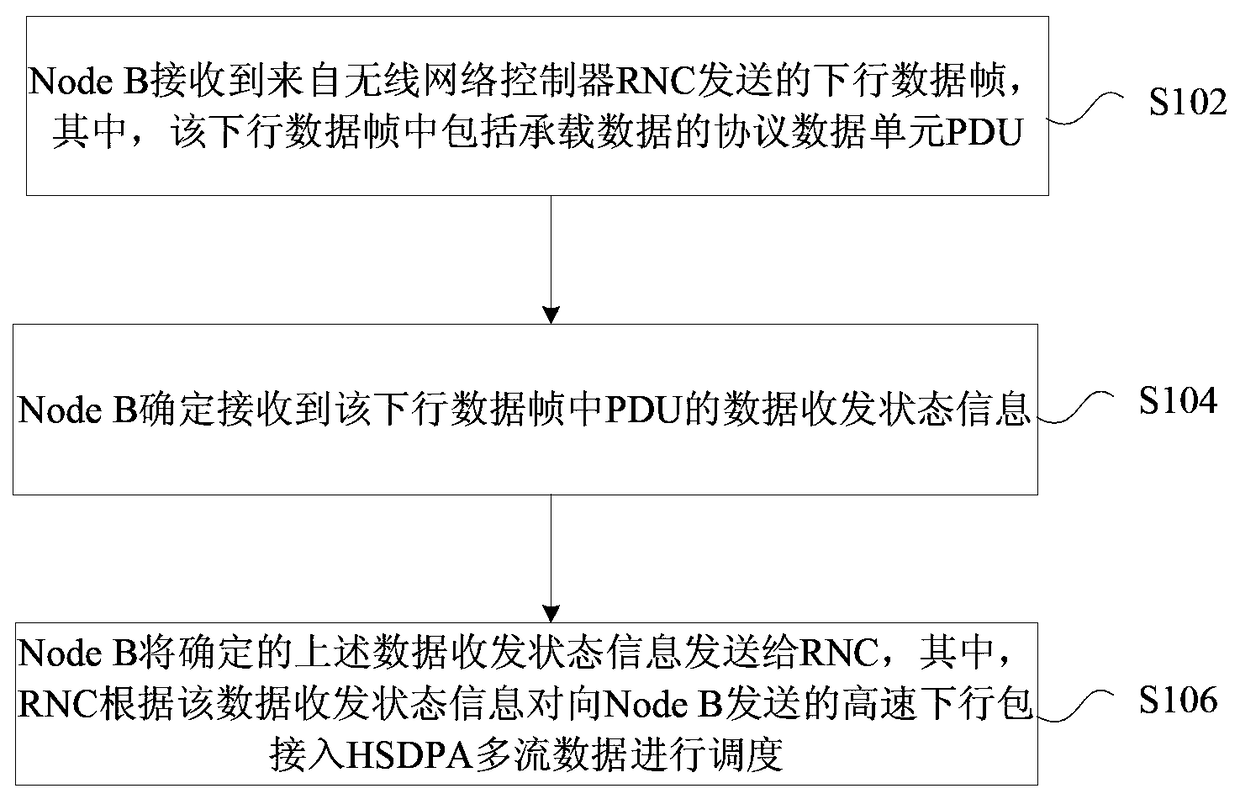
The present invention provides a data schedulingprocessing method and device, the method comprising: Node B receives a downlink data frame sent from a radio network controller RNC, wherein the downlink data frame includes a protocol data unit PDU carrying data; B determines to receive the data sending and receiving status information of the PDU in the downlink data frame; Node B sends the determined data sending and receiving status information to the RNC, wherein the RNC accesses the HSDPA multiplex to the high-speed downlink packet sent to the Node B according to the data sending and receiving status information Flow data is scheduled, and the present invention solves the problem of how to effectively alleviate the above-mentioned "SKEW" phenomenon in the prior art, and then achieves that Node B feeds back the sending and receiving status information of data frames to RNC, thereby guiding RNC to HSDPA multi-flow data The scheduling effectively alleviates the effect of the "SKEW" phenomenon.
Description
technical field [0001] The present invention relates to the communication field, in particular, to a data schedulingprocessing method and device. Background technique [0002] With the continuous and rapid development of data services, High Speed Packet Access (HSPA for short) technology is becoming more and more common, and it is developing towards the direction of multi-antenna and multi-carrier. For example, the R7 version of 3GPP introduced Multiple Input Multiple Output (MIMO for short) technology, so that NodeB (Node B) can send two transmission blocks from the same cell to UE at the same time through dual antennas; subsequently, 3GPP The R8 version of the new version introduces dual cell HSDPA (Dual Cell HSDPA, referred to as DC-HSDPA) technology, so that NodeB can send HSDPA data to UE from two frequency points of two adjacent cells at the same time. The introduction of these two technologies greatly improves the data throughput of the cell. [0003] When the us...
Claims
the structure of the environmentally friendly knitted fabric provided by the present invention; figure 2 Flow chart of the yarn wrapping machine for environmentally friendly knitted fabrics and storage devices; image 3 Is the parameter map of the yarn covering machine
Login to View More
Application Information
Patent Timeline
Application Date:The date an application was filed.
Publication Date:The date a patent or application was officially published.
First Publication Date:The earliest publication date of a patent with the same application number.
Issue Date:Publication date of the patent grant document.
PCT Entry Date:The Entry date of PCT National Phase.
Estimated Expiry Date:The statutory expiry date of a patent right according to the Patent Law, and it is the longest term of protection that the patent right can achieve without the termination of the patent right due to other reasons(Term extension factor has been taken into account ).
Invalid Date:Actual expiry date is based on effective date or publication date of legal transaction data of invalid patent.



 Login to View More
  Login to View More