
Method for synthetizing EMC-2 zeolite in absence of template agent
A technology of EMC-2 and synthesis method, which is applied in the direction of crystalline aluminosilicate zeolite, etc., can solve the problems of product crystallinity reduction, inability to get rid of template agent, and inability to obtain pure equivalence, and achieve the effect of simple implementation conditions and broad application prospects
- Summary
- Abstract
- Description
- Claims
- Application Information
AI Technical Summary
Problems solved by technology
Method used
Image

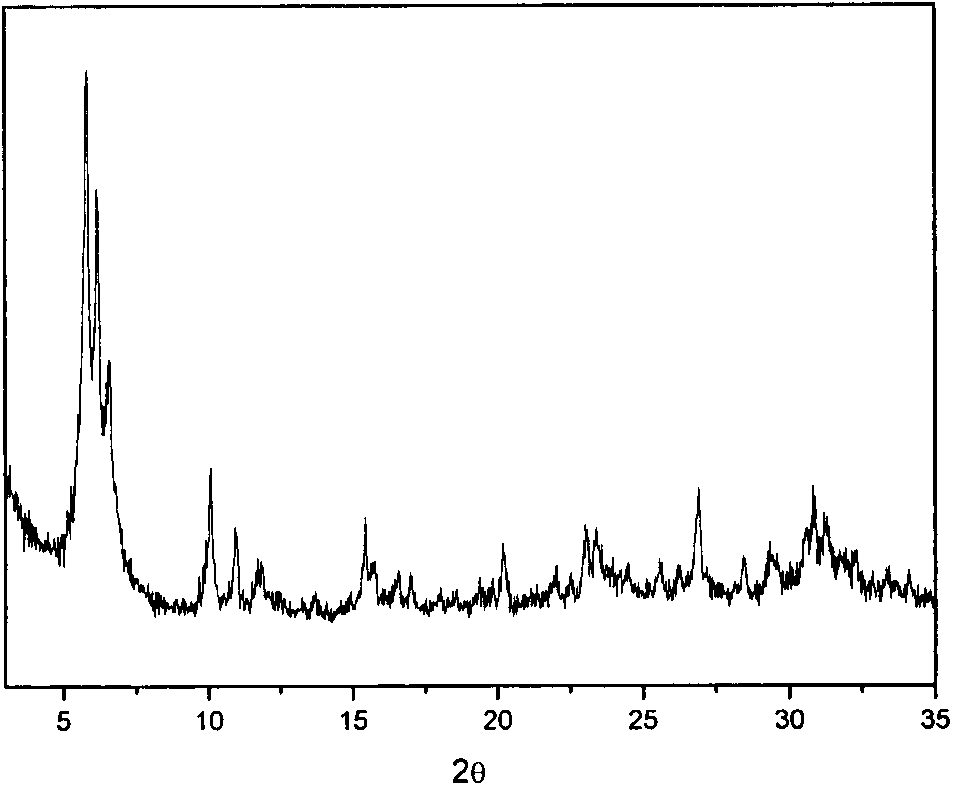
Examples
Embodiment 1
[0015] At room temperature, take 0.368 grams of sodium metaaluminate, add 3.1 milliliters of 10 mol / liter sodium hydroxide solution and 6.9 milliliters of distilled water, stir and mix evenly to a clear solution, then add 0.666 grams of white carbon black, stir for half an hour, and finally 0.167 g of seed crystals were added, stirred for 2 hours, and aged at room temperature for 1 day. Transfer to a 20 ml stainless steel reaction kettle containing polytetrafluoroethylene, and crystallize at 50° C. for 9 days under autogenous pressure. Quenching, washing, filtering, and natural drying to obtain the molecular sieve powder.
Embodiment 2
[0017] At room temperature, take 0.368 grams of sodium metaaluminate, add 2.8 milliliters of 11 mol / liter sodium hydroxide solution and 7.2 milliliters of distilled water, stir and mix until a clear solution is obtained, then add 2.360 grams of tetraethyl orthosilicate, and stir for half an hour , and finally added 0.133 g of seed crystals, stirred for 2 hours, and aged at room temperature for 1 day. Transfer to a 20 ml stainless steel reactor containing polytetrafluoroethylene, and crystallize at 80° C. for 7 days under autogenous pressure. Quenching, washing, filtering, and natural drying to obtain the molecular sieve powder.
Embodiment 3
[0019] At room temperature, take 3.74 grams of aluminum sulfate, add 2.2 milliliters of 10 mol / liter sodium hydroxide solution and 7.8 milliliters of distilled water, stir and mix until a clear solution is obtained, then add 3.334 grams of white carbon black, stir for half an hour, and finally add 0.5 gram of seed crystals, stirred for 2 hours, and aged at room temperature for 1 day. Transfer to a 20 ml stainless steel reactor containing polytetrafluoroethylene, and crystallize at 70° C. for 10 days under autogenous pressure. Quenching, washing, filtering, and natural drying to obtain the molecular sieve powder.
PUM
 Login to View More
 Abstract
Description
Claims
Application Information
 Login to View More