Supercharge Your Innovation With Domain-Expert AI Agents!

Composite particle modified high-density polyethylene material and preparation method thereof

A technology of high-density polyethylene and composite particles, which is applied in the field of high-density polyethylene materials, can solve the problems of not being able to meet high-performance HDPE, and cannot fully exert the comprehensive modification effect of modified fillers, so as to improve anti-aging performance and binding force Improvement, the effect of strength and flame retardancy improvement

Active Publication Date: 2015-04-01
GUANGDONG WEITIAN ENVIRONMENTAL PROTECTION NEW MATERIAL CO LTD
View PDF4 Cites 0 Cited by
  • Summary
  • Abstract
  • Description
  • Claims
  • Application Information

AI Technical Summary

Problems solved by technology

In addition, single-component modification can no longer meet the needs of high-performance HDPE preparation, and composite modification has become the main trend
At present, compound modification is mainly focused on simple blending, which cannot give full play to the comprehensive modification effect of modified fillers.
There is no literature on the modification of composite particles, and there is no literature on the shape, particle size and particle size distribution of composite modified particles

Method used

the structure of the environmentally friendly knitted fabric provided by the present invention; figure 2 Flow chart of the yarn wrapping machine for environmentally friendly knitted fabrics and storage devices; image 3 Is the parameter map of the yarn covering machine
View more

Image

Smart Image Click on the blue labels to locate them in the text.
Viewing Examples
Smart Image
  • Composite particle modified high-density polyethylene material and preparation method thereof

Examples

Experimental program
Comparison scheme
Effect test

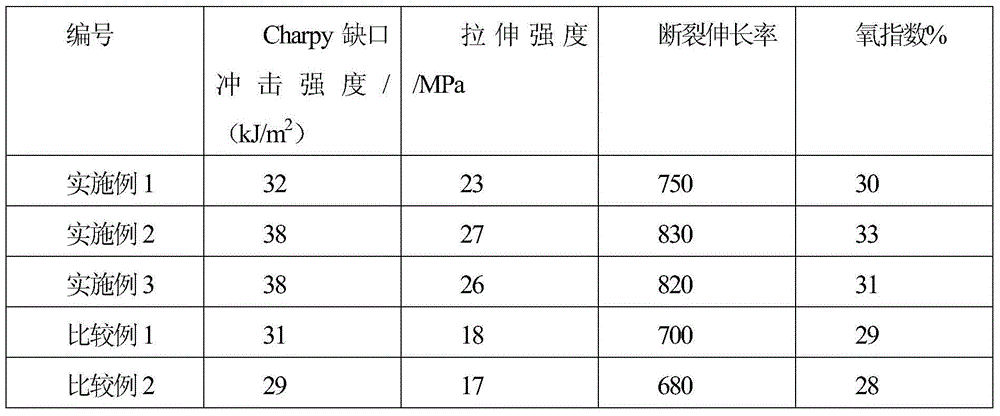
Embodiment 1

[0024] 100 parts of high-density polyethylene, 30 parts of composite modified particles, 8 parts of ethylene bisstearamide, 0.5 parts of chlorinated polyethylene, and 0.2 parts of antioxidant.

[0025] The composite modified particles are made of BaCO 3 Whiskers, Nano TiO 2 Particles, Nano Al(OH) 3 Particle and binder composition, the nano-TiO 2 Particles, Nano Al(OH) 3 The particles are bonded in BaCO by a binder 3 on the whiskers; among them, BaCO 3 Whiskers 10 parts, Nano TiO 2 5 parts, nano Al(OH) 3 10 parts, 5 parts of binder.

[0026] The binder is fatty acid zinc; the antioxidant is tetrakis[β-(3,5-di-tert-butyl-4-hydroxyphenyl) propionate] pentaerythritol ester.

[0027] Prepare the composite particle modified high-density polyethylene material according to the following steps:

[0028] ① Soften or partially melt the binder at a temperature higher than 60°C and lower than 160°C to 3 Whisker surface film formation, adding nano-TiO 2 Granular and Nano Al(OH) ...

Embodiment 2

[0033] 120 parts of high-density polyethylene, 50 parts of composite modified particles, 14 parts of ethylene bis-stearamide, 0.9 parts of chlorinated polyethylene, and 0.6 parts of antioxidant.

[0034] The composite modified particles are made of BaCO 3 Whiskers, Nano TiO 2 Particles, Nano Al(OH) 3 Particle and binder composition, the nano-TiO 2 Particles, Nano Al(OH) 3 The particles are bonded in BaCO by a binder 3 on the whiskers; among them, BaCO 3 Whiskers 20 parts, Nano TiO 2 10 parts, nano Al(OH) 315 parts, 5 parts of binder.

[0035] The binder is magnesium fatty acid; the antioxidant is β-(4-hydroxyphenyl-3,5-di-tert-butyl) n-octadecyl propionate.

[0036] Process step is with embodiment 1.

Embodiment 3

[0038] 110 parts of high-density polyethylene, 40 parts of composite modified particles, 10 parts of ethylene bis-stearamide, 0.8 parts of chlorinated polyethylene, and 0.5 parts of antioxidant.

[0039] The composite modified particles are made of BaCO 3 Whiskers, Nano TiO 2 Particles, Nano Al(OH) 3 Particle and binder composition, the nano-TiO 2 Particles, Nano Al(OH) 3 Particles bound BaCO by a binder 3 on the whiskers; among them, BaCO 3 Whiskers 20 parts, Nano TiO 2 5 parts, nano Al(OH) 3 10 parts, 5 parts of binder.

[0040] The binder is selected from fatty acid calcium. The antioxidant is selected from tetrakis[β-(3,5-di-tert-butyl-4-hydroxyphenyl)propionate]pentaerythritol esters.

[0041] Process step is with embodiment 1.

the structure of the environmentally friendly knitted fabric provided by the present invention; figure 2 Flow chart of the yarn wrapping machine for environmentally friendly knitted fabrics and storage devices; image 3 Is the parameter map of the yarn covering machine
Login to View More

PUM

No PUM Login to View More

Abstract

The invention provides a composite particle modified high-density polyethylene material and a preparation method thereof. The material comprises the following raw materials in parts by weight: 100-120 parts of high density polyethylene, 30-50 parts of compound modified particles, 8-14 parts of ethylene bis stearamide, 0.5-0.9 part of chlorinated polyethylene and 0.2-0.6 part of an antioxidant. The composite modified particles consist of BaCO3 whiskers, nano TiO2 particles, nano Al(OH)3 particles and a bonder, wherein the nano TiO2 particles and the nano Al(OH)3 particles are bonded on the BaCO3 whiskers through the bonder. The composite modified particles comprise 10-20 parts of BaCO3 whiskers, 5-10 parts of nano TiO2 particles, 10-15 parts of nano Al(OH)3 and 5 parts of bonder. Based on the original performances of HDPE, the toughness, strength, flame retardance and aging resistance are improved.

Description

technical field [0001] The invention relates to a high-density polyethylene material, in particular to a compound particle modified high-density polyethylene material and a preparation method thereof. Background technique [0002] Ziegler has used TiCl since 1953 4 and AlEt 3 It has been more than 50 years since ethylene was polymerized into HDPE under low pressure. The development and production of high-density polyethylene has been continuously innovated. Because of its excellent comprehensive performance, abundant raw material sources, and low cost, new uses and markets have been continuously developed. HDPE is a milky white translucent waxy solid. It is a non-polar thermoplastic resin with high crystallinity. Compared with LDPE and LLDPE, HDPE has the smallest degree of branching, tightly packed molecules, and the highest density (0.941~0.965gPcm3 ), high crystallinity. HDPE has high rigidity and toughness, good mechanical properties and high service temperature. Com...

Claims

the structure of the environmentally friendly knitted fabric provided by the present invention; figure 2 Flow chart of the yarn wrapping machine for environmentally friendly knitted fabrics and storage devices; image 3 Is the parameter map of the yarn covering machine
Login to View More

Application Information

Patent Timeline
no application Login to View More
Patent Type & Authority Patents(China)
IPC IPC(8): C08L23/06C08L23/28C08K13/06C08K5/20C08K3/26C08K3/22C08K7/08
CPCC08K2201/011C08L23/06C08L2201/02C08L2201/04C08L2201/08C08L2207/062C08L23/286C08K13/06C08K5/20C08K2003/265C08K2003/2227C08K7/08
Inventor 汪晨
Owner GUANGDONG WEITIAN ENVIRONMENTAL PROTECTION NEW MATERIAL CO LTD
Features
  • R&D
  • Intellectual Property
  • Life Sciences
  • Materials
  • Tech Scout
Why Patsnap Eureka
  • Unparalleled Data Quality
  • Higher Quality Content
  • 60% Fewer Hallucinations
Social media
Patsnap Eureka Blog
Learn More