Application of FoxO1 gene in drug preparation

A technology of 1.foxo1 and 2.foxo1, applied in the field of biomedicine, can solve problems affecting quality of life, delayed fracture healing, and increased fracture rate

CN104069508AInactive Publication Date: 2014-10-01RUIJIN HOSPITAL AFFILIATED TO SHANGHAI JIAO TONG UNIV SCHOOL OF MEDICINE
1 Cites 5 Cited by

Patent Information

Authority / Receiving Office
CN · China
Patent Type
Applications(China)
Current Assignee / Owner
Publication Date
2014-10-01
Estimated Expiration
Not applicable · inactive patent

Smart Images

  • Figure 1
    Figure 1
  • Figure 2
    Figure 2
  • Figure 3
    Figure 3
Patent Text Reader

Abstract

The invention belongs to the field of biological medicine and particularly relates to an application of a FoxO1 gene in drug preparation. According to the invention, the function of the FoxO1 gene in osteoblast proliferation differentiation under high sugar condition is researched so as to research the function of the FoxO1 gene in bone injury and osteoporosis induced by diabetes, in order to provide theoretical basis and experimental data for clinical treatment of diabetic bone injury and osteoporosis disease. The invention verifies that the FoxO1 gene can promote osteoblast proliferation, FoxO1 is used as a factor used for mainly regulating and controlling bone mass and has an antioxidant stress function on osteoblast, the FoxO1 gene generates a certain protection function on osteoporosis no matter in environment with increased oxidative stress level caused by ageing or diabetes or high blood sugar, and provides a new target for research and development of new anti-osteoporosis drugs.
Need to check novelty before this filing date? Find Prior Art

Description

technical field

[0001] The invention belongs to the field of biomedicine, in particular to the application of FoxO1 gene in medicine preparation. Background technique

[0002] Abnormally high levels of glucose in people with diabetes can lead to the development of many chronic complications. Studies have shown that diabetes can induce changes in calcium, phosphorus, and bone metabolism, thereby increasing the fracture rate of patients, delaying fracture healing, and affecting their quality of life. A leading hypothesis for the mechanism of diabetic complications is due to increased diabetes-induced oxidative stress, as reactive oxygen species (ROS) are elevated in the diabetic state and ROS have been shown to induce various cellular dysfunctions. Oxidative stress is induced by multiple mechanisms, including increased formation of advanced glycation end products (AGEs), increased flux through the polyol pathway, activation of protein kinase C isoforms, glucose autoxidation, ...

Examples

Embodiment 1

[0018] 1. FoxO1 gene knockout on osteoblasts

[0019] FoxO1 gene knockout on osteoblasts was completed by using pcDNA3.1-Fox01 vector construction, interference vector construction and screening, interference with lentiviral vector construction, interference with lentiviral packaging, and virus invasion and infection of cells.

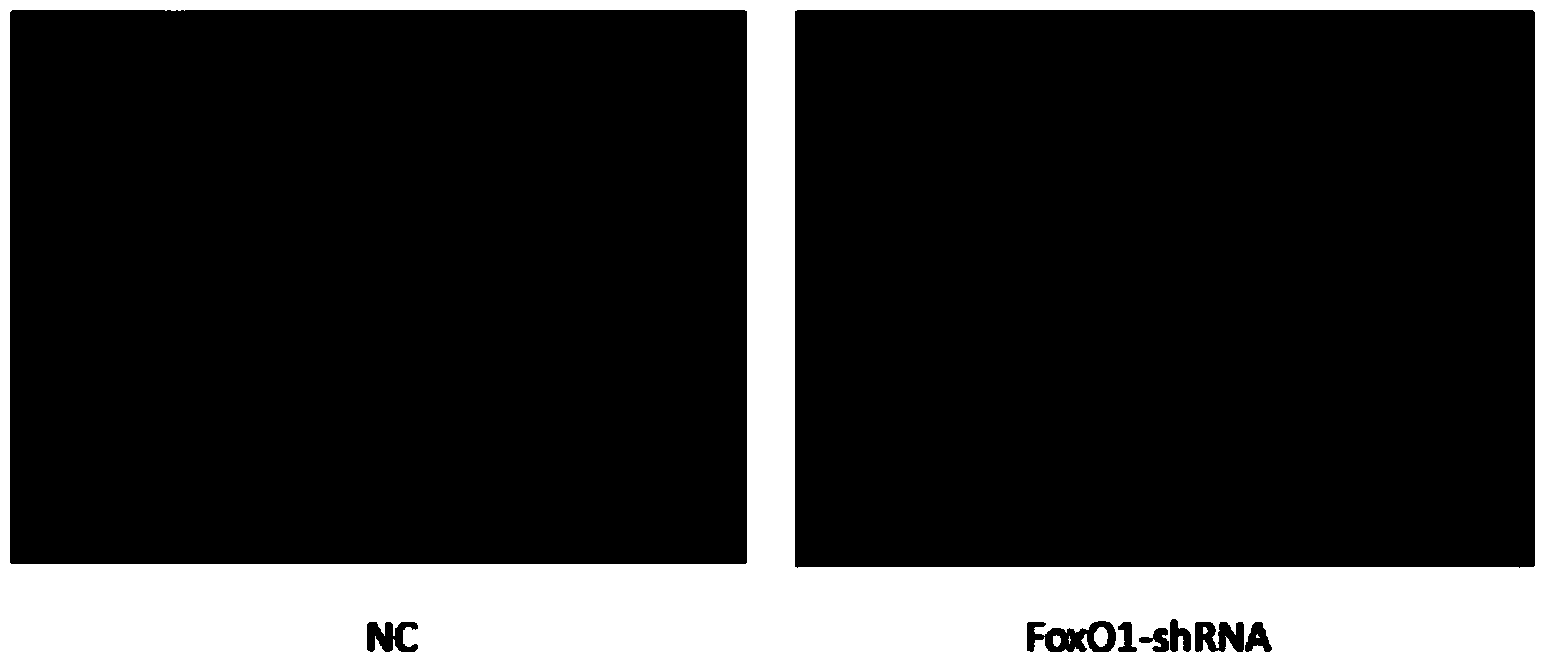
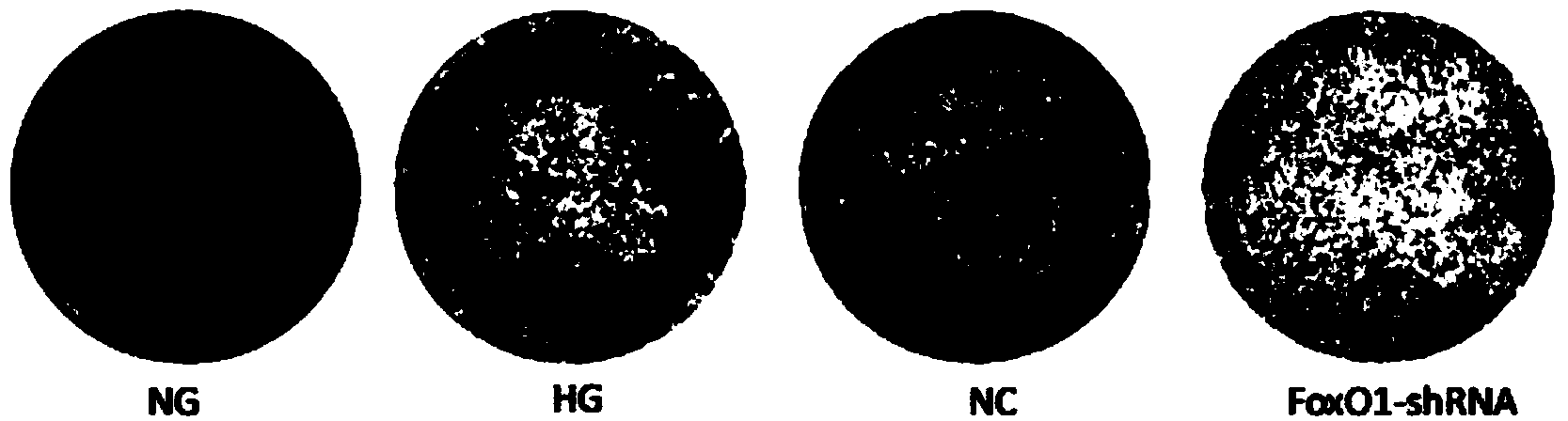
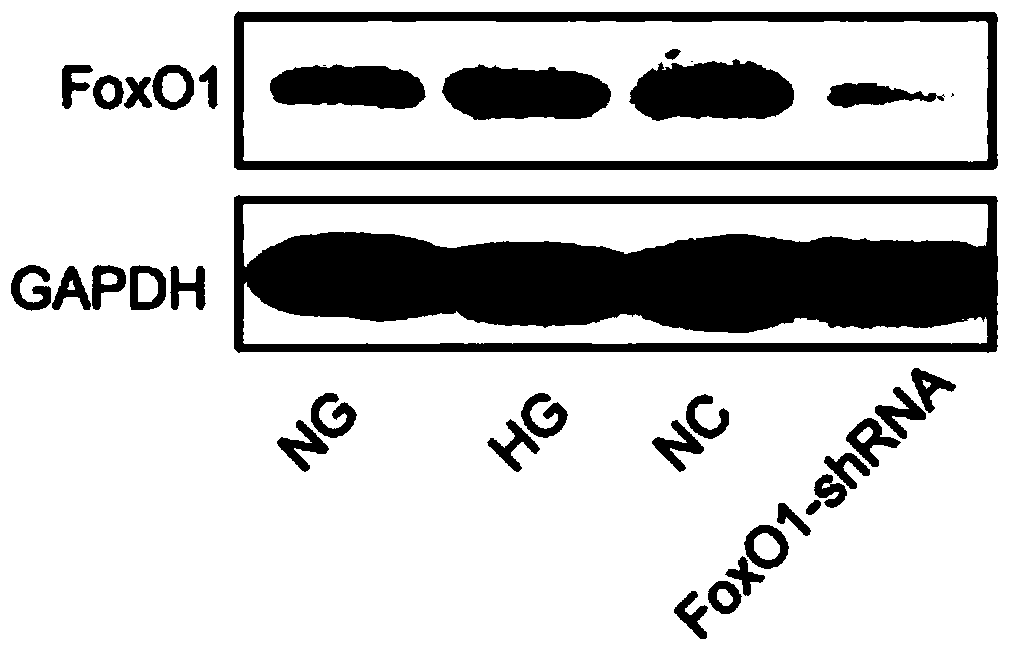
[0020] After the lentivirus infects the 3T3-E1 cells, the observation results of the stable transfection strains under the fluorescence microscope are as follows: figure 1 , the irrelevant shRNA transfection control group (marked as NC) and FoxO1-shRNA lentivirus transfected group (marked as FoxO1-shRNA) cells had significant fluorescence expression.

[0021] 2. Osteoblast culture and induced differentiation

[0022] 1) Culture of osteoblasts

[0023] Prepare α-MEM culture solution containing 10% FBS, 1% antibiotic and 1ug / ml blasticidin, and place it in a 37°C water bath to preheat for 20 minutes; normal sugar control group (NG), high sugar group (H...